Showing posts with label south africa. Show all posts

Saturday, September 6, 2014

An Epic of Hope

My partner is one of the people who gives me the best feedback on my sermons, and after a few weeks of trying to get back in the swing of things after returning home from vacation, I finally came home to an unprompted, "That was a good sermon today!" So, after having shared with with Presbury United Methodist Church, I bring it to you here to read, to critique if you wish, and (hopefully) to find a little hope. 

(If you are wondering where the reading comes from throughout August and September, we will be following an adapted Narrative Lectionary.)


Hebrew Bible: Genesis 45:1-15 (NRSV)
Then Joseph could no longer control himself before all those who stood by him, and he cried out, “Send everyone away from me.” So no one stayed with him when Joseph made himself known to his brothers. And he wept so loudly that the Egyptians heard it, and the household of Pharaoh heard it. Joseph said to his brothers, “I am Joseph. Is my father still alive?” But his brothers could not answer him, so dismayed were they at his presence. Then Joseph said to his brothers, “Come closer to me.” And they came closer. He said, “I am your brother, Joseph, whom you sold into Egypt. And now do not be distressed, or angry with yourselves, because you sold me here; for God sent me before you to preserve life. For the famine has been in the land these two years; and there are five more years in which there will be neither plowing nor harvest. God sent me before you to preserve for you a remnant on earth, and to keep alive for you many survivors. So it was not you who sent me here, but God; he has made me a father to Pharaoh, and lord of all his house and ruler over all the land of Egypt. Hurry and go up to my father and say to him, ‘Thus says your son Joseph, God has made me lord of all Egypt; come down to me, do not delay. You shall settle in the land of Goshen, and you shall be near me, you and your children and your children’s children, as well as your flocks, your herds, and all that you have. I will provide for you there—since there are five more years of famine to come—so that you and your household, and all that you have, will not come to poverty.’ And now your eyes and the eyes of my brother Benjamin see that it is my own mouth that speaks to you. You must tell my father how greatly I am honored in Egypt, and all that you have seen. Hurry and bring my father down here.” Then he fell upon his brother Benjamin’s neck and wept, while Benjamin wept upon his neck. And he kissed all his brothers and wept upon them; and after that his brothers talked with him.

Sermon:
Let us pray:
Patient teacher, we give you thanks for all the ways you guide us,
especially for the examples of those like Joseph who show such forgiveness and compassion even in the face of violence and betrayal.
Guide us today. May the words of my mouth and the meditations of all our hearts
reorient us so we can live lives overflowing with love
as Joseph did. Amen.

Last week I gave you all homework. Raise your hand if you did it! For those of you who either weren't here or forgot, the homework was to write down every day this week one blessing you received and one way you were a blessing throughout the day. We have been reading the past two weeks about God's promises to us through characters like Noah and Abraham. God told us that God blessed Abraham so he would go and be a blessing. Honestly, I found the homework more difficult than I expected it to be. While I can easily find ways I have been blessed, choosing a way I was a blessing felt uncomfortably like bragging. It also reminded me how even as a pastor, my days can too easily be spent without putting myself out there to really be a blessing to strangers. I don't know if that was your experience. But such difficulty reminded me that maybe I am a little hard on some of these ancient figures from the Old Testament. This call God has placed on our lives to be a blessing to others is not easy even without the added complications of conflict we see in Genesis alone.

The book of Genesis, the first book of the bible, is, frankly a depressing one. God created us and called us good. Then we sinned in the garden and had to leave. Then Cain killed Abel and things went totally downhill into a chaotic, violent, ugly mess until the flood came. But the destruction so upset God that God made a rainbow to remind us that life is too precious. But even with the rainbow and the new start, we continued to mess up. God showered blessings upon Abraham, but Abraham still lied and cheated. And God's whole promise to Abraham was that Abraham would be blessed so he could be a blessing! But Abraham had even more difficulty with that call than we do--- and so did his descendants. Jacob, his grandson, lied and cheated and encouraged violence within his own family by the way he valued some sons and wives and devalued others. The ugliness rivals Game of Thrones, for those of you who watch the show or read the Song of Ice and Fire series.

To look at our history as a people of faith through the bible story alongside our own struggles to be a blessing...it is all a little depressing. All God asked is that we show each other a little love, a little compassion, and instead we are greedy and self-serving or even just lazy. Brian D. McLaren, a pastor and public theologian, writes that “[t]he book of Genesis would be a tragic epic of despair,” that indeed would give us little hope for our own situations, if not for the end of the book: the story of Joseph.1

(Some of you were probably wondering when Joseph would be coming in here!) His story really begins in chapter 37 of Genesis, the first son of Jacob's favored wife and so Jacob's favorite son. Now Joseph, as much as I will praise him later in my sermon, is not perfect by any means. He is one of those annoying kids who doesn't realize how pretentious he is. I'm glad my sisters aren't here in worship this morning or they would tell you that I used to be(am?) a lot like Joseph in this way. He tattles on his brothers, he has dreams about his whole family bowing down to him and he doesn't keep said dreams to himself. He prances around in ostentatious clothing, which, in his defense, was his father's fault for buying him the fancy coat. But as annoying as he was, and as insufferable as his father must have been fawning over him, no one deserves the treatment that his brothers give him.

Joseph's brothers are classic bullies. They are obviously hurting, but instead of trying to break out of the cycle of hurt, they choose to hurt someone else instead. Joseph. They throw him into a pit, speak of killing him, but then decide to sell him into slavery. Afterward, they soak Joseph's fancy coat in blood and go to their father, allowing him to believe his beloved son was dead. This is a horrible, heart-wrenching story. And poor Joseph, as though his life wasn't bad enough, he tries to live as ethically as he can as a slave and still finds himself wrongly imprisoned!

But still Joseph does not break, and eventually he becomes Pharaoh's right-hand man. God gives him the power to interpret Pharaoh's dreams of a coming famine, and Pharaoh gives him the power to prepare and prevent starvation. And soon, Joseph's own brothers find themselves in Egypt at Joseph's own feet pleading for a little food to ward off starvation. They do not know who he is, but he knows exactly who they are. And then something amazing and beautiful and hopeful happens. Joseph, remembering the blessing of his father's love, looking at the blessing that here he was a slave who rose to prominence, looking at the blessing that in the midst of famine Egypt had plenty--- Joseph becomes a blessing. In McLaren's words, “Joseph refuses to imitate the hatred of his rival brothers. Instead, he returns to the imitation of God whose will, Joseph knows, is always benevolent.”2 He shows us that we aren't doomed forever to keep on messing up and failing God's call to love our neighbors, to bless one another. He shows us that what God asks of us is actually possible, even in the worst circumstances. He forgives his brothers. He feeds them and cares for them and reunites his family.

Now, Joseph's brothers committed a egregious sin. It would not do anyone any good if Joseph just saw them again and welcomed them in with open arms. He was abused by his brothers! But when he saw his brothers again, he was safe, in a position of power so that, if his brothers refused to repent, he would not have to worry about them committing another violence against him. Also, because they did not know he was their brother, he was able to scare them a bit, to see if they would treat their brother Benjamin badly as they had treated him so badly. But he saw they had changed. They were no longer bent on violence and destruction. And so they were able to receive the grace he offered, to receive the blessing.

I read a story once about this kind of compassion and blessing in the face of sin. It is a story from South Africa. I know not many of you are familiar with South African history, but you may remember hearing the term “apartheid” before. The government of South Africa, run by the white minority established apartheid, officially introduced in 1948. Apartheid is a word that means “apartness,” and was a system of violent racial segregation not unlike Jim Crow in our country. In it, however, people of color were not considered to be citizens at all, did not deserve any rights at all, and so most services like medical services were inferior to those for whites. People of color were to be constantly reminded of their so-called inferiority, and they lived in constant fear of violence at the hands of their white oppressors.

When apartheid was finally overthrown in the 1990s, leaders like Archbishop Desmond Tutu came up with a creative and life-giving way to bring justice to the country that would allow them to acknowledge the human rights abuses that were committed while breaking the cycle of violence. They established the South African Truth and Reconciliation Commission to bear witness to, record and in some cases grant amnesty to the perpetrators of crimes relating to human rights violations, as well as to determine reparation and rehabilitation.

There are many amazing stories about the commission, and I will share one with you today.
In the days of apartheid, seven youth were killed by the South African military in an ambush. One of the men who participated in executing the youth, who were lying wounded on the ground, testified before the Commission. In the room were the mothers of these young men. After he finished testifying, the mothers were asked if they wanted to say anything. The spokeswoman for the group of mothers said that they did want to speak. She turned to the young man and said, “You are going to listen to our anger. Sit there and listen.” One after another, these mothers spoke of the pain they had suffered. Then, after all had finished talking, one of the mothers turned to the man, who was totally crushed, and said, “Come here. Come here; let me hold you. Let me forgive you. I have no son, now. But I want you to be my son, so that you will never do these things again.”3

Like Joseph, these women did not say to the men that what they did was okay. But rather than returning violence with more violence, they showed love. They blessed the man who had sinned. And that blessing helped him turn away from sin. That blessing gave him hope.

So today I want you to remember that as difficult as being a blessing can be, as difficult as breaking cycles of violence and poverty and apathy and sin can be, repentance is possible. Let us go forward from this place and chose not to return sin with more sin. Let us go forth from this place like Joseph choosing to be a blessing even though it may be difficult.

1Brian D. McLaren, “How the Doctrine of (Un)Original Sin Can Help Christians Be Less Sinful,” Why Did Jesus, Moses, the Buddha, and Mohammed Cross the Road? Christian Identity in a Multi-Faith World (New York: Jericho Books, 2012), 112.
2Ibid.
3Thomas Porter, “The Last Supper: Naming the Conflicts and Giving Bread and Wine,” Conflict and Communion Reconciliation and Restorative Justice at Christ’s Table, ed. Thomas Porter (Nashville, Tennessee: Discipleship Resources, 2006), 23.
 

Monday, December 16, 2013

Invitation to Peace

The second Sunday of Advent, we had three baptisms at Presbury United Methodist Church and I felt called to remember the prophetic life of Nelson Rolihlahla Mandela. It was a lot for a young preacher to attempt in one sermon! What follows is adapted from the sermon I preached.

Scripture Lesson: Isaiah 55 (NRSV)
Ho,everyone who thirsts, come to the waters; and you that have no money, come, buy and eat! Come, buy wine and milk without money and without price. Why do you spend your money for that which is not bread, and your labor for that which does not satisfy? Listen carefully to me, and eat what is good, and delight yourselves in rich food. Incline your ear, and come to me; listen, so that you may live. I will make with you an everlasting covenant, my steadfast, sure love for David. 

See, I made him a witness to the peoples, a leader and commander for the peoples. See, you shall call nations that you do not know, and nations that do not know you shall run to you, because of the Lord your God, the Holy One of Israel, for he has glorified you. Seek the Lord while he may be found, call upon him while he is near; let the wicked forsake their way, and the unrighteous their thoughts; let them return to the Lord, that he may have mercy on them, and to our God, for he will abundantly pardon. For my thoughts are not your thoughts, nor are your ways my ways, says the Lord. For as the heavens are higher than the earth, so are my ways higher than your ways and my thoughts than your thoughts. 

For as the rain and the snow come down from heaven, and do not return there until they have watered the earth, making it bring forth and sprout, giving seed to the sower and bread to the eater, so shall my word be that goes out from my mouth; it shall not return to me empty, but it shall accomplish that which I purpose, and succeed in the thing for which I sent it. 

For you shall go out in joy, and be led back in peace; the mountains and the hills before you shall burst into song, and all the trees of the field shall clap their hands. Instead of the thorn shall come up the cypress; instead of the brier shall come up the myrtle; and it shall be to the Lord for a memorial, for an everlasting sign that shall not be cut off. 

Sermon: Invitation to Peace
Let us pray:
Patient Teacher, let not the Word that goes forth from your mouth return empty!
Plant your Word within us this morning,
pour out your Spirit upon us so that we may bear good fruit;
for the sake of Jesus Christ our Lord. Amen.1

I found myself reflecting this week on the Isaiah text we read together as though I was on Robben Island in South Africa, a place I visited four years ago. Robben Island is a desolate place. Even now that it is covered in tourists, it feels empty and cold. You can see Table Mountain and Cape Town across the water, but it feels so far away. It was easy to see how such a place could be used as a prison, as it was used since the seventeenth century until the mid-nineties, for it feels as though this little bit of land had broken off from civilization and was drifting off into the sea. And yet, it is a place that signifies, to me, the invitation to peace we read about in the fifty-fifth chapter of Isaiah. 

The text is introduced in my translation of the bible as an Invitation to Abundant Life. Yet, for the community who first read this invitation, they must have felt like the prisoners on Robben Island, desolate and cold, cut off from home and community unjustly. Such an invitation to abundant life that we read in scripture or hear in the words of great leaders like Nelson Mandela seems strange. And yet, when I was visiting Robben Island in 2009, I saw it has indeed become a place where it is as though the mountains and the hills break forth into song and the trees clap their hands. One of the most powerful things about visiting Robben Island was how the South Africans touring it with us burst into freedom songs.

Now, I know that not many of us are familiar with South African history--- I never even learned about apartheid in school and I don't know if it is taught today. But in light of Mandela going home to his ancestors, joining the great cloud of witnesses, this week, I could not shake the connection between Isaiah's and Mandela's invitations to abundant life, characterized by full bellies, joy, and peace. So even though a history lesson may be strange for a sermon, I hope you can hear the calls to abundant life within it.

The first connection I saw between these two invitations is that both invitations came from people in exile. When we read, “For you shall go out with joy and be led back in peace,” in the fifty-fifth chapter of Isaiah, it is a reference to the Babylonian exile, when important, prestigious, and powerful Israelites were forced out of Israel when it was conquered. But even after two generations of exile, prophets believed that they would return home.

So too the story of not only Mandela but of all South Africa is one of exile and a longing for home, especially for native black South Africans. South Africa was colonized by the Dutch and the British beginning in the 1600s. Slavery, war, and exploitation of labor and land were characteristics of Europeans' occupation of South Africa. And, as was the case in our own country, inequality was present from the beginning. The government run by the white minority established apartheid, officially introduced in 1948 when Nelson Mandela was 30 years old. Apartheid is a word that means “apartness,” and was a system of violent racial segregation not unlike Jim Crow in our country. In it, however, people of color were not considered to be citizens at all, did not deserve any rights at all, and for whom most services like medical services were inferior to those for whites. People of color were to be constantly reminded of their so-called inferiority, even to the extent that Mandela received short trousers instead of long pants that white prisoners received when he got into prison in Robben Island to remind them, he says, that they were boys.3 This system of segregation provided a labor force for the whites in charge.

Mandela resisted apartheid from the beginning, and worked for freedom. He started as a lawyer, often working with poor blacks on things like police brutality. He urged South Africans to fight for their freedom, and spread a vision of an egalitarian society where people could live free of domination based on race. He moved up the ranks in the African National Congress, a political party that was eventually made illegal by the apartheid government and was forced underground. Mandela was constantly harassed by the police, and was eventually imprisoned for twenty-seven years in that place of such cold loneliness on Robben Island.

And yet--- here is the second connection--- yet, leaders like the prophets of Israel and Nelson Mandela and Jesus kept dreaming and proclaiming a different world. They spoke of peace in the midst of violence, abundance in the midst of hunger, equality in the midst of huge economic difference. Now, in Mandela's case, this dream was not a nice, nonthreatening one. Mandela was actually considered to be a terrorist by our own government until 2008. While I find that absolutely ridiculous and embarrassing on our part, I must confess that as a pacifist I struggled reading his autobiography when in it he talks about his decision in the African National Congress to take up arms against the white supremacist government. But I still consider him to be a fighter for peace because, even in his acts of sabotage he was against hurting civilians, and his presidency was defined by reconciliation. He was elected president, the first true democratically elected president, in 1994, and he served until his retirement in 1999.

Mandela oversaw the establishment of the Truth and Reconciliation Commission during his presidency, where war criminals, those who had perpetuated the sin of apartheid in South Africa could be brought to justice. However, those convicted were not thrown in Robben Island's cold cells. Rather, the commission offered amnesty in return for truth and breaking the silences around the human rights violations that had occurred. It offered opportunity not to dwell in the past, but to break silences that blocked the possibilities for the future.

In his inaugural speech, Mandela said:
We understand it still that there is no easy road to freedom. We know it well that none of us acting alone can achieve success. We must therefore act together as a united people, for national reconciliation, for nation building, for the birth of a new world. Let there be justice for all. Let there be peace for all. Let there be work, bread, water and salt for all. Let each know that for each the body, the mind and the soul have been freed to fulfill themselves. Never, never, and never again shall it be that this beautiful land will again experience the oppression of one by another and suffer the indignity of being the skunk of the world. The sun shall never set on so glorious a human achievement. Let freedom ring. God bless Africa.4

That is an invitation to abundant living. While we do not know the exact impact the invitation of abundant life in Isaiah had on the exilic community, we do know the impact Mandela's invitation had in South Africa. I saw the impact in a conversation I had while in South Africa with a refugee named Fabien from the Democratic Republic of Congo. One of the things I asked him was why he thought his country and the countries around him are still plagued by such violence and cruelty. War is constant in countries like the Congo. I mean, I had my ideas about how nations like ours continue to colonize countries like the Congo economically and politically by encouraging debt and corruption. But Fabien said that the violence was a result of a lack of leadership.

His answer kind of dumbfounded me. So simple and yet so powerful. In South Africa, the first democratic president had been a political prisoner for almost thirty years: he had been degraded and abused and yet he and other leaders preached reconciliation. Unity. Peace. These leaders extended an invitation to build a world like the fifty-fifth chapter of Isaiah envisions, one in which everyone who thirsts--- no matter their color, no matter how much money they have, no matter what--- can come to the waters.

This Sunday, the second in Advent, is one in which we have already come to the waters, the waters of baptism. And so, on this Sunday, the invitation to build a world of abundant life is extended to us. We prayed together today that through baptism we would be incorporated by the Holy Spirit into God's new creation and made to share in Christ's royal priesthood. The new creation is a world of peace and plenty so complete that the nations of the world run toward it, of justice and joy so catching that even the mountains sing and the trees clap their hands. And as ones who share in Christ's royal priesthood, we are to be leaders, extending the invitation to this new creation.

Mandela's leadership demonstrates for us that this invitation is not to an imaginary place or a vision of the world where we will go when we die. This invitation is a different way of living here and now when we speak out and witness, even at great cost to ourselves, for that which is good and right. This invitation is a different way of living when we stand up to say enough is enough in the face of bullying and hate speech. This invitation is a different way of living when we reach out in love across our differences. There is no easy road for freedom, but when we work together, we will bring glory to God. So let us respond to the invitation this holiday season.

I found a prayer of thanksgiving for Mandela's life that I wanted to close with. Will you pray with me?
Merciful God,
Author of salvation, Giver of every gracious gift,
we give thanks for the life and witness of your servant, Nelson Mandela.
His quest for freedom was was a witness to your saving power in our world
– a power that can break the shackles of sin and oppression and hatred.
And his commitment to justice gave us a glimpse of what your kingdom should look like
– a place where swords of war can actually be traded for the plowshares of peace;
a place where bitter enemies can, by your grace, become friends.
Receive your servant, Mandiba, and grant him the eternal rest of your saints.
May he rest in your mercy and rise in your glory.
And may we, your Church, follow his witness of peace and justice marked by reconciliation.
For when we do, we know we are also following the ways of your Son, Jesus Christ our Lord,
who, with you and the Holy Spirit, lives and reigns now and forevermore. Amen.5

1Based on Kimberly Bracken Long, ed., Prayer for Illumination, Eighth Sunday after the Epiphany, Feasting on the Word: Worship Companion, Advent through Pentecost (Louisville, Kentucky: Westminster John Knox Press, 2012), 85.
3Nelson Mandela, Long Walk to Freedom: The Autobiography of Nelson Mandela (New York: Little, Borwn and Company, 1994), 383.
4Nelson Mandela, Inaugural Speech, 10 May 1994, http://www.africa.upenn.edu/Articles_Gen/Inaugural_Speech_17984.html.
5Prayer by Bgosden, A Prayer of Thanksgiving for Nelson Mandela, 6 December 2013, covered in the master's dust, http://mastersdust.com/2013/12/06/prayer-thanksgiving-nelson-mandela-1/.

Tuesday, July 5, 2011

Seeking Shalom

This is a sermon I preached July 3 at the combined worship service for Delta and Bryansville United Methodist Churches. These churches are involved in the Tri-Village Shalom Community of Delta, Cardiff, and Whiteford, with whom I am interning along with the York City Communities of Shalom this summer, and so I preached on the concept of shalom and designed a kind of shalom service for them.

It was a difficult sermon to write first of all because I have preached rather infrequently from the Hebrew Scriptures. But more than that it was difficult because though I see the beauty in the text, it is a letter to a people being ethnically cleansed--- and Jeremiah is telling them that it is punishment but that they are to make the best of it and use it for good. It is like all those places in scripture where we read God has a plan for us, and we realize that such a thought is less a comforting thought than a time to question that if God really has these sorts of violent plans for us do we really want to worship that kind of God? And this is not an aspect of the text I confront in this sermon. I chose the text because we use it as the Communities of Shalom scripture. I just say all of that to let you in on the struggle and acknowledge that there is a dark side to this text that I shy away from. What made it easier was using a story I've used in sermons before, but I figured that I might as well reuse my favorite stories now since I won't be able to when I am preaching in the same church every Sunday!


Call to Worship: A Litany of Shalom by Ruth Duck
ONE: Two things we know about the vision of shalom. Shalom is a gift to us from God. And Shalom is our mission.
ALL: Shalom is a personal relationship between God and all God's earthly children.
ONE: Shalom is the home that we seek, the goal of our spiritual journeys, and the valley of our delight.
ALL: Shalom is our sense of security, of being cared for and loved.
ONE: Shalom is the source of our courage and strength for which we so earnestly yearn.
ALL: Shalom is the harmonious relationship with God, which then expresses itself in our thinking, feeling, and doing with ourselves, others, and God.
ONE: Shalom is reconciliation: a body and soul become whole, a house once divided becomes a home again, the lion lies down with the lamb.
ALL: Shalom is justice for all that we so easily forget when we are in control.
ONE: Shalom is our Christ, God's Hoy Child, whom we crucify and bury, but who will not die.
ALL: Shalom is a gift to us from God. Shalom is our mission.

Scripture: Jeremiah 29:4-7 1

(NRSV, adapted: This scripture comes from the prophet Jeremiah. I will be reading from the New Revised Standard Version, but I have adapted it by “untranslating” to include the original word shalom. As we read in the opening litany, the Hebrew word shalom is a rich rich word for which we have no good translation. So we translate it many different ways. The dean of Drew Theological School, Jeffery Kuan, says that shalom is one of those Hebrew words you should never translate because so much gets lost in translation. So look over your shalom litany again and recall those definitions here as I read our scripture this morning.)


Thus says the Lord of hosts, the God of Israel, to all the exiles whom I have sent into exile from Jerusalem to Babylon: Build houses and live in them; plant gardens and eat what they produce. Take wives and have sons and daughters; take wives for your sons, and give your daughters in marriage, that they may bear sons and daughters; multiply there, and do not decrease. But seek the shalom of the city where I have sent you into exile, and pray to the Lord on its behalf, for in its shalom you will find your shalom.


Children's Sermon: Check out Enemy Pie by Derek Munson about a little boy who gets rid of his enemy by making him his friend. It fit in well with trying to figure out what it means to seek shalom in exile.

Sermon: Seeking Shalom

Will you pray with me?
Patient Teacher,
We give thanks this morning for this time to come together and worship.
And we ask for you to stand with us today, to let these words from my mouth
and the meditations of all our hearts show us what your shalom really means. Amen.

This is a beautiful scripture that we read from the prophet Jeremiah this morning, but it is a difficult one. Sometimes the Gospel stories are difficult because Jesus' time just seems so totally different from our own, so far from our own, but here we are reading something written over 500 years before Jesus' birth! Who was this Jeremiah guy and what was this exile he's talking about anyway? We don't really learn the very ancient history of Israel in one of our high school history classes, after all. So this seems as good a place as any to start to figure out what is going on here.

The book of Jeremiah is Jeremiah's witness to the destruction of Israel by Babylon and the beginning of the Babylonian exile. Jeremiah is a priest, not a bullfrog in case some of you were wondering. For forty years, Jeremiah was a priest and prophet who led Israel, who pastored them through this painful and terrifying period of Israel's history. What we read today is a part of a letter written by Jeremiah to the exiled community, an attempt to breathe a little hope into their despair.

But what Jeremiah tells them is not what they want to hear.
Build houses and live in them; plant gardens and eat what they produce.
Take wives and have sons and daughters; take wives for your sons, and give your daughters in marriage, that they may bear sons and daughters; multiply there, and do not decrease.

Here the exiles are, waiting. They are waiting to see how God is going to liberate them from their Babylonian oppressors. I imagine them sitting alongside the dusty road, their bags still packed. They are watching, waiting, suspended in the moments since being dumped there in Babylon. But they aren't just waiting for something, anything to happen; no, they are waiting to return to Israel. So when Jeremiah's letter gets to them, when they hear God wants them to settle down, can you imagine their horror? They want to go home, but God is telling them to make this new, foreign place their home by building homes and growing food and getting married. But this is not just any new, foreign place: this is the place of their exile, the home of their oppressors, of their enemies.

Jeremiah's message is not a revolutionary one, folks. Jeremiah wasn't telling the Israelites to stand together and revolt against the tyrants who forced them into exile. That's really difficult for me, personally. I want stories where Moses is standing up to Pharaoh, saying "Let my people go!" I want Jesus in the Temple turning over tables and throwing out the money lenders. But in this particular place and time, God has given Jeremiah another message to share with the exiled community:
But seek the shalom of the city where I have sent you into exile, and pray to the Lord on its behalf, for in its shalom you will find your shalom.


Shalom. We have already talked a little about this word this morning (see the litany above). Translators have used all of the following English words to describe shalom: welfare, completeness, to cause to be at peace, to make peace, peace offering, at rest, at ease, secure, safe, to prosper, to be whole.2 And it is this word heavy with meaning for holistic living, peaceful living that Jeremiah uses here in his letter to the exiles. He is not saying, just build houses and duck your heads down and plow on ahead through the exile: he is saying build houses and while you do, build God's beloved community right there in exile. Rather than longing for the past, rather than waiting for God to do something Exodus-style like send plagues upon the enemy until they throw in the towel and send the Israelite's back to their homes, Jeremiah called the exiles to live as God’s people where they find themselves, whether it is a time and a place and a circumstance of their own choosing or not.3

Not many of us today in this room this morning know the pain of exile the way these Israelite's did. Dr. Wil Gafney, translates verses two and three of this chapter, which we didn't read this morning because the names are unfamiliar and a little confusing, into our own terms: "Our national government has just collapsed as the result of an invading foreign power. There is no remnant of the military. There is no government. The President, First Lady, Cabinet, and Congress have all been exiled. All of the artists in New York and steel workers in Pittsburgh were separated from their families and exiled as well." We have not experienced such an upheaval here in Delta, though there are so many places around the world suffering such a fate. Many of us have roots deep in Harford County and South Central Pennsylvania and cannot imagine building house and planting gardens elsewhere.

But I think perhaps we know what it is like to feel isolated and alone, to feel that all of what we were certain of has been taken away whether through our own sin or someone else's, or just some catastrophe. Some of us know what its like to live in a hostile environment, as well, whether it be in our own home or in our neighborhood. Often, it is easy to just put our heads down and plug along. It is easy to keep isolating ourselves.

So when we read Jeremiah, it speaks to us even though we are outside of this context of exile. When we read Jeremiah's letter and see God calling us out to live in community, we want to be incredulous, check God's forehead to see if God's sick, you know? It is just a crazy thing to demand of us, to go out and build community among people we don't even know or even consider to be enemies. But here we are, sitting around miserably as those exiled Israelites were on the side of the road, bags still packed, and we realize that we have to make a change in the way we have been living or we will continue to be miserable.

As Christians, we are a people called to abundant living as Jesus said in John 10:10, "I came that they may have life, and have it abundantly." God through Jeremiah was calling the Israelites to abundant living too. That's what shalom is about; shalom is abundant living. It is about looking at the circumstances around us and instead of retreating inside ourselves, shutting ourselves off from everyone around us, we live as God's people by building God's beloved community.

One of the stories I keep coming back to that really illustrates for me this call from Jeremiah to seek the shalom of the city where I have sent you into exile, and pray to the Lord on its behalf, for in its shalom you will find your shalom, comes from Peter Storey, a Methodist Bishop from South Africa. Many of you may remember apartheid in South Africa, the racist system of white governance over the majority back Africans. It was a terrorist government, really, forcing all people, black and any whites who thought the system was wrong, to live in fear. Hear this story from Bishop Storey in his own words:

"I once received a phone call," Bishop Storey writes, "in the early hours of the morning telling me that one of my black clergy in a very racist town sixty miles from Johannesburg had been arrested by the secret police. I got up and drove out there, picked up another minister and then went looking for him. When we found the prison where he was and demanded to see him, we were accompanied by a large white Afrikaner guard to a little room where we found Ike Moloabi sitting on a bench wearing a sweatsuit and looking quite terrified. He had been pulled out of bed in the small hours of a freezing winter morning, and dragged off like that. I said to the guard, 'We are going to have Communion,' and I took out of my pocket a little chalice and a tiny little bottle of Communion wine and some bread in a plastic sachet. I spread my pocket handkerchief on the bench between us and made the table ready, and we began the Liturgy. When it was time to give the invitation, I said to the guard, 'This table is open to all, so if you would like to share with us, please feel free to do so.' This must have touched some place in his religious self, because he took the line of least resistance and nodded rather curtly. I consecrated the bread and the wine and noticed that Ike was beginning to come to life a little. He could see what was happening here. Then I handed the bread and the cup to Ike because one always gives the Sacrament first to the least of Christ’s brothers or sisters— the ones that are hurting the most— and Ike ate and drank. Next must surely be the stranger in your midst, so I offered bread and the cup to the guard. You don’t need to need to know too much about South Africa to understand what white Afrikaner racists felt about letting their lips touch a cup from which a black person had just drunk. The guard was in crisis: he would either have to overcome his prejudice or refuse the means of grace. After a long pause, he took the cup and sipped from it, and for the first time I saw a glimmer of a smile on Ike’s face. Then I took something of a liberty with the truth and said, 'In the Methodist liturgy, we always hold hands when we say the grace,' and very stiffly, the guard reached out his hand and took Ike’s, and there we were in a little circle, holding hands, while I said the ancient words of benediction, 'The grace of our Lord Jesus Christ, the love of God and the fellowship of the Holy Spirit, be with us all.'"5

This story for me is evidence of what living shalom looks like in exile. It isn't about giving in, but it isn't about taking up arms either. It is about finding your shalom by praying for your enemies and by helping them find theirs. Here, the Bishop was a patient teacher of this white Afrikaner guard, seeking his own shalom and Ike's shalom through leading the guard to live more abundantly. Despite the horror of the apartheid system, the Bishop used such a little action, communion--- a simple life-giving action like building houses, planting gardens, and getting married--- to act our what it looks like to be part of God's people even in an ugly time. This is an example for us as we seek our shalom wherever we are. Again, we see how we are called to live as God’s people wherever we find ourselves, whether it is a time and a place and a circumstance of our own choosing or not.6

We see this morning in Jeremiah, in this example from Bishop Storey, our interconnectedness, which is where the revolutionary message is in this text. This is a new way of living for us, this way of shalom, and it is counter to the way we have been living. And those of you who have heard about Communities of Shalom, the grassroots, faith-based, community development network, know that this is what we are trying to do. We recognize that to live abundantly as Jesus called us, we can't just sit at home, or go to church, without reaching out to the community around us, without actively praying for them, building relationships with them, learning to love them until there isn't an us and them anymore, there is just one community.

Let us pray,
Gracious and loving God,
We give thanks for the opportunity to glimpse your message of love this morning.
Pour your Holy Spirit on us gathered here, enable us to live out that message,
to seek the shalom of the city wherever we are,
to be the people of God in all times and places. In Jesus' name we pray. Amen.


Wednesday, November 3, 2010

What Saints Look Like

This is the adapted sermon I preached on Luke 6:20-31 and Ephesians 1:11-23 at Calvary United Methodist Church in Kearny, New Jersey, for All Saints' Day on October 31. As both my partner Aaron and my friend Rev. Nancy Webb said, it sounds just like my mother's sermons. Ha. Anyway, I have preached before multiple times, but never have I designed the service in its entirety, printed the bulletins, and then served as the leader of the congregation by myself. This congregation is the smallest in the Gateway North District--- 6 to 15 people on a Sunday, 7 this Sunday--- but one that is entirely committed to the work of the church.

It was such a blessing to be with these welcoming people, but I was nervous about leading. First, I was in this tiny chapel with only seven others, but I was expected to be behind the pulpit. It felt like forced formality. Then, I had printed out the scripture using the NRSV translation, so when they found it in their NIV bibles, they were really confused. I spoke too fast when preaching, and the hymns I picked were only three verses each (I don't know what hymns the congregation is used to, and there is nothing worse than being asked to sing seven verses of a song you don't know when there is no strong musical voice to follow!), so the service only ended up being forty minutes. Still, the passing of the peace was one of the most beautiful I have ever experienced because everyone hugged and kissed me and I could really feel the love of Christ in everyone in that room.The sermon that follows has been edited.


...Tomorrow is All Saints' Day, a day typically celebrated more in the Catholic tradition than Protestant tradition. When we think of saints, we often think of martyrdon and that process of canonization that is usually associated with saints in Catholic traditions. But my mom always used the holiday to explain to us that our church believed that we could all be saints. She used to say during the church service, "Let me show you what a saint looks like." And then she would hold up a mirror, so we could see our own reflections.

All saints aren't dead saints,1 she was saying. But if, for us, to be a saint you don't have to go through a process of beautification as in the Catholic Church, and if saints don't have to be dead to be saints, than what is a saint? I have heard many a time from folks that my father must be a saint after they meet me and my two younger sisters together. I think those people are insinuating that us three girls are a bit of a handful, which is untrue because we are angels, so I don't think that accurately captures the meaning of sainthood either. This is where our gospel lesson for this morning comes in.

When I saw that the gospel lesson we read this morning came from Luke's version of the Beatitudes, I was a bit perplexed and asked myself what this had to do with saints. But in reading a bit more, I saw that this passage is describing what a saint is. Jesus says:
Blessed are you who are poor, for yours is the kingdom of God.
Blessed are you who are hungry now, for you will be filled.
Blessed are you who weep now, for you will laugh.
Blessed are you when people hate you, and when they exclude you, revile you, and defame you on account of the Son of Man.

Jesus is saying that the poor are saints, the hungry are saints. Those who weep are saints, and those who are hated and reviled are saints. It's hard for some of us to think of those living on the streets as saints. It's hard for some of us to think of Muslims and gay people as saints, though they are often reviled and excluded from our very churches. And it's hard to think of ourselves as saints when we weep over the loss of loved ones. After all, those pictures of saints we see with the halos and stuff show them smiling and peaceful looking, right?

But the description of sainthood does not end there. At the end of the passage we read today, Jesus moves from a picture of what a saint is to how we can all become saints.
...Love your enemies, do good to those who hate you, bless those who curse you, pray for those who abuse you. If anyone strikes you on the cheek, offer the other also; and from anyone who takes away your coat do not withhold even your shirt. Give to everyone who begs from you; and if anyone takes away your goods, do not ask for them again. Do to others as you would have them do to you.


Here we see that to be a saint is not just to be poor and in mourning, but it is also to make a personal decision day after day to live in a way that brings to life this Sermon on the Plain. Great. Ok. So now what? I mean, these are not some easy how to's that we can all just start doing right now no problem, right? Loving your enemies? Turning the other cheek? If someone takes our stuff, don't ask for it back? It is when we read things like this that I really agree with one of my professors who referred to Jesus as "that crazy bird Jesus." Jesus must be one crazy bird to think that we can really live this way.

I want to paint a picture for you about just how crazy this work of the saints is. This is a story about Bishop Peter Storey, a Methodist bishop and ecumenical leader during apartheid in South Africa. Apartheid was a violent legal system of racial segregation--- much like the system of segregation and Jim Crow here in our country before the Civil Rights Act was passed--- in South Africa in which the white minority called Afrikaners ran the country and committed horrible acts against the black African population. The system was put in place in the 1940s and was not overturned until 1994. This story is in Bishop Storey's words and for me it really illustrates the work of the saints:

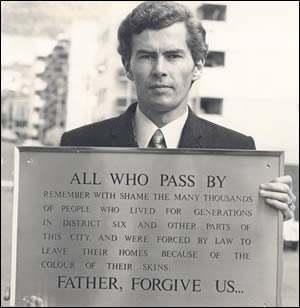
A young Peter Storey

"I once received a phone call," Bishop Storey writes, "in the early hours of the morning telling me that one of my black clergy in a very racist town sixty miles from Johannesburg had been arrested by the secret police. I got up and drove out there, picked up another minister and then went looking for him. When we found the prison where he was and demanded to see him, we were accompanied by a large white Afrikaner guard to a little room where we found Ike Moloabi sitting on a bench wearing a sweatsuit and looking quite terrified. He had been pulled out of bed in the small hours of a freezing winter morning, and dragged off like that. I said to the guard, 'We are going to have Communion,' and I took out of my pocket a little chalice and a tiny little bottle of Communion wine and some bread in a plastic sachet. I spread my pocket handkerchief on the bench between us and made the table ready, and we began the Liturgy. When it was time to give the invitation, I said to the guard, 'This table is open to all, so if you would like to share with us, please feel free to do so.' This must have touched some place in his religious self, because he took the line of least resistance and nodded rather curtly. I consecrated the bread and the wine and noticed that Ike was beginning to come to life a little. He could see what was happening here. Then I handed the bread and the cup to Ike because one always gives the Sacrament first to the least of Christ’s brothers or sisters— the ones that are hurting the most— and Ike ate and drank. Next must surely be the stranger in your midst, so I offered bread and the cup to the guard. You don’t need to need to know too much about South Africa to understand what white Afrikaner racists felt about letting their lips touch a cup from which a black person had just drunk. The guard was in crisis: he would either have to overcome his prejudice or refuse the means of grace. After a long pause, he took the cup and sipped from it, and for the first time I saw a glimmer of a smile on Ike’s face. Then I took something of a liberty with the truth and said, 'In the Methodist liturgy, we always hold hands when we say the grace,' and very stiffly, the guard reached out his hand and took Ike’s, and there we were in a little circle, holding hands, while I said the ancient words of benediction, 'The grace of our Lord Jesus Christ, the love of God and the fellowship of the Holy Spirit, be with us all.'"2

The fellowship of the Holy Spirit be with us all. Here is a man who is doing the saintly work of that crazy bird Jesus, who is


Loving his enemies, doing good to those who hate him, blessing those who curse him, and praying for those who abuse him and his friends.

His friend Ike has been taken violently from his home for no other reason than the color of his skin. And yet, he with the smile of assent of Ike, takes the moment to offer grace to the guard who represents the system of oppression they live under. And he shows that to do this work, he isn't becoming some sickly sweet spineless guy, not like that picture of the saint with the halo, but someone filled with the Holy Spirit to stand up for the least of these. This is how to become a saint.

Luckily for us, we are a people who believe in the work of the Holy Spirit. The text from Ephesians reminds us this morning that we


were marked with the seal of the promised Holy Spirit.

Marked. That is such a strong word to me, reminding us of the power that is in our baptism as Christians. It reminds us that whether or not we think we can do it, the Holy Spirit moves among us and within each of us to make us holy, to make us even love our enemies, as Bishop Storey did.

So let's look again into that mirror that shows us what a saint in our own community looks like. What are ways that we can be saints together? So many of you already do saintly work each and every day. Think of your Vacation Bible School work! This is a true example of what Jesus ends his how-to of sainthood:


Do to others as you would have them do to you.


Here you are, reaching out to the community around you to bring a little light into children's lives, to give to these children what we all hope to give to our own: the love of Christ. It is also standing up, I think. Standing up to the culture of disconnect that we live in. Do you know what I mean? We live in a culture where no one knows our neighbors. Where one of the richest counties in the nation where I am living while I go to school is only sixteen miles from Newark where one in three children live in poverty. To open your church doors to the children in the community is such a gift. It is acting as Bishop Storey did in a way of standing up to the culture to be that picture of saints that Jesus describes in the Sermon on the Plain. It is living into, as is written in Ephesians,


the hope to which he has called you, what are the riches of his glorious inheritance among the saints.


I don't know how many of you attended the District's Vacation Bible School Celebration several weeks ago. It was a powerful moment of communion with the saints in this area. One thousand children participated in the Vacation Bible school programs across the district, making the connectional church a reality. Here there were churches from across the district sharing resources to make real ministry and real sainthood possible. I saw the face of God in those children singing their bible school songs to us at this celebration service.

Too often, we think that Saints can only be perfect people that we have only seen in pictures. But we know that there is another image of a saint that we can look at in our own mirrors. And remember, as we celebrate this All Saints' Day, saints don’t always know they’re saints, or feel saintly all the time.

My prayer for each of you this day, is that you allow those holy things to happen in your lives. Be a saint. Allow the Holy Spirit to use you.

Thanks be to God.

Faithful God, Our True Witness,
Give us the strength and wisdom to live lives
of love, peace and acceptance
in a world fraught with hatred, dissension and exclusion.
Help us to reach out and love
both those who are oppressed and those who oppress.
Guide our journey
that we may live as saints
in remembrance of those saints who have lived before,
those saints who live among us, and those who are to come.
In the name of Jesus, Amen.3
All Saints Day I (1911) by Wassily Wasilyevich Kandinsky


***

1Taken from the "Who's out in the conversation?" lectionary series for All Saints' Day. http://www.hrc.org/scripture/?page=11-01-07

2Peter Storey, "Table Manners for Peacebuilders: Holy Communion in the Life of Peacemaking," Conflict and Communion: Reconciliation and Restorative Justice at Christ's Table, ed. Tom Porter (Nashville: Discipleship Resources, 2006), 61-62.

3Prayerfully Out in Scripture, from All Saints Aren't Dead Saints, http://www.hrc.org/scripture/?page=11-01-07

Biblical quotations are from The Harper Collins Study Bible: New Revised Standard Version. San Francisco: Harper Collins Publishers, 2006.

Sunday, July 18, 2010

A Pilgrimage of Pain and Hope

July 18, 2010, is the 92 birthday of Nelson Mandela. We take a moment this day to honor his amazing life. A year ago on Mandela Day, I was walking through the apartheid museum in Johannesburg, South Africa. This is my reflection I wrote for my home church after the trip last summer.

"Where there is poverty and sickness, where human beings are being oppressed, there is more work to be done. Our work is for freedom for all. After 90 years of life, it is time for news hands to lift the burdens. It is in your hands now."

-Nelson Mandela, Hyde Park, London, June 2008


For me, South Africa was a place where I could really begin to visualize what being liberated to hope looks like. While I was in Carlisle, Pennsylvania, working with some of the local churches, my pastor asked me to help lead a trip to South Africa. The idea came out of a desire to partner Allison United Methodist Church in Carlisle with Manning Road Methodist Church in Durban South Africa. The associate pastor at Manning Road had grown up at Allison UMC and gone to seminary at Duke, where she had the opportunity to intern at Manning Road one summer, and they eventually asked her to come back and serve as their associate pastor. She wanted to link her home church with the church she currently served. I have always wanted to lead a mission trip, and so agreed to help, particularly because everyone was willing to make an effort to do mission differently for this trip.

We used South African pastor Trevor Hudson's book Walk a Mile in My Shoes to design a pilgrimage of pain and hope. This is a pilgrimage designed mainly to get privileged people out of their closed communities to see the larger world around them, to listen, to learn, to connect. To be exposed to pain, but also see the hope existing in the community through the ministries already going on in the community.

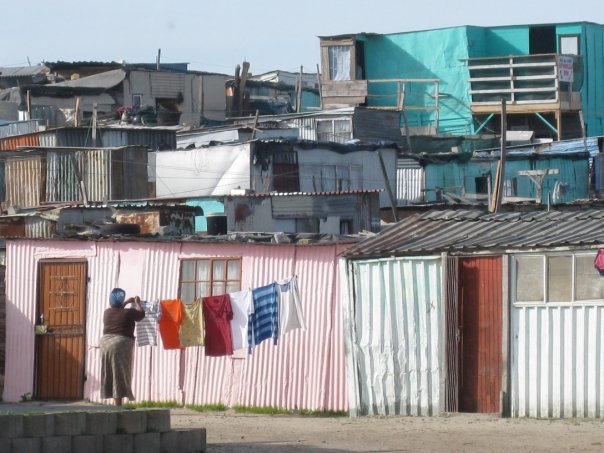
We saw a lot of pain here. You can see the poverty in these pictures. There are a million people living in the slums, or townships, of Cape Town. Miles and miles of shacks, wounds left by apartheid. We didn't learn about apartheid in school, but I wasn't even 7 years old in 1994 when Nelson Mandela was elected South Africa's first democratic president. So, in brief, apartheid was a segregationist policy in which people of color were denied dignity, evicted from homes in mixed communities and forced into ghettos. And still today, the poverty is overwhelming. And of course, with poverty comes crime, a huge problem throughout South Africa.

But the hope here was so strong. I'm going to use my experience of one day on the trip to illustrate this. One morning in Durban, we went to this huge, falling down building, walked up three flights of steps that smelled of urine and weren't lit at all. But when we got to the third floor, the place lit up with light and color and the laughter of children. We were visiting a preschool and day care run by a group called Union of Refugee Women. Jeanine, supervisor of the school and founding member of the Union of Refugee Women and a refugee from Burundi told us how they began with five women car guards and their children and have since expanded.

We took the older class of children to the zoo. And then the playground.
While pushing one of the little girls on the swing, I heard a her singing "If you're happy and you know it." And that really touched me, a child like that who hardly ever goes outside, still is evidence of hope because her singing proves what happens with just a little love.
That night, we headed to Anna's church for dinner. Refugee women who are part of the Manning Road congregation had been preparing another feast for us since eleven in the morning with a donation we had made to them (they don't normally get such meals). These women and their families had taken sanctuary at Anna's church during the three month xenophobic crisis last year and ended up staying to become part of the church family.

We walked into the hall which was warmed by good food and smiling faces. We were welcomed with song, and we offered a song as well. Then food was heaped on our plates and we sat down, conversing in between bites. We talked of homelands, families, politics, of the beauty of being multilingual. So much pain and suffering yet such joy in fellowship.

While there, I talked to a man named Fabien from the Democratic Republic of Congo in French--- a man who spoke at least three languages, how beautiful. One of the things I asked him was why he thought his country and the countries around him are still plagued by such violence and cruelty. I mean, I had my ideas about how Western nations continue to colonize third world countries economically and politically by encouraging debt and corruption. But Fabien said that the violence was a result of a lack of leadership.

That really hit home when I thought about South Africa and how the first democratic president had been a political prisoner for almost thirty years, had been degraded and abused and yet he and other leaders preached reconciliation. Unity. That's such a powerful message. Alleluia. Amen.