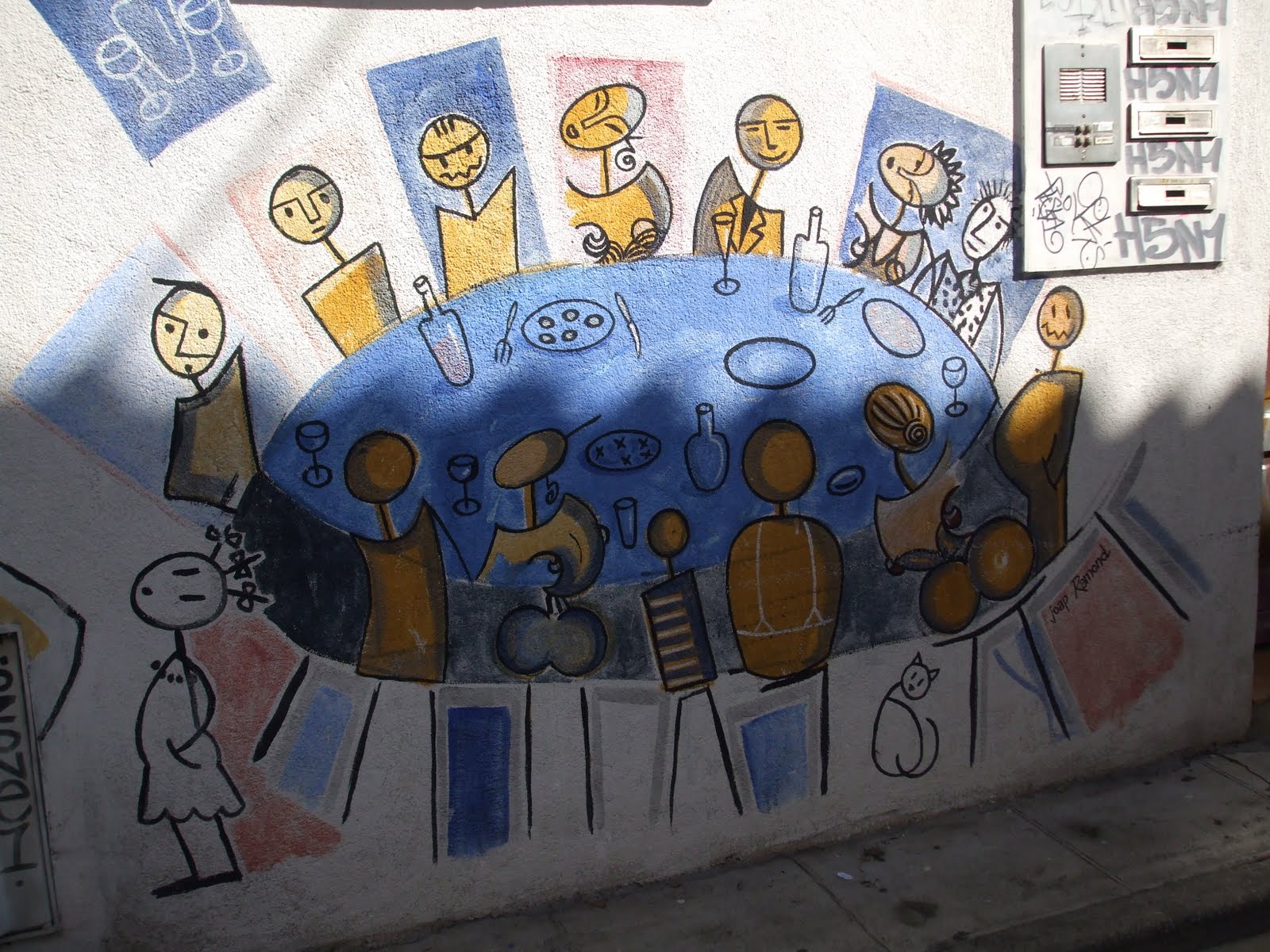
Also, we used a communion liturgy written by myself and Amanda Rohrs-Dodge and it was very well received. You can check it out here.
Scripture:
John
6:24-35
So when the crowd
saw that neither Jesus nor his disciples were there, they themselves
got into the boats and went to Capernaum looking for Jesus.
When
they found him on the other side of the sea, they said to him,
“Rabbi, when did you come here?” Jesus answered them, “Very
truly, I tell you, you are looking for me, not because you saw signs,
but because you ate your fill of the loaves. Do not work for the food
that perishes, but for the food that endures for eternal life, which
the Son of Man will give you. For it is on him that God the Father
has set his seal.” Then
they said to him, “What must we do to perform the works of God?”
Jesus answered them, “This is the work of God, that you believe in
him whom he has sent.” So they said to him, “What sign are you
going to give us then, so that we may see it and believe you? What
work are you performing? Our ancestors ate the manna in the
wilderness; as it is written, ‘He gave them bread from heaven to
eat.’”

Then Jesus said to
them, “Very truly, I tell you, it was not Moses who gave you the
bread from heaven, but it is my Father who gives you the true bread
from heaven. For the bread of God is that which comes down from
heaven and gives life to the world.” They said to him, “Sir, give
us this bread always.”
Jesus said to them,
“I am the bread of life. Whoever comes to me will never be hungry,
and whoever believes in me will never be thirsty.”
Sermon:
Searching for the Bread of Life
Today's scripture
reading comes almost immediately after the feeding of the five
thousand, which is why Jesus talks about how the people were
following him, not because they wanted to learn more, but they wanted
to be physically fed again. The people are treating Jesus as another
Moses, here.
In
Exodus chapter sixteen, verse three, we read that after the Hebrews
have been liberated in Egypt, the people began complaining: “The
Israelites said to [Moses and Aaron], ‘If only we had died by the
hand of the Lord in the land of Egypt, when we sat by the fleshpots
and ate our fill of bread; for you have brought us out into this
wilderness to kill this whole assembly with hunger.'”1
So God creates manna. Again, the story from Exodus: “When
the layer of dew lifted, there on the surface of the wilderness was a
fine flaky substance, as fine as frost on the ground. When the
Israelites saw it, they said to one another, ‘What is it?’ For
they did not know what it was. Moses said to them, ‘It is the bread
that the Lord has given you to eat.'”2
This background is
important to the story because, though Jesus' words in this scripture
are beautiful, I hear a harshness in them, particularly when he tells
them not to work for the bread the perishes. I think the harshness
comes from this backstory of the complaining Israelites who refuse to
trust the God who has brought them out of Egypt. Jesus knows the ways
that we refuse to trust God, and the ways that we, like the crowd
gathered in the story, want to see more signs, want Jesus to continue
to do for us without responding to his teaching.
But
Jesus is patient with us, even when we can sense that he doesn't want
to be! He teaches us yet again about his way of abundant living,
saying, “For
the bread of God is that which comes down from heaven and gives life
to the world. I am the bread of life. Whoever comes to me will never
be hungry, and whoever believes in me will never be thirsty.”
Let us pray:
Patient teacher,
one
who nourishes us and fills us,
help
us be bread. Teach us this morning and every day
to
center our lives on you, so that we may be sustained by you
and
led into more abundant living. Amen.
Bread
of life. I think this is a hard concept for many of us who have never
been hungry to understand. Of course, some of us have been hungry,
and most of us have seen hunger in ways we will never forget. Most of
us are disconnected from the baking of bread--- that's
why I brought in the supplies to make bread today for the kids.
But I don't want to lose this, of all of the Gospel of John's what
are called “I am statements”--- you know, “I am the way the
truth and the life”--- because when Jesus says that he is the bread
of life, when he says “whoever
comes to me will never be hungry,”
he is talking about abundant living in a way that shows the physical
and connectional ways that we are to live.
Last
week I talked a little about how God cares for our well being, God
cares about our bodies.
Jesus fed five thousand hungry people, not because he was expected to
do so by that crowd, not only as a sign of his power, but because he
had compassion for hungry people. Jesus has compassion too this
morning in our story. The crowds have searched and searched for him,
but, as he explains to them, they don't even know what they are
searching for. They are looking to feed on bread again, and while
Jesus cares about their hunger, he points out a deeper hunger within
them. A deeper hunger within all of us.
We
are hungry not just for food. Food was a sign for many of the crowds
gathered that day, a sign of a different way of living, but many of
them did not understand that sign, as many of us may not today. But I
think they were seeking after that abundance that Jesus showed him in
the fragments; how Jesus could feed five thousand people with a five
barley loaves and two fish, fragments, and how Jesus cared about the
fragments of the meal and collected them into baskets. From the
fragments comes abundance with Jesus. And that's what the people were
searching for.
When
we talk about eating and abundant living, we are not talking about
the Desert Fathers of early Christianity fasting in the desert. Some
may be called to such a life, and some fasting is important to all
our spiritual lives. And of course, abundantly living does not mean
sitting on the couch with bags of chips and oreos lined up, either.
We are talking about having enough, about being healthy, and if we
have enough food sharing with those who don't, and finding ways for
them to be fed always as well.
When
Jesus uses the metaphor of bread, he is talking about what for many
people, though this may not be true today, was a staple in their
diets. Jesus is not the icing on the cake of life, he is the bread of
life, a wholesome staple in our diets, not something extra that
spruces things up a bit. Jesus feeds us and wants us to feed others.
That
is the connectional piece of the bread of life. Jesus doesn't stop
with being our sustenance, but calls us to feed the world, by
witnessing to our faith in words, like sharing our stories, and in
deeds, like feeding the homeless.
And
we celebrate this abundant life every month with communion, a simple
taste of bread and juice to symbolize an sustaining meal--- a meal
that goes beyond the elements of food to knit together the people
sharing together and open up ways for us to seek that abundant living
together. Many of us may not think much about communion.
Unfortunately too often rituals that we do with regularity, to
imprint them onto our bones, can become meaningless, things that we
do without thinking about them. But I want us to turn to the Lord's
Table now to think about what this Bread of Life can mean with a
story of my own encounter with the Bread of Life.
I studied abroad in
Toulouse, France, my junior year of college. I was not a happy person
then, though. While I was excited to live outside of the country, I
was nervous, as many of us are when we are far from home, and I felt
kind of dejected. See, I thought that God was calling me to be a
missionary at the time, but my study abroad plans to go outside of
Europe fell through, and so here I was, nineteen, so sure of God's
call on my life, only to find that I didn't know where God was
leading me at all. I had been seeking the Bread of Life with such
certainty that I knew the way--- and maybe I did. Many of us feel
God's call on our lives but sometimes that call changes or is lived
out in ways we never expected. I think that is what happened to me.
But I didn't know this at the time. I just knew I was tired and
frustrated.
And I was lonely.
Aaron and I had talked on the phone at least every day for the past
five years before this--- and I went the entire month of September
without hearing his voice at all. My sister Kate was starting college
and I was missing all her exploits, and Suzanne was getting her
driver's license. My host family was wonderful and the other women in
the program--- we were all women that year--- were great, but I still
felt alone.
I was going through
what I think we are all familiar with in one way or another---
spiritual drought. I am the kind of person, as many of you may have
noticed, who tries to see God in everything, particularly outside.
But when I was in France, I felt as though I was walking through a
fog or that kind of mud that sucks at your feet so you have to focus
all your attention on the next step and ignore whatever is around
you. This was perhaps one of the worst spiritual droughts of my life,
though many of us have much less dramatic, day or week long drought,
and many of us have droughts that last for years and years and we
can't pull free. I knew I was in a funk, and I knew I didn't want to
be in that funk anymore. I think that those people in the crowd
following Jesus that day were also in a spiritual drought. They were
seeking a way out, but they didn't know what they were searching for.
They just didn't want to be in that drought anymore.
And so they started
looking for Jesus. And I, I kind of did the same thing. I did what I
as a preacher's kid knew to do. I went to church.
There are not many
Protestant churches to go to in France. Though I have found beauty in
Catholic worship, I really needed the familiarity and comfort of a
protestant church. I looked around until I saw the closest one to my
host family's house, called the Temple du Salin. The church sits
facing a park, so I sat in the park for a few minutes before church
started. I was afraid to go in the sanctuary early because my French
was still very shaky and I didn't want to be pulled into a
conversation. I also didn't want to have to sit alone inside a church
for very long.
When I finally
walked in, the building was enormous and cold. It was stone, and
ancient, as most buildings are in Europe. In the winter time, I later
learned, they had these kind of old looking red hot heaters hanging
from the ceiling to give off a little warmth. The pews were not even
remotely full. See, France is a largely secular country, and those
who are religious are usually Catholic or, increasingly, Muslim. They
are usually either older folks or they are immigrants, which is
actually a trend in most parts of the USA as well. So we in the pews
were an eclectic bunch, and no one really sat near one another.
I couldn't
understand most of what was going on--- I was newly arrived, you see,
and even though I had aced most of my French classes, you don't
really know a language until you've been immersed in it. I didn't
know any of the songs. And so I had almost resolved not to go back to
the church...until it came time for communion.
Communion was when
that little church came alive. It was what held that little church
together, I think. The dark stone sanctuary became vibrant and warm.
Everyone stood up and fanned around the sanctuary in a big circle.
And then we all served one another communion. The bread, ordinary
bread that was pre-cubed, which I usually hate because they kinda end
up hard like crutons, was passed around the circle, each one of us
serving one another with words of blessing. And let me tell you, that
faintly stale bread tasted so amazing that first Sunday, like a
little bit of heaven.
Then they passed the
cup. Now, in France people care much less about germs than we do.
When you buy bread, no one wears gloves to hand it to you, and they
give you a little piece of paper to hold around the baguette with---
but if the baguette just goes in your bicycle basket, it certainly is
not protected from the elements! So they passed the cup--- which was
filled with wine: grape juice is hard to come by in Europe--- again
with words of blessing to one another, and we all drank out of the
same cup. It was liberating--- though when later in the winter I
would take communion and hear the sniffles around the sanctuary and
be sniffling myself, I must say sometimes I passed the cup without
drinking. But in that moment on that day I could not think of any
other ritual that would make us more connected.
This
was the first time I felt as though I was a part of something bigger
than myself. I didn't feel alone anymore. It was a simple communion
with stale bread and germy wine, and we were ordinary people standing
around that room. Some of us might have had a good week, some of us
might have been having trouble at work, some of us, like me, were
lonely. And yet, we all came together and blessed one another. I
wanted to say with the crowd in our Gospel lesson this morning, “Sir,
give us this bread always.”
I was able to start
to come out of that spiritual drought after taking communion that
day. Though I still struggled with loneliness and a deep sense of
loss because I didn't know where God was calling me, I was able to
make meaning in my time there. I began volunteering at a women's
shelter. I traveled to visit friends. I made new, close friends. I
even began to look at seminaries, though I refused to acknowledge any
call to ministry at the time. But the Bread of Life was sustaining
me, leading me to an ever-greater abundance.
May
you find the Bread of Life sustaining too this morning. May we all be
led to say as the crowd did, “Sir,
give us this bread always,”
until it becomes a prayer.3
Let us pray:
Bread
of Life,
we
give you thanks for the ways you have fed us in our faith journeys,
and
we ask this morning that you feed us always,
and
that we may respond to being fed by feeding others.
As
we gather around your table this morning,
nourish
us and strengthen us for the work ahead. Amen.
1Exodus
16:3. NRSV.
2Exodus
16:14-15, NRSV.
3Christopher
Morse, Theological Perspective on John 6:24-35, Proper 13 (Sunday
Between August 1 and August 6 inclusive), Feasting on the Word:
Preaching the Revised Common Lectionary,
Year B, vol. 3, ed. David L. Bartlett and Barbara Brown Taylor
(Louisville Kentucky: Westminster John Knox Press, 2009), 312.