Showing posts with label gender-based violence. Show all posts

Sunday, December 10, 2017

Do Not Be Afraid, Mary

Scripture: Luke 1:26-38 (NRSV)
In the sixth month the angel Gabriel was sent by God to a town in Galilee called Nazareth, to a virgin engaged to a man whose name was Joseph, of the house of David. The virgin’s name was Mary. And he came to her and said, “Greetings, favored one! The Lord is with you.” But she was much perplexed by his words and pondered what sort of greeting this might be. The angel said to her, “Do not be afraid, Mary, for you have found favor with God. And now, you will conceive in your womb and bear a son, and you will name him Jesus. He will be great, and will be called the Son of the Most High, and the Lord God will give to him the throne of his ancestor David. He will reign over the house of Jacob for ever, and of his kingdom there will be no end.” Mary said to the angel, “How can this be, since I am a virgin?” The angel said to her, “The Holy Spirit will come upon you, and the power of the Most High will overshadow you; therefore the child to be born will be holy; he will be called Son of God. And now, your relative Elizabeth in her old age has also conceived a son; and this is the sixth month for her who was said to be barren. For nothing will be impossible with God.” Then Mary said, “Here am I, the servant of the Lord; let it be with me according to your word.” Then the angel departed from her.

Sermon:
Our theme for Advent comes from the words the messengers from God, the angels, be they Gabriel or a whole host, say when they appear to share the good news of Jesus' birth. Do not be afraid. Our world is a fearsome place, and we are fear-filled people, often for good reason. But the angels remind us that such fear can keep us from hearing and experiencing the good news that God is with us. Last week, we looked at the story of Zechariah, the father of John the Baptist and cousin-in-law of Mary of Nazareth, Jesus' mother. His fear was so much a part of his identity he didn't believe the angel standing in front of him. This week, we are talking about Mary, and our fear that God has made a mistake and that nothing can ever change.

So as we delve into this story, let us pray:
Patient teacher, we give you thanks for the words of your messengers, and ask that they sink into our hearts today as we worship you. Amen.

Aaron and I returned from vacation just over a week ago. We went on a big European adventure for our thirtieth birthdays, spending most of our time in France, though we also spent a few days in Italy and an afternoon in Switzerland. We drove, well, Aaron did anyway, to get from place to place because we figured we would see more that way. Anytime we saw a really cool old church or old castle, we could just stop on a whim. Except every town in France has an old church or castle. That may be a slight exaggeration, but not by much. I distinctly remember at one point Aaron pointing out the window and saying, “Oh look. Another castle.” Now castles sometimes cost money to go inside, so we didn't always go in those. But churches are free. So we visited a lot of churches. And most of them, being Catholic, seem to be named Notre Dame, or Our Lady, in deference to the Mary we read about in our scripture today.

We saw so many statues, icons, and paintings of her in these churches, particularly of the moment our scripture today describes. She's always calm and serene, regal, usually reading a Bible or some kind of devotional in the Annunciation. Even if she appears small and child-like in stature, there is a calmness to her in these images that makes her seem not just older but otherworldly. And though we Protestants may complain about this veneration of Mary of Nazareth sometimes, we too are guilty of relegating Mary to a pedestal of perfection. Because the more perfect we make her, the less we feel we can emulate her.

But when I read this scripture, I don't read this Mary as this meek, ethereal being. I think she's kind of snarky. Whereas Zechariah cowered in fear and clung to disbelief when faced with Gabriel, she raises an eyebrow and points out the flaw in God's plan. In fact, reading back over the scripture in preparation for this sermon, I had trouble figuring out where such a delightfully self-confident young woman was fearful. Notice the words: perplexed, not fearful: But she was much perplexed by his words and pondered what sort of greeting this might be. Zechariah is terrified when he meets the angel. The shepherds are as well. Mary is perplexed. She is confused and has no qualms about asking the angel to explain himself. That is a bit different than fear.

It is the angel himself who brings up fear. Writer and theologian, Frederick Buechner imagines the scene of Mary encountering the angel from the angel's point of view, and in so doing uncovers an interesting understanding of where that fear comes from. He writes:
She struck him as hardly old enough to have a child at all, let alone this child. But he had been entrusted with a message to give her, and he gave it. He told her what the child was to be named, who he was to be, and something about the mystery that was to come upon her. “You mustn't be afraid, Mary,” he said. As he said it, he only hoped she wouldn't notice that beneath the great golden wings, he himself was trembling with fear to think that the whole future of Creation hung on the answer of a girl.1

Maybe the fear in this story is not Mary's fear at all. Maybe it's Gabriel's. From scripture, we do not know much about angels, what they think. We don't know that they experience emotions like fear. We only know that they share God's message with us. But I, like Buechner, wonder. Was anyone in heaven talking to God, throwing ideas about redemption back and forth. And did anyone think the whole incarnation thing was a good idea? As Buechner points out, “the whole future of creation hung on the answer of a girl.”

One of the beautiful images of Mary of Nazareth that we encountered in France was a Mary with an intricate and expensive crown on her head and royal bearing. This is not the Mary Gabriel encountered. Mary was just a young woman, girl really. She was nothing special in the conventional sense, certainly not someone who had proven herself responsible or worthy or anything else we might consider a requirement to bear God's own self into a world filled with violence, pain, and suffering. How could one young girl bring God into this kind of world?

So maybe the fear in this story is not just Gabriel's. Maybe it's ours. Fearing that God has made a mistake. A mistake to choose a young, poor, brown woman to bear God’s own self. A mistake for God to put on flesh and dwell among us at all. A mistake to keep loving us. A mistake to keep offering us opportunities to transform the world.

Most of us, though, would never admit that we thought God would make a mistake. But we act like we do. We throw up our hands and say, “I don't know what you're trying to do, God, seems a little off, and nothing we do is ever going to change anything anyway.” And so we don't. Even with angels before us, sharing God's plan, more often than not we don't say yes, as Mary did. More often than not, we have a list of reasons why God's plan wouldn't work. We want a total do-over, to wipe the slate clean. We've given up on the world as it is. We believe changing it is impossible.

But Mary didn't. She asked questions, of course. “How can this be?” she asked, eyebrow still arched in confusion. Almost like she's saying to the angel, “You know there's a pretty big problem with your plan, so how are you going to get around that?” But when the angel answered her, she was in. Because she believed the angel. Nothing is impossible with God. This mess that our world is in is not irredeemable. God uses us, maybe not to bear Jesus in the same way that Mary did, but God uses us to bear God's self, to bring light and love into a hurting world, and to work for the kingdom that will have no end.

Now, I should admit to you that I had a rough week. I found myself crying or clenching my teeth in rage whenever I turned on the news and heard something about politics. On Friday, I read a powerful letter about moral bankruptcy in our country and in the church that made me wonder if we should just shut everything down. And then I came back to this sermon. I came back to Mary of Nazareth and her unwillingness to let fear turn to disbelief and disbelief turn to apathy. When God said, “Will you do this with me?” She said, “Here I am. Let's go.”

And so, even though the news is filled with stories of morally bankrupt leaders, I began to think of other stories, stories like Mary's, of people who have not given into despair but instead transform the world by saying, “Here am I, the servant of the Lord.” I want to share one such story with you.

Tarana Burke is a name that has come up recently in the news.2 She is the founder of the Me Too campaign ten years ago, recently taken up on social media and exploded. An actress used this campaign, writing, “If all the women who have been sexually harassed or assaulted wrote 'Me too.' as a status we might give people a sense of the magnitude of the problem.” The hashtag exploded everywhere and got people talking about the epidemic of sexual violence in the country, and even creating cultures in some places where that violence is no longer tolerated. Tarana said that the campaign evolved out of her own experience. She said the simple words, “Me too,” are so powerful because someone said that to her. She is a survivor, as well, and those two words helped her in her healing, and so she has been able to help others in their healing. We still have far to go, so far it may seem daunting and impossible. And in some ways it seems useless, as some senators are being forced to step down over allegations of harassment but others are possibly getting ready to be voted in regardless of similar acusations. How easy it would be to let our fear that nothing will ever change, our fear that we are powerless keep us from breaking the silence! But Tarana didn't let that fear keep her locked in shame. She spoke out, and through her campaign and survivors sharing with survivors, she shared God with a hurting world.

Now perhaps it's not exactly a fair comparison, to say that either Mary of Nazareth or Tarana Burke's stories are about a simple response of hope in the face of fear and despair. After all, Mary's “Here am I” launched her into a pregnancy outside of marriage and a motherhood that would lead to watching her son die on a cross. Tarana Burke's “me too” has deepened her organizing work with hurting people in hurting places. You can't say, “me too” and go back to life as usual. But so often we think that if it isn't something big, it isn't going to make a difference, so why even bother? Mary's and Tarana's stories show that even simple words can be transforming in big, though difficult, ways.

Do you know of other Mary of Nazareth stories? Of people who refuse to let the fear that nothing will ever change and God's plans are crazy keep them from working with God anyway? Perhaps you may know one from history, like Harriet Tubman, or maybe from watching television and hearing of peacemakers like Malala Yousafzai, or maybe you know someone from church or school or work who has in some way brought God into the world. Find those people. Become those people. Yes, our God might seem pretty crazy at times. But, as the angel Gabriel said to Mary, nothing is impossible with God. Let's jump into the possibility together. 

 
1Frederick Buechner, Peculiar Treasures, as quotes in Maria LaSala, “Mary's Choice: What the Annunciation Story Tells Us About Moral Agency,” 19 December 2011, https://rewire.news/article/2011/12/19/marys-choice/.
2See 17 October 2017 accessed 9 December 2017, https://www.democracynow.org/2017/10/17/meet_tarana_burke_the_activist_who. See also Tarana Burke, “The Inception, Just Be Inc., accessed 9 December 2017, http://justbeinc.wixsite.com/justbeinc/the-me-too-movement.

Thursday, February 14, 2013

Dance Then Wherever You May Be

Blogging, what? Prepare yourselves for a bunch of sermons to appear sometime, but for now:

"Dance then, wherever you may be!"

Dancing is not my strong suit. You should have seen me out there today, attempting to follow the simple choreography the students at North Harford High School put together. But my soul has been dancing ever since, dancing to the tune of new world possibilities.

If you had told me eight years ago that I would be spending VDay 2013 at North Harford High School, my alma mater, in Harford County, Maryland, I would have laughed in your face. My high school is in a conservative, isolated community--- not one that you would think would foster VDay festivities. When I say VDay, I don't just mean Valentine's Day. I mean the reimagining of VDay to include a fight to end gender-based violence. This reimagining began with Eve Ensler, famous playwright of The Vagina Monologues.

I began my love affair with Eve Ensler's work when I first read The Vagina Monologues in high school and my drama teacher Ms. Green allowed me to do my playwright project on Eve Ensler. Since then, I have seen productions of The Vagina Monologues all over, including a production in French! I have helped organize performances at Dickinson College and Drew Theological School. The performance at Drew Theological School was one of the proudest moments of my life--- and was the best performance of The Vagina Monologues I have ever seen. That performance was for VDay 2012, the year I also saw the official Occupy Wall Street Vagina Monologues in New York City featuring Eve Ensler herself.

So after the high of VDay 2012, if you would have told me even last year that I would be spending VDay 2013 in the high school I graduated from, I would not have laughed at you, I would have been sad.

See VDay 2013 is a big deal. Eve Ensler explains:
This February 14 2013, V-Day will be 15 years old. It was never our intention to be around that long. Our mission was to end violence against women and girls, and so we planned to be out of business years ago...So less than a year ago, we announced One Billion Rising, a call for the one billion women and all the men who love them to walk out of their jobs, schools, offices, homes on Feb 14, 2013 and strike, rise and dance!
I wanted to rise up and dance. I saw myself at Times Square or in DC--- not the community where I grew up in the high school where my angsty teenage self located so much that was wrong in the world. And yes, my community still suffers from isolation and is often limited by a conservative value system, but I could not imagine a better place to participate in One Billion Rising.

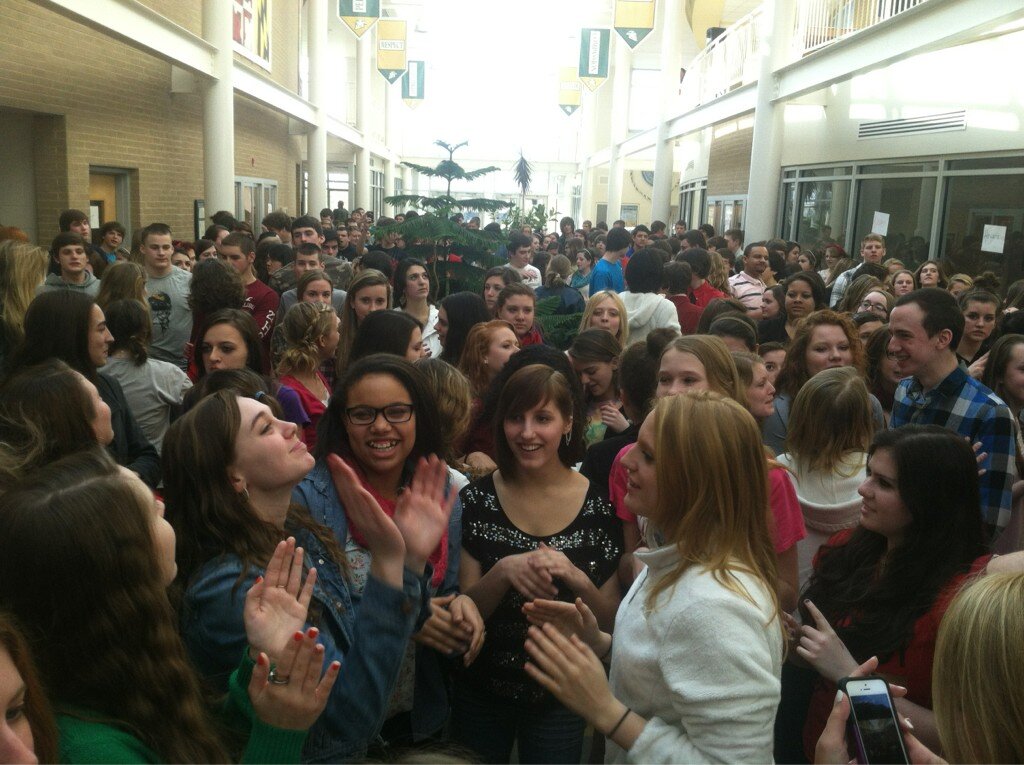
Going to North Harford High School to see over 250 students crammed into the school atrium, holding up their pointer fingers to signify One Billion Rising--- this reminded me that this is the kind of work that matters most. My teacher Ms. Green was the one who got the event off the ground, opening space for these students the way she did for me as I studied Eve Ensler ten years ago. Here, I saw how teachers work with young people (even when I was too angsty to see it when I was a teenager) to create spaces in which they can begin to imagine a different world, a more healthy and loving world in which no one lives in fear of abuse or assualt.

Every third woman was given a card with the number 3 and asked to stand up to help their fellow students visualize how many women are beaten or raped in their lifetime. These students were given space to begin to understand the pervasive nature of violence across the world. And they were shown that they don't have to be a part of that cycle of violence and control. They can resist.

As I stood next to the principal, who is supportive, and saw my former teachers, and a few students I recognized from church dancing, I have never been prouder to be an alum of North Harford High School. I have never been more inspired to be part of a movement to rise up and say enough is enough. We are over violence. We were, in Eve Ensler's words, "Dancing up the will of the world to end violence against women and girls."

And when we wake up tomorrow, we cannot go back to our silence and our ignorance. We will not go back to being part of households, communities, or a world that condones violence against women. We will continue our dance, wherever we may be, even though it will be difficult with the specter of violence on our backs.

Inspired by those teenagers at North Harford High School and their amazing teachers, I, as a pastor, will speak on gender-based violence from the pulpit on Sunday. I will make a more concerted effort in the future to create space in my churches that looks a bit more like that atrium at North Harford, filled with people creating a different world. A world in which we are all safe and free.

How will you join in the dance?

One picture of the flashmob from @laxingirl79

Wednesday, January 19, 2011

We, the Living, Uphold This

I went to Ghana January 3-18, 2011, to fulfill the Drew Theological School Cross Cultural requirement. It seems that my trips have led into each other, into this one to Ghana. Venezuela and South Africa--- these pilgrimages began in a small way to force me to recognize my race privilege. This pilgrimage to Ghana is yet another step, a bigger step, for me on the journey to understanding my race privilege and working against racism. This is my reflection from January 6, one of the most powerful days of the trip.

When I walked down into the dungeon for men in Cape Coast "Castle," there was just this horrible weight that pushed me down so much that I thought I would scream under the weight of it. The dungeon was designed to be a place of terror, a place where 1500 men were packed in and abused like livestock on factory farms are today, while so-called Christian missionaries lived in the apartments above them. In reflection later Jessica asked, how can a merciful God love us when this is what we do to one another?

Today began with a lot of apprehension on the part of our group. Most of the other students dressed up, knowing that this place they were visiting is a grave and trying to show respect. Then they sang gospel and praise songs on the bus on the way there, which Garrett broke into to read from Genesis 50:15-20:
Realizing that their father was dead, Joseph’s brothers said, "What if Joseph still bears a grudge against us and pays us back in full for all the wrong that we did to him?" So they approached Joseph, saying, "Your father gave this instruction before he died, 'Say to Joseph: I beg you, forgive the crime of your brothers and the wrong they did in harming you.' Now therefore please forgive the crime of the servants of the God of your father." Joseph wept when they spoke to him. Then his brothers also wept, fell down before him, and said, "We are here as your slaves." But Joseph said to them, "Do not be afraid! Am I in the place of God? Even though you intended to do harm to me, God intended it for good, in order to preserve a numerous people, as he is doing today."

I shivered as he read it. Shivered to realize what it was my African American classmates were facing as we journeyed ever closer to those forts on the coast, looking out over the sea where so many died in the Middle Passage.

As soon as we arrived to the Elmina Dungeon--- castle is not an appropriate term here as it signifies to me Disney princesses, rather we must find a name that better captures the horror of it like dungeons or concentration camps--- one woman began crying, overwhelmed by just standing on these steps, stones soaked in death and brutality.

At Elmina, our guide told us the story of the systematic dehumanization of the slaves, the rape of the women, the slow starvation of resistors, the deprivation of light, air, food. The stench of death and dying still lingers in the poorly ventilated women's quarters, almost two hundred years after its use, while the sea air caressing us in the officer's quarters was a slap in the face. Particularly as we stood in the Dutch church above the women's dungeon, or the Portuguese church in the center of the fort (different churches for different occupiers), feeling sick to our stomachs to think people could worship God on the very spot they committed atrocious crimes against humanity. We walked from the men's dungeon into the transition room, into the Room of No Return, where an opening barely big enough for me was the only way out into, in those days when the water was higher, the sea, into boats that would take them to those ships of death that would take the Middle Passage.

In the face of walking over this space where such atrocities, people, particularly white people I think, link this horror to others we know. The horror of Elmina reminded me of the orderliness of German-run concentration camps during the Holocaust. Systematic, orderly destruction. Here bodies had to be kept weak to avoid revolt, so they practiced a business model that caused the death of countless unknown. A business model. Cape Coast Dungeon, though, that reminded me of the sheer brutality of the Bosnian and Rwandan genocides. Out of control brutality rather than orderly brutality. We walked down this slope into the male dungeon, stones worn by the feet on men, the filth of their humiliation now fossilized on the stone floor so no amount of sandblasting or excavation could remove it. This serious of dungeons for men had tiny oles way at the top of the walls for slivers of light and air. When our guide shut off the already pitiful lightbulb dangling from the ceiling, added for the tours, I couldn't breathe. It was like being in a cave.

Beside this first room was one in which resisters were chained and starved--- crucified--- in sight of the others, a primitive drain for this blood, urine, and shit to run off. Then we continued to descend into a sorting room where men were sorted by the merchants who bought and branded them. The tunnel--- through which the men would be forced down another, agonizingly long, that led to the Door of No Return--- has now been sealed and blocked by an Akan shrine that had been in that spot long before this place of death and returned to educate and I think try to drive the spirits of that place home to rest.

The women's prisons were not like the men's, down a tunnel through which no guard or officer would go even to feel the men--- no, the women's dungeons had to be more accessible to satiate the white monsters'--- for there is no way men working in these places could be anything but monsters--- lust for power, control. And these women's fates, like those of the men, led out of that Door of No Return just the same.

Both our guides in these places ended with hope. At Cape Coast, you leave through the Door of No Return, look out over the sea, but when you turn back around the door has been labeled the Door of Return as the remains of those who had been slaves in Haiti and the USA have been exhumed and returned through that door, symbolizing the right of return for all whose ancestors were victims of that place.

Both ended with a hope that such sites and the education that is their purpose are a call that Never Again will something like this happen. Yet I am always disturbed by this call because too often we think that if slavery has ended in that form the brutality has also ended. Our guide at Cape Coast boasted that the "castle" is more than a site of terror but, because of how it was used afterward, a site that helped bring Ghana into the new international economic order. I agreed: it is a site that is representative of an economic system that still exists today in which people of color are exploited so a small number of whites (and those who share white hegemonic power) can get rich. One of the realizations I had standing there as he spoke was that today I stood in slave dungeons. On January 31 I will stand in a prison to take a course with women on the inside. Just another way that this system in which we live enslaves people of color.

Yet these sites have forced us to ask questions, critical questions about the way the slave narrative has been fed to us (in text books written by white men, as Dr. Naana Opoku Agyemang talked about in a lecture we went to later that night). We saw in the structure of the building that these dungeons were intended as sites of terror from the laying of their foundations NOT as places to trade gold and ivory that evolved into the trade of human beings. We saw the resistance that must have been, despite their absence in the history books, in the very shape of that building, cannons not only facing the sea but the surrounding village. And we heard a few stories of walled communities to protect from kidnapping, people hiding from slavers in the immense hollow center of a baobab tree. We heard of the white merchants creating tribal warfare to benefit their trade as continues to be common economic and political practice in the two-thirds world today.

And I am an inheritor of these white merchants, as I am white, middle class, and a citizen of the U.S.A. I came to Ghana to continue my journey to understand my race privilege and unlearn racism and these slave dungeons now sit on my heart with the weight of the crimes against humanity. Too long have I thought, "My people"--- which as a construction in and of itself is problematic--- "have never been slave owners. We were busy being colonized by the British ourselves.---" as though I have any kind of cultural memory of that event--- "We came over after the Civil War because of the Famine, and we once classified as people of color too." This delusion denies the fact that when the Irish became white, I became an inheritor of a system in which because of the color of my skin I have opportunity, guarantees, safety, education, wealth, and other privileges I take for granted that some of those African American students with me in Ghana have not had. And this means it is my responsibility to acknowledge my inheritance of this racist system and work against it.

So when I, like Joseph's brothers, say,


"I beg you, forgive the crime of your brothers and sisters and the wrong they did in harming you...please forgive the crime of the servants of the God of your parents."

I have felt the weight of those crimes, breathing in the putrid air in the women's dungeons in Elmina. And I know it is not enough to ask forgiveness, so I must seek ways to act to erode racism, to atone.