Showing posts with label hysteria. Show all posts

Monday, January 30, 2017

An Afternoon in a Refugee Camp

The refugee camp in Bijelo Polje, 2004.
When I was fifteen, I visited a refugee camp in Bosnia and Herzegovina. I don't remember much about it--- I think the people there were refugees from Kosovo maybe? I don't remember much what the camp director told us about how the camp ran, how many people were there, how long people could expect to be there. But I do remember the children in the camp. How we tried to play games with them but really the kids were clinging to us so tightly we could barely move our arms to toss a ball, and the ball would come right back to us. My sister, who was fourteen then, said she still remembers the face of the little girl who held her hand the entire time. She remembers trying to get her to play but she'd just smile, shake her head and just hold her hand. I remember not all the children had shoes, but perhaps it was just because it was summer? I remember the concrete everywhere--- different from the images of tent cities with blue UN tarps like we usually see on TV nowadays. But this camp was concrete encased in a chain link fence. I remember the faces of the children pressed into the fence as we left.

The woman who translated for us while we were in Bosnia went on to work in a local school there and I remember her telling me that the children at that camp went to her school. So these refugees had different opportunities than ones crossing the sea or living in a tent on a border somewhere. But whenever I hear about refugees in the news, I remember the feel of tiny hands gripping mine with fierce longing. I remember the faces of children so desperate to be treated as something other than a criminal or a burden or unwanted that they were willing to attach themselves to a stranger like me who could not even remotely speak their language or, let's be realistic, throw or catch a ball.

And so when the president of my country issues an executive order banning refugees from entering the country for 120 days--- except those from Syria who will be banned indefinitely--- I get angry. How dare we prioritize a mythical concept of safety over the lives of children? I remember the faces of the kids watching us leave--- those were not the faces of terrorists. Those were not the faces of threats to our national security. They were the faces of children wondering why they lived in a cage. Wondering when they would have a home. According to the United Nations Refugee Agency, 65.3 million people around the world have been forced from their homes, including nearly 21.3 million refugees. Over half of refugees are under the age of 18. These are the people we are really rejecting.

So let's stop allowing our politicians to feed us lies about our safety and instead embrace our fellow human beings. Call your representatives. Financially support organizations working with refugees. Reach out to local organizations that help with resettlement (if you are in the Baltimore area, check out the Refugee Youth Project). Pray and work for a world where people are not forced from their homes in pursuit of peace and stability. Remember that it is not our safety that is a concern but the safety of these children in camps.

Friday, March 25, 2016

A Forsaken God

What follows is a sermon on the Fourth Word for a community Seven Last Words service. Seven United Methodist Churches (with 6 pastors) came together to remember the crucifixion: Cokesbury Memorial, Presbury, Union, Union Chapel, Clarks, and New Hope Christian Fellowship UMCs. As usual, I wish I had more time to work on it...there are a few places that seem rough and not quite as pointed as I would hope. But the Holy Spirit spoke anyway. 

Scripture: Mark 15:33-39 (NRSV) 
When it was noon, darkness came over the whole land until three in the afternoon. (34) At three o’clock Jesus cried out with a loud voice, “Eloi, Eloi, lema sabachthani?” which means, “My God, my God, why have you forsaken me?” When some of the bystanders heard it, they said, “Listen, he is calling for Elijah.” And someone ran, filled a sponge with sour wine, put it on a stick, and gave it to him to drink, saying, “Wait, let us see whether Elijah will come to take him down.” Then Jesus gave a loud cry and breathed his last. And the curtain of the temple was torn in two, from top to bottom. Now when the centurion, who stood facing him, saw that in this way he breathed his last, he said, “Truly this man was God’s Son!” 

Reflection:
Let us pray:
Even from the cross you are our patient teacher. You turn to scripture when words fail. On this dark night, when words fail us, may the whispers of all our hearts and the words of my mouth proclaim your love for us, declaring in the words of the Psalmist that, indeed, God has done it! Amen.

A teenage boy, childhood memories undoubtedly filled with images of violence and a constant undercurrent of fear, stands at the border between Greece and Macedonia in a makeshift refugee camp. He holds a plain sign with these words written across it: sorry for Brussels.” But it is not an apology; it is a gesture of solidarity, for he, too, (better than anyone in Brussels) knows what it's like to be surrounded by bombing, to see the dead in the streets, to live in constant fear. And now he has escaped, only to find himself mired in a camp in which the “living conditions are poor, and children his age are suffering from dysentery, influenza and scabies. Food, proper shelter and clothing are also scarce.”1 And now he does not only have to worry about his own fear of death, but also that he has suddenly become the object of fear. He can see it in the faces of those on the other side of the border, hear it in the anti-immigrant rhetoric that seeps into the camp.

And I wonder if his words don't echo Jesus': “My God, my God, why have you forsaken me?
And then someone else somewhere else says the same thing. Maybe it's because they've heard of another terrorist attack, or another innocent gunned down, or another child taken away from abusive parents. Maybe it's because they have heard about another family or community member overdosing. Maybe it's after getting the diagnosis of cancer or depression or Alzheimer's. Or after losing a job or a baby or a spouse. Or maybe they are the sole caretaker of a loved one and are feeling overwhelmed. Or maybe they are facing abuse from a loved one and keep hoping they can fix them. The list goes on, but the sense of abandonment is the same. You have felt it too, being cut off from everyone around you, even if you, like the young boy with his sign, are surrounded by thousands of people. You know what it feels to say, “My God, my God, why have you forsaken me?

Jesus' cry on the cross, the last words he says before his death according to the Gospel of Mark, is a familiar one to us, even if we are not familiar with the story of the crucifixion, and even if we aren't familiar with Psalm 22, which is the scripture that Jesus echoes in this cry. Mark's community, and Jesus' as well, would have known Psalm 22. Without reciting the whole psalm, that opening line gives us insight to the anguish Jesus felt. The psalmist goes on to say, “I am poured out like water, and all my bones are out of joint; my heart is like wax; it is melted within my breast; my mouth is dried up...and my tongue sticks to my jaws; you lay me in the dust of death” (Psalm 22:14-15). This is the depth of despair Jesus felt on that cross. Many times we "theologize" the despair, labeling this as the only moment when Jesus was fully human and not fully divine. For surely God could not be so powerless. Surely God could not be so like us. 
 
Besides, we don't want a God who cries like we do, feels forsaken like we do. We want a God who swoops in to save us, who breaks down the barrier between Macedonia and Greece for that young boy, who flicks away bullets Matrix-style from the bodies of young black men, who cures cancer and rescues the abused. We want an awesome display of power, complete with fireworks, worthy of a big budget action film.

But in that way, we are more like the crowd watching the crucifixion that day than we are like true disciples. We often think of the crowd as being bloodthirsty, wanting to see suffering, wanting to get rid of Jesus and his blasphemy once and for all, but the Gospel of Mark shows a secret desire within the crowd for Jesus to win. “The crowd wanted to 'see' a miracle”--- as someone claims when they say, “Wait, let us see whether Elijah will come to take him down.” They wanted to see a God who comes to us, crosses split in two, guns blazing, Roman soldiers and abusive religious leaders scattered in terror. But what they see instead is the Human One, the Word became Flesh.2 Oh, we will get triumph and glory--- just you wait and see--- but it will not come as we expect it to come. Instead, Good Friday teaches us that God comes to us broken, feeling everything that we feel, even the very worst feeling any of us has ever had: that is, feeling forsaken by even God. That is incarnation. God does not just sample our emotions when God puts on flesh and dwells among us. God in Jesus feels what it means to be human to the very depths of how awful and frightening and lonely it can be.

So, even when we cry out, “my God, my God, why have you forsaken me?” we are not really forsaken. Our God is beside us, knowing our pain intimately, crying with us, even when we don't realize it. Jesus is holding up that sign with the teenage boy, “Sorry for...” not as an apology for tragedy and hardship but as a reminder that he understands our fear and pain better than anyone.

We still want a God who fixes everything. Who overturns the oppressors, exchanges our pain for pleasure, and keeps the shadows at bay. The story, of course, is incomplete without Easter, in which we do find a kind of triumph and power.3 But for a moment, for tonight, I want us to sit with our incarnate God, God-with-us, and open our hearts to the one who knows our struggle completely. Because the point of Good Friday is not God's power. The point is God's presence. On Good Friday and every day God chooses to love us, no matter how vulnerable that makes God to us. Over and over again, God chooses love. What do we choose?


1Kathleen Wong, “In Wake of Belgium Bombings, Refugee Child Holds Up Sign That Says, 'Sorry for Brussels,'” 22 March 2016, News.Mic, accessed 23 March 2016, http://mic.com/articles/138647/in-wake-of-belgium-bombings-refugee-child-holds-up-sign-that-says-sorry-for-brussels#.hoNGTwV0t.
2Ched Myers, Binding the Strong Man: A Political Reading of Mark's Story of Jesus, Twentieth Anniversary Edition (Mayknoll, New York: Orbis Books, 2015), 390.
3Marcus Borg and John Dominic Crossan, “Palm Sunday,” The Last Week: What the Gospels Really Teach About Jesus's Final Days in Jerusalem ( New York: HarperCollins, 2006), location 2409 of 3342.

Tuesday, December 8, 2015

Iman Means Faith

This is the answer I gave to our Board of Ordained Ministry about an experience with peace with justice ministries I've had as a pastor. I wanted to write about my experience of Islam to counter the hate-speech that seems to be acceptable today, but, without the time during Advent, I thought I would recycle this:

A group of women from a church were sitting in a restaurant during Advent, and talking about how Mary of Nazareth, Jesus' mother, has been represented across cultures, including an Arabic representation. Mary is revered in some Muslim communities and is mentioned more in the Qu'ran than she is in the Bible. Except in the middle of this conversation,  one of the women said, “Well, if that's true, then it's too bad they [Muslims] all are still so violent.” 

Comments like this, willfully ignorant, incorrect, and even hateful, about Islam are too common in our churches. I have served congregations in Harford County, a largely white county, overwhelmingly Christian, and also woefully illiterate on other faiths. Some Christians do not see why such illiteracy is a problem, but the reality is that illiteracy breeds violence and intolerance. In his book on Christian identity in a multi-faith world, Brian McLaren writes, “Our root problem is the hostility that we often employ to make and keep our identities strong--- and whether those identities are political, economic, philosophical, scientific, or religious.”1 If I wanted to interrupt the hostility, I would need to engage in peace and justice ministries that fostered interfaith relationships.

My own faith became stronger through my friendship with Muslims who I met through a mission trip to Bosnia and Herzegovina in 2004 (and have returned to visit at least eight times). I have always felt called to interfaith youth work, believing in the South African concept of ubuntu, that we become who we are through relationship with others. I never expected to be about to do interfaith work in homogenous Harford County, but when preparing to teach confirmation, I sought non-Christian congregations to visit, and somehow came into contact with Tasniya Sultana, an organizer for Project Iman, a Muslim Girls youth group. We met, had a great time, and began to plan ways for our youth to get together.

The first year, we met twice, starting by meeting with Project Iman during Ramadan. Their group was much bigger than our own, particularly because only my girls in youth group were invited the first time. I also ended up bringing a few younger girls with my youth (whose pictures ended up in the paper).2 Some of the youth went to the same school! We began with a craft where we learned to write our names in Arabic and talked about our favorite holidays. We shared stories, explaining in very basic terms how we walk in the footsteps of many of the same giants of faith, Abraham who they call Ibrahim, or Jesus who they call Isa, for instance. They spoke of Ramadan and the sacrifice of Ishmael (Isaac in the Bible). When our craft was finished, we stood up and got in a circle for a game. One of the leaders of Project Iman read a series of statements and we were supposed to take steps into the circle if the statement was true for us. She deftly included theological and scriptural statements along with statements about our families and favorite foods. And then they prayed. We sat at the tables in our own attitude of prayer while they prayed before breaking their fast. The girls from Presbury were quiet. I didn't see suspicion or self-righteousness or anything our culture teaches us about how Christians should see Muslims; instead, I only saw wonder and openness.

The second time we met was at Presbury. We ate together and painted birdhouses as a craft to go with the scripture I shared, Luke 12:22-29, about how we should not worry for God is with us. Then I had questions about how our faith teaches us to deal with worry and fear. One of the leaders from Project Iman said she loved the scripture! But the most powerful experience of the night was when we moved to the sanctuary and shared about our worship experiences. I told the kids they could ask each other whatever they wanted, but I also asked them questions. It was fascinating to see what kinds of questions they had for us, how they noticed the colors in the sanctuary and asked about their meaning, as well as to see how excited they were when I asked them to tell me about how they worship. It was a safe space where the Muslim girls were asked questions not to put them on the defensive but just out of wonder. And we as Christians were able to model Christ's hospitality.

Rev. Emily Scott, a Lutheran pastor of a dinner church called St. Lydia's in New York, said recently: “Sometimes you are seated next to someone so different, that you don't know how to start a conversation. And then something happens. In that moment, heaven and earth overlap, and God builds a bridge between the world as it is and the world as it should be.”3 The interfaith relationships between Project Iman and Presbury are fostering those moments where God builds a bridge between the world as it is and the world as it should be, a world of peace and justice where Muslims and Christians are more interested in eating, laughing, and sharing together than fighting or using hostility to shore up our identities. Our plans for this ministry are to expand it to all our youth, as there is now a Muslim youth group for boys that Project Iman works with, and to have not just dialogue together, but to work together for justice too. For Ramadan in 2016, we are planning a 30 Hour Famine-type event to raise money and awareness about world hunger. We want to continue to create that overlap between heaven and earth, that glimpse of earth as it should be, in our little corner of Harford County.


1Brian D. McLaren, Why Did Jesus, Moses, the Buddha, and Mohammed Cross the Road? Christian Identity in a Multi-Faith World (New York: Jericho Books, 2012), 63


2See Nimra Nadeem, “Muslim, Christian girls join for interfaith iftar,” The Baltimore Sun, 28 July 2014, accessed 14 July 2015, http://www.baltimoresun.com/news/maryland/harford/fallston-joppa/ph-ag-comm-interfaith-muslim-christian-20140728-story.html.


3Emily Scott, from a talk at the ELCA's national youth gathering posted by Nadia Boltz-Weber on Facebook, 18 July 2015, https://scontent-iad3-1.xx.fbcdn.net/hphotos-xft1/v/t1.0-9/11752340_859677020806230_5199339091003344713_n.jpg?oh=0222e446a363352940c43655630e7477&oe=56155FCB.

Monday, May 14, 2012

Belated General Conference Reflections

Continuing in the vein in which I have operated all semester, I am belatedly offering my General Conference reflections. These particular reflections come from my journal entries for the first and last day of conference (April 24-May 4). For more reflections from more folks, see the OnFire blog.

Portions of this reflection are crossposted on OnFire.

So General Conference was overwhelming.

I got up early on the first day, April 24, realized I forgot a bunch of important stuff, finally got to Tampa, dropped off my bags, and didn't see the hotel room again for a long time after that. Now, of course, there are people who don't sleep at all during General Conference, so I should not complain, but just the running around without having any clue what is going on is pretty tiring. When I got home from Conference, I slept several 10 hour nights to make up for this and was still tired.

But the thing about any big United Methodist event is that no matter how boring voting on whether we should end at 9 or 9:30 or at the discretion of the committee chair is, no matter how tired you are, and no matter how stressful the day has been, there are these moments of intense, beautiful connection, like when I was standing in the airport and jumped into a conversation with random people because I noticed one of them was wearing UM swag. When a friend I hadn't seen in a while jumped out of nowhere and gave me a hug--- oh and there have been so many hugs from so many people! When a person I had met five minutes before bought me coffee because I was already looking frazzled. When I got a text message courtesy of one of those mass text-messaging organizing tools following a proposed rule to outlaw protests because people know how powerful our demonstrations were before and just how close we are to making the church a more just place. So that last one was a crazy run on sentence, but you get the idea. When me and some seminary friends skipped down the river walk and just breathed in the salty air.

There was a commissioning service for Common Witness Volunteers in the evening that first day in what's called the tabernacle--- a big tent across from the convention center. In it we sang a song by Holly Near:
I am open and I am willing
for to be hopeless would seem so strange
it dishonors those who go before us
so lift me up to the light of change.

These moments of connection lifted me up to the light of change. It reminded me through all the stress and through the fear--- frankly, fear that the church won't change or that it will for the worse--- that we can do beautiful things together. Lifting each other up to the light of change. This is the connectionalism I wrote about when I wrote about why I am a United Methodist.

But.

General Conference was ugly. I have seen Annual Conference before; I know that "holy conferencing" is 99 percent of the time bullshit. But the degree to which we were not church was staggering. Every vote was 60-40, every single one in favor of the status quo. Even after moving speeches from Garlinda Burton and Erin Hawkins of the General Commission on the Status and Role of Women and on the General Commission on Religion and Race among so many others, the votes were the same. Delegates were not open to the movement of the Holy Spirit at all. Their minds were made up, votes bought and paid for, no returns.

But around 4pm that last day there was an explosion.The General Conference secretary announced that the Judicial Council ruled Plan UMC unconstitutional.

Plan UMC was the attempt to salvage the restructuring plan proposed by the Connectional Table that failed in committee. It was created by an ad hoc group that included IOT folks and Plan B, another restructuring plan. These plans were not goof for women, minorities, or anyone in the Central Conferences, a theme of General Conference 2012. Fed by fear-mongering over the USAmerican church decline and urges to cut spending, though, Plan UMC was narrowly voted through and was to become our restructuring plan, despite the fact that there were major issues around protecting the rights of women and people of color. When the General Council on Financial Administration reported back on it, they swore that the restructuring plan could be implemented within budget. And with a sinking feeling, I thought we were done for. Nice try justice voices in The UMC. The only thing that was to come out of General Conference 2012 would be an institutional move further away from the kindom of God.

But then the secretary of General Conference announced that the Judicial Council ruled Plan UMC unconstitutional.

There was this intense feeling of release, release into chaos maybe, but release. The tension that had been present all of conference over everything, sexuality included, finally exploded as every person breathed out together, whether or not they were pleased by the announcement. I called my roommate and texted my TA for the General Conference class and started to feel this strange giddy sensation of hope. Someone called for a time to caucus, and it was granted, but the bishops themselves were so disoriented the break was extended into dinner time. The General Conference secretary left us with the words (in reference to the rushed creation of the Connectional Table?), "And remember when we come back after dinner that we should be working for quality not quantity..."

Giddy, exhausted, nervous. But I wasn't the only one who felt weird. When I got back to the conference center everyone was weird. People were not making any sense whatsoever, until finally Rev. Laura Easto from Baltimore Washington stood up to chastise everyone. She said she felt the Holy Spirit move with the judicial council decision and the fact that we were still talking about that restructure plan was ridiculous. She called us instead to repentance. It was powerful and effectively ended conversation on restructure and moved us to other items of business. Finally Joey Lopez, my hero, moved to end General Conference, so we did! With a short worship service and hugs from everyone. So General Conference did not end on this horrible note, but we left with hope.

One of the problems lamented by everyone at the beginning of conference was a lack of trust. I myself felt a huge distrust of delegates and the whole process. There was no movement of the spirit (except for in the judicial council decision), no holy conferencing. But I leave the conference with a little bit of trust budding, trust in young people, including myself, WAKING UP. We are going to change the church, even if we have to drag it kicking and screaming.

Taking back the communion table May 3; photo from UMNS

Saturday, January 1, 2011

These "Fear-Infested Times": The Christian Advocate's and Social Questions Bulletin's Coverage of the House Committee on Un-American Activities and Methodism 1951-1953

This post is adapted from a presentation I did from my research in the Methodist archives at Drew University for a United Methodist history class taught by Dr. Kevin Newburg.1

Introduction

In the 1950s in the USA, the Methodist church was a powerhouse. Though beginning as a church of the poor and working class, in the almost 100 years between the end of the Civil War and the 1950s, the church had steadily moved from the periphery to the center. Yet, in reading the national Methodist publication the Christian Advocate and the publication the Social Questions Bulletin (SQB) (now The Progressive Voice) of independent social justice Methodist group Methodist Federation for Social Action (MFSA), there was a tension, a hysteria embodied in the investigations undertaken by the House Committee on Un-American Activities (HUAC).

I chose to look at 1951-1953 to cover the General Conference of 1952 in which MFSA was instructed to change its name and move out of Methodist offices and to cover the HUAC hearings of both Rev. Jack McMichael of MFSA and Bishop G. Bromley Oxnam. The media I chose to look at were the Christian Advocate (the national publication out of New York) and the SQB. The Christian Advocate was a much more widely read as well as much more politically moderate publication than was the SQB. I wanted to compare coverage in these publications to understand what it was Methodists understood a Christian economy to be and how they were affected by the hysteria surrounding communism.

What I found, though, was a church so afraid of splitting that prophetic voices were silenced by the mainstream church.

Christianity and the Isms

There was close to one article a week, or one article every other week in the Christian Advocate that centers around some aspect of communism--- which alone indicates the great anxiety that came with the Cold War. However, I was surprised at the multiple opinions and nuanced opinions published by the Advocate in this period, having expected to see much more conservative and univocal articles on the topic. Perhaps the best overview of what the Advocate published concerning economic systems was a series they ran called "Christianity and the Isms" in 1951. An editorial explaining the series called "Christianity and the Isms," indicated that the editors found it important to be in dialogue, and important to understand as Christians. They had pastors, not professors, write each piece.2

The first, over the week of April 19, was "Christianity and Capitalism" by Charles M. Crowe.3 Here, he argued that not only was capitalism not contrary to the teachings of Jesus, but, as you see in the picture, it is based on and honors biblical values. He writes, "It is time the church quit holding up to scorn the one system that has done more in more ways for more people than any other economic program. It needs to be said, without equivocation, that the free enterprise program of private ownership best supports and affords the chance to realize basic Christian ideals."4 This article interests me for two reasons in particular: 1. the focus on values, and 2. the direct address to those who disagree. The values focus, we will see later, is one the Advocate relies on most when discussing economic systems. The direct address is intriguing because it tells us that there are those who are loud and who have power to speak for Christians who disagree that capitalism is the economic system of Christians.

"Christianity and Socialism" by Edgar N. Jackson ran the following week.5 I was surprised here at the fact that the Advocate would publish something so open about supporting socialism, so often seen as a dirty word today. The beginning of the article deals with disentangling religion from economic system (i.e. capitalists can be atheists too). Then, he explained that fascism, communism, and socialism are not the same thing, a battle we still fight today. The whole article had a calm, reasoned, teaching feel to it. He corrected misconceptions, pointed out that Jesus would not support one particular economic system, but rather argues that all economic systems must be judged based on the gospel standards. He writes, "Socialism would seek to free society from the economic motives that place a premium on money and selfishness, and in their stead place the value of the human person and the common desire to serve human needs..."6 Thus, he tries to paint socialism as common sense, and as democratic, and so American.

But ultimately, the most important part of this article is at the end. He writes, "Socialism asks of people a maturity of spirit that can pass judgments on facts, free from unreasonable bitterness and blinding emotion."7 This is important because it foreshadows the coverage of the HUAC hearings. The Advocate in publishing this piece is ultimately asking for reason, for acceptance or at least tolerance to reign in confronting communism. They are putting themselves firmly against the anti-communism that support the HUAC. Now, of course, Jackson, does receive many such anti-communist reactions to this article published in the Mailbag at the end of May.8

The last installment was "Christianity and Communism" by Clarence Seidenspinner.9 The article on communism basically argues that Christianity and Communism are completely incompatible because both are evangelistic religions:
The Christian can never be happy until the words of Jesus are fulfilled, "Go ye therefore, and teach the nations, baptizing them in the name of the Father and of the Son and of the Holy Spirit." The Communists can never be happy until the words are fulfilled which were set forth in the Communist Manifesto, written by Marx and Engels back in 1848: "The Communists disdain to conceal their views and aims. The openly declare that their ends can be attained only by the forcible overthrow of all existing social conditions. Let the ruling classes tremble at a Communist revolution. The proletarians have nothing to lose but their chains. They have a world to win. Working men of all countries unite!"10
This is the basic argument throughout the three years I looked at: Christianity and Communism are by definition incompatible. And those articles like this one that are more anxious about it also have an urgency to them--- that if Christians don't evangelize more and soon, they will lose.

All in all, I think my surprise at these say more about my prejudices than about life for Methodists in the 1950s. However, with these articles, we have a foundation for not only the different arguments, but we also see how the Advocate invites the different discussions.

Anti-Hysteria

I want to take a moment here to highlight what I mentioned with Jackson's "Christianity and Socialism" article. In August of 1951 with L. Harold DeWolf's article, we see yet again the concern of the Advocate of countering the hysteria of the Red Scare. DeWolf writes, "The pressure of all this Red-hating hysteria is so strong that it is hard for Americans who love their historic freedoms to keep from being swept into it. But we must keep our heads is we are to protect our liberties and win the peace. Hitler, Mussolini, and Franco all rode to power on anti-communist, patriotic slogans. Such patterns, must not be repeated here."11 When publishing against hysteria, most piece have this form, focusing on what it means to be American and what it means to be free. The argument here is about reason, about the ethics of the constitution. And again and again, the Advocate cautions against Red-hating hysteria, often profiling the words of bishops, particularly Bishop Oxnam,12 who I could write an entire paper on. He is the champion of anti-hysteria in the Advocate.13

Of course, the Advocate's message against the hysteria of the HUAC makes sense given the fact that freedom of the press would be important to a weekly publication. But the anti-hysteria message is important because it becomes the Advocate's official position of sorts when it comes to discussing communism and the economy.

"Can't We Leave Jesus Out?"14

While the SQB certainly agreed with the Advocate in terms of opposing the anti-communist hysteria, what I found most striking about the way economic systems are discussed in the SQB was the Jesus-language used. By Jesus-language, I mean that everything MFSA published was underscored with scripture, particularly the Gospel.15 Part of the reason for this constant use of the Gospel and scripture is that it is a defensive tactic. Everywhere we see assurances that MFSA's message is Gospel-rooted.1617 For this reason, their discussion on economics is one not that says we must be open to see positives and negatives in capitalism, as publications of Christianity and the Isms seemed to say, nor is it one that focuses primarily on fighting against the anti-communist hysteria as the Advocate messages, but rather the SBQ's message is praxis based, saying that it is the responsibility of Christians to find alternatives to Capitalism and Communism.18

And while the anti-hysteria expressed in the Advocate is based on ethics and reason, in the SQB, it is very much based on the idea that Jesus would directly oppose McCarthyism. It was not just an ethical, but a spiritual issue. Rev. Jack McMichael writes, "When this crucial period is recorded, persons may be judged by what Jesus called fruits, not by labels propagandists threw their way. Glory will be assigned courageous words and deeds to which conscience drove Christendom and others--- to end hysteria and defend the spiritual freedom and democratic rights which made America great."19 This quotation again directly links the work of MFSA with the Gospel, but also assures the reader, reminding them that even through MFSA's problems with the HUAC, they are doing the work of Jesus that will be judged as fruits in the end.

These articles place the work of MFSA directly in the sandals of Jesus himself. They even draw a parallel between the crucifixion and the HUAC under the heading "Jesus and the UnRoman Activities Committee": "Have we forgotten the stand taken by Jesus when quizzed as to his alleged UnRoman activities by investigators and courts in his day who were bent on sending him to death on a cross?"20 Those are powerful words with which to scold the HUAC, and distinctly places MFSA as direct inheritors of Jesus' work.

The 1952 General Conference

So we come to the 1952 General Conference with the understanding of the gospel-rooted message of MFSA and the multivocal economic opinions of the Advocate that ultimately seem to settle on an anti-hysteria message. So I can't help but be confused when we see in 1952 such fierce opposition to the MFSA in the Advocate. You can see the preparation for General Conference with the increased focus on MFSA, driving home the opinions of the editors to those readers who will also be delegates.21

In May of 1952, we read that MFSA is responsible for a breach between lay and clergy.22 The editorial about social action and General Conference was triumphant:
The Conference's expected rebuke to the Methodist Federation for Social Action was based on the unrepresentative character of this group that had often been thought to be speaking for The Methodist Church when it actually was doing no such thing. So the majority report, which was adopted by a large vote, requested the federation "to remove the word 'Methodist' from its name" and "to terminate its occupancy" of the building at 150 Fifth avenue, New York, N.Y.23
This particularly quotation is edifying in its naming of the Advocate's problem with MFSA: they do not want MFSA's message to be confused with that of the whole church. But, as the SQB points out, the MFSA had its name before the Methodist church even had its present name.24 Similarly the SQB points out that MFSA is specifically targeted in ways that conservative papers like One (Methodist) Voice is not. Why are the facts not talked about in the Advocate?

The Social Questions Bulletin recounts the ruling in this way:
In retrospect, there is a striking thing about the General Conference debate. Federation opponents admit that their majority-adopted proposals (requesting the Federation to change its name and office location) can only be implemented by Methodist Federation for Social Action members themselves...and only when and as Federation members determine...From such considerations many at General Conference concluded that the most vigorous Federation opponents were not primarily concerned with the Federation's name or its office location, but rather with telling constituents (stirred up by secular and other misrepresentations)--- that the 45-year-old Federation had been properly spanked.25
It is very interesting that despite the care with which the Advocate presents differing economic opinions, it so thoroughly backs the "spanking" of MFSA and does not provide space for any rebuttals by MFSA.

Covering Rev. Jack McMichael's Hearing

Jack McMichael in seminary
Rev. Jack McMichael of MFSA's hearing before the HUAC is treated in much the same way. Though very little is said about McMichael's hearing in July of 1953 in the Advocate, the whole attitude of the short article is very negative towards him and towards MFSA. It is covered in a short piece from the segment News of the World Parish entitled, "Congressional Hearing: McMichael Says No."26 The title alone is bizarre, implying that the story here is not that McMichael, like Bishop Oxnam, was wrongly investigated, but that rather he finally denied being a communist. The article went on to talk about how McMichael was "evasive" and "contemptuous" throughout the hearing. It ended conceding that McMichael must not be a communist despite everything: "Mr. McMichael had gone into the hearing with assurance of support form a number of Methodists who, whether agreeing with him or not, did not want him considered guilty without proof."27 Such language undercuts those who support McMichael, MFSA, and their cause but implying that the only reason McMichael could have support is for a fair trial, not because people supported his work itself.

An older Rev. McMichael
McMichael himself frames his hearing as one on religious freedom, and he does so in much more religious terms than the Advocate does,28 but it is interesting again that the Advocate, rather than returning to its framing of anti-hysteria demonizes the work of the radical left in its coverage of McMichael's trial and its coverage of all things MFSA. Why the vastly different treatment between McMichael and Oxnam?

I argue here, that this can represent the beginning of the effects of the limits of tolerance. Certainly, the Advocate itself in the early 1950s seems to learn more left than right, but even with that lean, it does an impressive job at including voices for and against capitalism in ways that could be subversive. However, their demonization of MFSA to me is an early example of today's construction of a general public that does not include anyone who engages in radical political advocacy, or, in church language, a general public that ignores the prophetic voice. I am referring here to the work of Janet R. Jakobson and Ann Pellegrini in Love the Sin: Sexual Regulation and the Limits of Religious Tolerance. They argue that tolerance, listening to both sides of the story without evaluation, "sets up a political culture in which extremism, rather than injustice, is the major problem to be addressed in public life."29

Thus, in this case, the Advocate presents MFSA as threatening to Methodism because of their unapologetic position on the Left. It positions itself for this particular issue as existing above politicization, offended that MFSA chooses sides. But this positioning is also necessary in these early years after the 1939 Methodist merger when the north and south (which split just before the Civil War) became one church again. There was still a strong memory of that split in the 1950s. Taking the side of MFSA could alienate conservative church members and cause a split there, which was unacceptable for the Methodist church then and today. Unity, it seems, is everything.

Perhaps there is a place for such tolerance of both sides. I did appreciate the range of views the Advocate offered on economic systems throughout 1951-1953. However, demonizing MFSA seemed completely unnecessary to holding that position of "neutrality" because in demonizing MFSA, the Advocate in fact demonized all those who felt compelled to take a side based on their rootedness in the Gospel.

Conclusion

And what about this "fear-infested time" we live in today?

I have been interested in the anti-communist, anti-leftist sentiment expressed particularly in the 1950s because I see some similarities with the hysteria and fear I have seen in my own lifetime as I was born in the 1980s, during the backlash against the political activism of the 1960s and 1970s, and I became an adult post 9/11, in this only-getting-worse anti-terrorist hysteria.

Today, we are influenced by media that is incapable of analyzing the ethics of the politically active. And our church allows itself to be bullied for fear of being labeled as too politically active, and especially as too Left. Just this past October, the General Board of Church and Society withdrew its participation from the One Nation Working Together rally in Washington, DC, citing the fact that they did not want to be part of an event that was divisive, and since the August Glenn Back rally, it had came to be seen as the anti-Beck rally.30 This happened after a New York Times article (incorrectly) citing (former MFSA staff member) Rev. Amy Stapleton as speaking for the UMC--- and political pundit Glenn Back picked up on it. He cites other organizations involved and then says, "If you're a Methodist, you should demand: Do you [the church] stand with all of these communist organizations?"31

After receiving angry messages from Methodist Glenn Beck fans, GBCS caved and withdrew its endorsement. It did not want to seem threatening, did not want to rock the boat too much for fear not of being "too divisive" but for fear of being seen as "too radical." It abandoned its prophetic message for fear of causing division.

MFSA at the One Nation Rally

Fortunately there continue to be prophetic voices speaking loudly within the church when even the General Board of Church and Society caves in fear of division. They remind us, as was published in preparation for the 1952 General Conference in the Social Questions Bulletin, that "Some who whip up the great hysteria in America today do not really fear capture of this country by the small Communist minority. They do fear dissent, free and independent thinking, and prophetic religion and action--- for all of which the Methodist Federation for Social Action has stood for 43 [now 103] significant years. They were never more needed than today."32


Flash over Substance: The Balance between Freedom and National Security

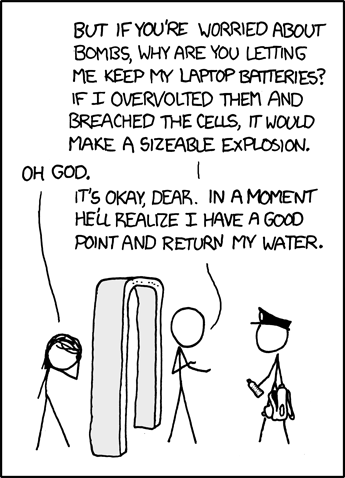
I dread going to the airport. No, I don't have a fear of flying. And usually the waiting time isn't too bad because I have a book. And security gives me a lot less trouble because I'm white. Still, I dread the waste of time that is the Transportation Security Administation (TSA) (and the equivalent in the UK too, which is arguably much much worse). I am just waiting for the day when in my over-tired traveling state I will snap. Because I am disgusted with the ways over and over again people submit themselves to over-reaction in the name of counter-terrorism. The TSA does not make us safer. Created after 9/11, its existence is basically a charade to make us think that they are doing something, when in reality they have done nothing.

http://xkcd.com/651/
This "flash over substance" approach to security comes into play even more vividly as Thanksgiving 2010 marked the more widespread use of full body scanners in airports across the U.S.A. My parents argued with me about the scanners, saying that I and others were overreacting and it was no big deal (my mother in fact implied that I was being rather puritanical about bodies in refusing to go through the scanners). They argued that we ought to submit to these scanners if the can make our airspace safer. However, in all my reading I found over and over again that, as the xkcd comic on the left reminds us, these tactics of the TSA do little to protect us.

I want to take a moment here to refer to the fantastic Bully Bloggers had a piece (one that was not as good as usual but still had a good point)reminding us that white liberals complaining about full body scanners and the invasion of privacy they brought with it obviously forget that it is "the sort of treatment black women and men have been accustomed to ever since they were pawed and poked on the auction block." But this, for me, is just another example of how we in our anti-terrorist hysteria, have allowed the restrictions on our civil liberties to go too far. Randy Ananda in an article for the Dissident Voice quotes Deborah Jacobs, executive director of the American Civil Liberties Union of New Jersey, as saying:

"In England where they spent about a third of all [their] security budget on video surveillance, there is study after study after study that shows that those who observe the surveillance are tracked to look at pretty girls' special parts, and to use those kinds of technologies to essentially violate women’s privacy, or children’s or boys’ or whoever we might be looking at.

"The same danger exists here, and that's something we should be aware of. It's been absolutely consistent in the tests. Some jurisdictions have even stopped using these technologies."

In this case, we see such scanners make us less safe.

So why do we continually allow ourselves to be treated like animals when studies have shown that such invasive tools do little to protect us?

Aaron and I watched a short documentary on the world's oldest continually operated airport, College Park airport, (which I included at the end because I thought it was that interesting, particularly the third section) that I think best narrated how ridiculous this hysteria surrounding flight post 9/11 is. The customer base at College Park airport prior to 9/11 was over 400,000. Now, it is just over 50 because the airspace within the 495 beltway is off limits without an extensive vetting process. Now, the manager of the airport says that he believes that there ought to be a vetting process. However, to fly at College Park, a pilot must get a background check by physically driving to Baltimore, physically getting finger printed at National airport in DC, bringing that documentation physically to College Park, and then waiting 4-8 weeks. These things could be done online or at any number of locations besides Baltimore and DC. And today, you can't even walk onto the airport property without being vetted, meaning the airport can't have the educational and child-oriented aviation events they used to have.

And for those of you who still think the College Park story is sad but necessary to make the Capitol safer, who think that no matter how much surveillance can be abused, if it just helps that one time--- go visit the general aviation section of an international airport like National or BWI. There is no security there.

At the end of the College Park documentary, Jim Campbell of Aero-News Network asks "how long the current security hysteria continues to value flash over substance, hype over reality?" I ask us the same question.

***

"Behind the Front Lines: Historic College Park Airport Struggles to Stay Alive"