Friday, August 13, 2010

we keep our confessions long, but when we pray we keep it short

There is no experience quite like a concert. Live music does something to a person. Tuesday night I to the Ottobar in Baltimore to see (one of) my favorite band(s) mewithoutYou (and got the added benefit of hearing Buried Beds and Murder by Death open). Always after going to a good concert, I feel more whole--- not whole in the sense of complete, but whole in the sense that implies some kind of healing has taken place. Art does that.

Now my friends often comment that the art I like is horribly depressing, and this is certainly true. mewithoutYou's early work especially is most certainly not happy (though their latest album is decidedly more uplifting). I think I am drawn to the sadness because there is realness to it that is not found in much popular culture entertainment. The sadness is just part of what it means to live in this world post-Holocaust, post Vietnam. We need to break out of the apathy of this culture in which we live, and good art--- particularly that which confronts us with our own brokenness--- can help us do that. When I was younger, I used to want to be a politician because I wanted to change things, but as I got older I realized it wasn't the politicians who make change. It is artists who are the prophets of change, who can galvanize people to move. So even when the images described by music, poems, paintings are horribly depressing there is a healing to real art, I think, because of the truth within it.

Here is an example of what I mean. Samuel Bak is a prolific painter and a survivor of the Holocaust. He has worked on a series of paintings based on the picture of the Warsaw ghetto boy (check out this article [PDF] about it). When you look at these images, you don't feel warm and fuzzy inside the way you might looking at entertainment. That isn't healing. But Bak's work gives voice to the horror that is genocide in a way that touches me deeply. He reveals our brokenness and forces us to face it. Now Bak is not an artist who suggests solutions to our brokenness but his art does hold us accountable to the horrors that we have committed. Healing cannot happen without this accountability because it is the beginning of the path to reconciliation.

mewithoutYou has touched me in a similar way on this path to reconciliation. Even since my friend David introduced me to them, I was relieved to find religious art that was not shallow the way praise music (which is not art) is, but that dipped into doubt, into the struggle of being human. This is intensified live, even in the happy songs from it's all crazy! it's all false! it's all a dream! it's alright!. Though I love singing in church, even good old hymns full of bad theology, I can never just raise my hands in worship the way I did when mewithoutYou played.


Messes of Men*

"I do not exist," we faithfully insist,
sailing in our separate ships and from each tiny caravel---
tiring of trying, there's a necessary dying,
like the horseshoe crab in its proper season sheds its shell

such distance from our friends,
like a scratch across the lens,
made everything look wrong from anywhere we stood
and our paper blew away before we'd left the bay
so half-blind we wrote these songs on sheets of salty wood
caught me making eyes at the other boatman's wives
and heard me laughing louder at the jokes told by their daughters
I'd set my course for land, but you well understand
it takes a steady hand to navigate adulterous waters

the propeller's spinning blades held acquaintance with the waves
as there's mistakes I've made no rowing could outrun
the cloth low on the mast like to I say I got no past
but I'm nonetheless the librarian and secretary's son
with tarnish on my brass and mildew on my glass
I'd never want someone so crass as to want someone like me
but a few leagues off the shore, I bit a flashing lure,
and I assure you, it was not what I expected it to be!

I still tastes its kiss, that dull hook in my lip
is a memory as useless as a rod without a reel.
to an anchor-ever-dropped-seasick-yet-still-docked
captain spotted napping with his first mate at the wheel
floating forgetfully along, with no need to be strong,
we keep our confessions long, but when we pray we keep it short
I drank a thimble full of fire and I'm not ever coming back
Oh, my G-d!

"I do not exist," we faithfully insist
while watching sink the heavy ship with everything we knew
if ever you come near, I'll hold up high a mirror
Lord, I could never show you anything as beautiful as You


I felt more whole, even among all the sweaty, tattooed people crammed into the Ottobar. Because there is a truth to the words, to the way Rickie Mazzotta, framed up there on stage by a kind of sweat halo as David says, throws his whole body into drumming to the way Aaron Weiss bends awkwardly over the microphone...I can feel it. The last song, "In a Sweater Poorly Knit," people emptied the floor to get up on the stage until the stage was full, everyone singing “I do not exist, I do not exist, only You exist." It's a healing that helps you wake up, even if it's only for a few minutes, from a world where so many of us feel alone, feel guilty for doubting, feel powerless. Art is healing in the way it can help knit us--- an individual us, yes, but ultimately a collective us) back together. It's like we drank a thimble full of fire and we're not ever going back.

***

*Didn't find many good live versions of this song (too many shaky videos with bad sound), but this is a pretty awesome performance!

Monday, August 2, 2010

To be liberated creatures committed to the freedom of humanity

Crossposted at the Beatitudes Society blog.

Reflecting on what I mean when I claim for myself the name Progressive Christian*

According to a Gallup poll released this month, 54 percent of adults nationally are unsure of what the word “progressive” means. Add the word Christian after it, and I'm sure people become even more confused. These past eight weeks I have been working through what it means to be a progressive Christian with six other Beatitudes fellows in DC. Defining progressive Christianity is perhaps an impossible task but I am going to explore here what I mean when I claim that name as my own.

Progressive Christianity is, as I understand it, a movement of the Spirit. It is a radical renewal that points us back to our roots (radical) to better seek the kindom of God. The vision of the kindom on earth as it is in heaven (Matthew 6:10), Jesus Christ's call to live abundantly (John 10:10), seeking the shalom of the city (Jeremiah 29:7)--- this, for me, is what drives progressive Christianity. We hold onto the idea that we as Christians are called to work within this world for social change.

This radical vision is a rejection of the Christian voice that has within my lifetime been the primary voice in the USA--- that of the religious right. The religious right is a criminal distortion of the Christian faith in so many ways because it has become merely a way to anchor USAmerican imperial, white, male, middle and upper class hegemony rather than a movement that follows the teachings of the historical Jesus of Nazareth. I reject the idea that salvation is only individual, or the idea that being a Christian is defined by opposition to abortion and non-normative sexuality and a blind support of free market capitalism. I claim the name progressive Christian in part to separate myself from this blasphemy.

Progressive Christianity as a movement really came out of the horror of the 2004 election. People of faith woke up and realized that the outcome of the election had been dominated by voices of the religious right--- voices that did not speak for so many of us. This is when organizations like Faith in Public Life and the Beatitudes Society emerged to work together to voice this opposition to the nationalism, militarism, racism, and materialism of the religious right. It was a revival, God's answer to our plea: “Won't you revive us again, so that your people can rejoice in you?” (Psalm 85:6).

Though there is still much to do, the tide has turned. Rev. Jim Wallis of Sojourners, a leading voice for progressive Christians points out that the religious right peaked in 2004, but now the religious right has lost its children because so many young folks are more interested in reclaiming the social justice in the gospel message than participating in the culture wars over abortion and sexuality.

This reclamation of the gospel message of social justice is not, for me, centered on favorite lefty scriptural passages like the Lukan blessings and woes 6: 20-26 (the more radical version of the Beatitudes), but rather on the greatest commandments described in Matthew 22:37-39.
You must love the Most High God with all your heart, with all your soul, and with all your mind. That is the greatest commandment. The second is like it: You must love your neighbor as yourself.


Within these two commandments is a threefold love of God, self, and neighbor that is central to living the kindom vision of the Gospel. The Phoenix Affirmations are a beautiful progressive creed of sorts that are organized according to the greatest commandments. I will highlight three of these affirmations to illustrate:

Loving God includes: Celebrating the God whose Spirit pervades and whose glory is reflected in all of God's Creation, including the earth and its ecosystems, the sacred and secular, the Christian and non-Christian, the human and non-human. (Affirmation 3)
We live in a disconnected culture in which we are often blind to the ways in which God is manifest in everything around us. Progressive Christianity recognizes God’s movement among us, even in spaces like the environment that have been devalued in the evolution of Christian tradition.

Loving our neighbor includes: Standing, as Jesus does, with the outcast and oppressed, the denigrated and afflicted, seeking peace and justice with or without the support of others. (Affirmation 6)
Our God is the God of the oppressed. We see that over and over throughout the Hebrew and Christian scriptures. Progressive Christianity puts this revelation back into the definition of what it means to follow Jesus Christ.

Loving ourselves includes: Claiming the sacredness of both our minds and our hearts, recognizing that faith and science, doubt and belief serve the pursuit of truth. (Affirmation 10)
Progressive Christianity is a movement that does not demand compartmentalization of body and spirit in order to participate! Particularly moving to me here is the mention of doubt. When I claim the name progressive Christian, I am acknowledging that I doubt. We have grown up being told that doubt is negative, but I believe that the moment you stop doubting, you have let a vital revelation slip through your fingers.

My exploration of what I mean when I talk about progressive Christianity is constantly evolving. My own understanding of progressive Christianity is that it is (a) movement. But what I have written today is my first attempt to put it to paper. I am always looking for new language through which to understand my relationship with God, so please engage me here.

I want to end with James Cone’s definition of being a Christian from God of the Oppressed because I think it says hauntingly what I am stumbling to find my own language to say here.


To live as a Christian simply means being what God has made us, namely, liberated creatures committed to the freedom of humanity.


***

All scripture passages are quoted from The Inclusive Bible: The First Egalitarian Translation, Priests for Equality (Sheed and Ward 2007). The last quotation comes from James H. Cone, God of the Oppressed (Harper San Francisco 1975), 207.

*This summer I am a Beatitudes Fellow at Faith in Public Life. The Beatitudes Society is a progressive Christian resource center for and network of faith leaders that offers seminarians like me internships at key national social change organizations. Faith in Public Life is one of those organizations, focusing on "advancing faith in the public square as a positive and unifying force for justice, compassion and the common good," a lot of which is in making the progressive faith voice audible in the media. I believe God has called me to parish ministry, yet I felt strongly that I needed experience outside of parish ministry if I want to be an effective pastor working for a just world. I have not been disappointed with this decision.

This is my final reflection on this experience and I dedicate it (yes, I know that sounds hokey, but this reflection comes from so many of our discussions this summer) to the six other DC Beatitudes Fellows of 2010.

Wednesday, July 28, 2010

Using the Afghan War Diary to guide our feet into the way of peace

Crossposted at Sojourners' God's Politics blog. How exciting!

Reflecting on the response of the faith community to the war in Afghanistan**

After reading about this for a few days and not seeing an adequate faith response, I had to write something. Particularly after the House approved $37 billion in new spending for the war in Afghanistan.*

The details brought to us in the Afghan War Diary from WikiLeaks paint a picture that those of us familiar with the wages of war have seen before. We see vast human rights abuses, routine murders of civilians, and a military authority more interested in protecting their own public image than anything else. We see war as the chaotic mess that it is.

And yet, the talking points since the release of these documents have generally settled around whether or not they tell us anything new, in progressive circles, or whether or not they have greatly endangered the troops in Afghanistan, in more moderate and conservative circles. Even the president said in response to the leak that "these documents don't reveal any issues that haven't already informed our public debate on Afghanistan."

These discussions miss the point. As a person of faith, I want to pause to redirect the discussion of these documents. After missing numerous opportunities (like one pointed out by Logan Laituri in his own response to the media coverage of Wikileaks this week and like Wikileaks' release of a video earlier this year) to stand up loudly against the war in Afghanistan for a sustained period of time (let's face it, the faith voice has gone almost completely silent here), we are presented now with the opportunity to inject ourselves into the conversation currently captivating mainstream media. To use these documents to say 8 years is 8 years too long.

In church this Sunday if you have a time for sharing of joys and concerns, pray for peace. Educate your congregation about the Afghan War Diary if they don't already know about it and begin to talk about how you can be engaged in peace work. Call your representatives and tell them that ending the war in Afghanistan must be a priority for them. This is an opportunity for us to let the Holy Spirit work through us for peace.

Such is the tender mercy of our God,
who from on high
will bring the Rising Sun to visit u
to give light to those who live
in darkness and the shadow of death
to guide our feet into the way of peace.
(Luke 1:79)


***

*May someone explain to me why it's a good idea to give more money to the war in Afghanistan when the USA cannot account for $8.7 BILLION in Iraq?

**This summer I am a Beatitudes Fellow at Faith in Public Life. The Beatitudes Society is a progressive Christian resource center for and network of faith leaders that offers seminarians like me internships at key national social change organizations. Faith in Public Life is one of those organizations, focusing on "advancing faith in the public square as a positive and unifying force for justice, compassion and the common good," a lot of which is in making the progressive faith voice audible in the media. I believe God has called me to parish ministry, yet I felt strongly that I needed experience outside of parish ministry if I want to be an effective pastor working for a just world. I have not been disappointed with this decision.

Struggling for the Soul of the USA

Reflection on "good news" from Arizona*

Judge blocks parts of Arizona immigration law

By JACQUES BILLEAUD and AMANDA MYERS (AP)

PHOENIX — A judge has blocked the most controversial sections** of Arizona's new immigration law from taking effect Thursday, handing a major legal victory to opponents of the crackdown.

The law will still take effect Thursday, but without many of the provisions that angered opponents — including sections that required officers to check a person's immigration status while enforcing other laws. The judge also put on hold a part of the law that required immigrants to carry their papers at all times, and made it illegal for undocumented workers to solicit employment in public places.

U.S. District Judge Susan Bolton put those controversial sections on hold until the courts resolve the issues.

Opponents say the law will lead to racial profiling and is trumped by federal immigration law.

This news story made the rounds of the Faith in Public Life office this afternoon and we all breathed a big sigh of relief--- relief for a short moment anyway. Then we turned back to the work we are doing this week to continue to protest Arizona's SB1070 and laws like it.

Not two hours after the news of the judge's decision to block the more heinous portions of SB1070, Rev. Trine Zelle of Arizona Interfaith Alliance for Worker Justice reminded us in a phone conference that in actuality, SB1070 has been enforced since its passage April 23. It is merely the next in a long line of policies (she named NAFTA and the USAmerican government's funneling of immigrants through the desert in Arizona in particular) that ultimately "tighten the noose" around the immigrant community, dehumanizing them by forcing them to live in paralyzing fear.

This is why we so need comprehensive immigration reform over the misguided and racist "solution" presented by SB1070. Rev. Peter Morales, president of the Unitarian Universalist Association, said on the phone call today, "Our public policy ought to represent our most humane values not our narrowest fears. This is a struggle for America's soul. Will we operate out of fear, or out of hope? Will we retrench into racial profiling...or move forward with optimism and acceptance into a multiracial and multicultural future?"

So let us give thanks for the judge's ruling today while recognizing that this struggle for the soul of the USA is not over yet. Let us stand up to fear with hope, continuing to work for justice for all our brothers and sisters.

***

**To learn more about what parts of SB1070 will still go into effect tomorrow and what has been blocked, check out an article from the Arizona Daily Star here.

*This summer I am a Beatitudes Fellow at Faith in Public Life. The Beatitudes Society is a progressive Christian resource center for and network of faith leaders that offers seminarians like me internships at key national social change organizations. Faith in Public Life is one of those organizations, focusing on "advancing faith in the public square as a positive and unifying force for justice, compassion and the common good," a lot of which is in making the progressive faith voice audible in the media. I believe God has called me to parish ministry, yet I felt strongly that I needed experience outside of parish ministry if I want to be an effective pastor working for a just world. I have not been disappointed with this decision.

Wednesday, July 21, 2010

"Religion Works Because of Media"

Reflecting on media and ministry*


This clip is a great example of what good messaging looks like. It is from Meet the Press when former Secretary of State Colin Powell announced his endorsement of Barack Obama before the 2008 election. And it is beautiful. We find ourselves captivated by this picture he paints for us, and are drawn into his message. Monday, the Beatitudes fellows participated in a media training program in which we learned what to say and how to say it so maybe we too can speak so powerfully about issues we care about. This is the reflection I wrote for Faith in Public Life's blog Bold Faith Type.

Media and Ministry

"Religion works because of media," Macky Alston, founder and director of Auburn Media, reminded me and fellow seminary students at our Beatitudes Society Summer Fellows workshop on understanding media strategy on Monday. In a world shaped by the media, religion works because of the ways religious leaders navigate media to communicate core messages on important issues. Religion cannot be separated from media and still be relevant.

However, as a seminarian, I can tell you that theological education does not prepare us to respond to the media. Being a strong communicator is an essential part of ministry, and so we are trained to preach, but we also need to be trained to talk to the press. I feel pretty comfortable in the pulpit, but sitting in a chair across from a journalist with a camera is a completely different story!

Even without actively seeking to be a voice in the realm of faith and politics, faith leaders are often called upon as public figures by the press to respond to issues of financial management, sexual misconduct, community tragedy, and hot button political debates on social and moral issues. The Auburn Media Training was an opportunity for me to fill in some of the gaps of my seminary training to more effectively do ministry.

Too often in seminary, we pick up habits that disconnect us from public debate because we rely too heavily on theological rhetoric and church-speak to be relevant in the media. Media training was a blessing in its focus on how to reach people through the press. For example, I learned how to take a story about sharing vegetables in my home church in rural Harford County, Maryland, to the press to send a message about food justice in our community and how people of faith can make our communities healthier. In this situation, the media is a way to share resources with other groups wanting to do similar work and also a way to share what we offer with a part of the community who may not be aware of this ministry.

Media is an important tool in social change, but it only works if faith leaders can make journalists care about the issue. One interview can change the course of a church project, a career, even a movement, so faith leaders must make media strategy a priority in the ministry they do.

***

Check out fellow Beatitudes Society Fellow Whitney Pierce's post about the media training up on the Beatitudes Blog: I'm Ready for My Close Up.

*This summer I am a Beatitudes Fellow at Faith in Public Life. The Beatitudes Society is a progressive Christian resource center for and network of faith leaders that offers seminarians like me internships at key national social change organizations. Faith in Public Life is one of those organizations, focusing on "advancing faith in the public square as a positive and unifying force for justice, compassion and the common good," a lot of which is in making the progressive faith voice audible in the media. I believe God has called me to parish ministry, yet I felt strongly that I needed experience outside of parish ministry if I want to be an effective pastor working for a just world. I have not been disappointed with this decision.

Sunday, July 18, 2010

A Pilgrimage of Pain and Hope

July 18, 2010, is the 92 birthday of Nelson Mandela. We take a moment this day to honor his amazing life. A year ago on Mandela Day, I was walking through the apartheid museum in Johannesburg, South Africa. This is my reflection I wrote for my home church after the trip last summer.

"Where there is poverty and sickness, where human beings are being oppressed, there is more work to be done. Our work is for freedom for all. After 90 years of life, it is time for news hands to lift the burdens. It is in your hands now."

-Nelson Mandela, Hyde Park, London, June 2008


For me, South Africa was a place where I could really begin to visualize what being liberated to hope looks like. While I was in Carlisle, Pennsylvania, working with some of the local churches, my pastor asked me to help lead a trip to South Africa. The idea came out of a desire to partner Allison United Methodist Church in Carlisle with Manning Road Methodist Church in Durban South Africa. The associate pastor at Manning Road had grown up at Allison UMC and gone to seminary at Duke, where she had the opportunity to intern at Manning Road one summer, and they eventually asked her to come back and serve as their associate pastor. She wanted to link her home church with the church she currently served. I have always wanted to lead a mission trip, and so agreed to help, particularly because everyone was willing to make an effort to do mission differently for this trip.

We used South African pastor Trevor Hudson's book Walk a Mile in My Shoes to design a pilgrimage of pain and hope. This is a pilgrimage designed mainly to get privileged people out of their closed communities to see the larger world around them, to listen, to learn, to connect. To be exposed to pain, but also see the hope existing in the community through the ministries already going on in the community.

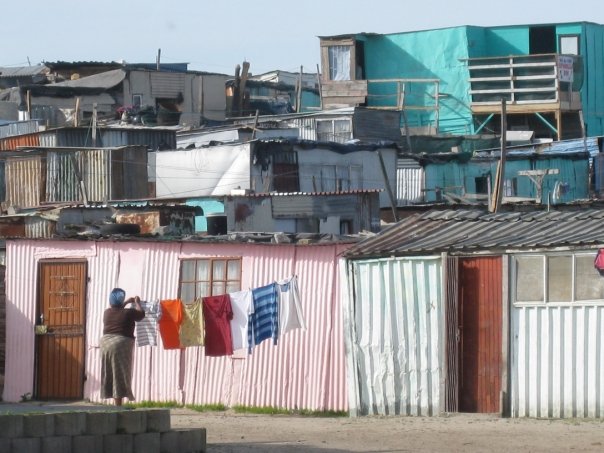
We saw a lot of pain here. You can see the poverty in these pictures. There are a million people living in the slums, or townships, of Cape Town. Miles and miles of shacks, wounds left by apartheid. We didn't learn about apartheid in school, but I wasn't even 7 years old in 1994 when Nelson Mandela was elected South Africa's first democratic president. So, in brief, apartheid was a segregationist policy in which people of color were denied dignity, evicted from homes in mixed communities and forced into ghettos. And still today, the poverty is overwhelming. And of course, with poverty comes crime, a huge problem throughout South Africa.

But the hope here was so strong. I'm going to use my experience of one day on the trip to illustrate this. One morning in Durban, we went to this huge, falling down building, walked up three flights of steps that smelled of urine and weren't lit at all. But when we got to the third floor, the place lit up with light and color and the laughter of children. We were visiting a preschool and day care run by a group called Union of Refugee Women. Jeanine, supervisor of the school and founding member of the Union of Refugee Women and a refugee from Burundi told us how they began with five women car guards and their children and have since expanded.

We took the older class of children to the zoo. And then the playground.
While pushing one of the little girls on the swing, I heard a her singing "If you're happy and you know it." And that really touched me, a child like that who hardly ever goes outside, still is evidence of hope because her singing proves what happens with just a little love.
That night, we headed to Anna's church for dinner. Refugee women who are part of the Manning Road congregation had been preparing another feast for us since eleven in the morning with a donation we had made to them (they don't normally get such meals). These women and their families had taken sanctuary at Anna's church during the three month xenophobic crisis last year and ended up staying to become part of the church family.

We walked into the hall which was warmed by good food and smiling faces. We were welcomed with song, and we offered a song as well. Then food was heaped on our plates and we sat down, conversing in between bites. We talked of homelands, families, politics, of the beauty of being multilingual. So much pain and suffering yet such joy in fellowship.

While there, I talked to a man named Fabien from the Democratic Republic of Congo in French--- a man who spoke at least three languages, how beautiful. One of the things I asked him was why he thought his country and the countries around him are still plagued by such violence and cruelty. I mean, I had my ideas about how Western nations continue to colonize third world countries economically and politically by encouraging debt and corruption. But Fabien said that the violence was a result of a lack of leadership.

That really hit home when I thought about South Africa and how the first democratic president had been a political prisoner for almost thirty years, had been degraded and abused and yet he and other leaders preached reconciliation. Unity. That's such a powerful message. Alleluia. Amen.

Wednesday, July 14, 2010

Witch Hunts

Reflecting on Terrorism*

Part of what I do at Faith in Public Life is read the news every day to compile stories on faith and politics for the Newsreel, as I have mentioned before. Some stories I read about in particular weigh heavily on me. This is one of them.

An anonymous group in Utah calling themselves the Concerned Citizens of the United States have sent a 30 page watchlist of 1300 names to various members of the state and local governments as well as the media. Along with these names, addresses phone numbers, workplaces, social security numbers, names of children, and the due dates of the pregnant women are included on the list. Their rationale for such an atrocious invasion of privacy? The people on the watchlist, this anonymous Utah group alleges, are living in the country illegally (and how do they know this? because the names are of Latino origin, duh).

Scared yet?

This watchlist is a blatant disregard for human dignity. And this anti-immigrant group rests safely in their anonymity while outing others!

Faith in Public Life blogged before about the fear that such anti-immigrant witch hunts, in the words Hispanic activist Tony Yapias, create. Here's what Dan Nejfelt wrote about his experience at the March for America:

"Then it hit me all of a sudden- the terror, the separation - this is what our immigration system inflicts on immigrant families every day. Except in communities across the country, when little children are separated from their parents, no announcements are made. No army of volunteers fans out to find them. The men with guns come to pull the family apart, instead of bringing them back together."

MSNBC reports that there is uneasiness even from state Representative Steven Sandstrom (R-Orem), who is drafting Utah's version of SB1070, about the anonymous Utah group's terrorizing tactics. But this watchlist goes hand in hand with anti-immigrant measures because, in the end, civilian and state-level attempts to enforce our broken immigration system succeed only in tearing communities apart and forcing people to live in fear of violence and hate crimes.

***

*This summer I am a Beatitudes Fellow at Faith in Public Life. The Beatitudes Society is a progressive Christian resource center for and network of faith leaders that offers seminarians like me internships at key national social change organizations. Faith in Public Life is one of those organizations, focusing on "advancing faith in the public square as a positive and unifying force for justice, compassion and the common good," a lot of which is in making the progressive faith voice audible in the media. I believe God has called me to parish ministry, yet I felt strongly that I needed experience outside of parish ministry if I want to be an effective pastor working for a just world. I have not been disappointed with this decision.

Monday, July 12, 2010

Mellowed Out or Watered Down

Reflecting on the Non-Profit Industrial Complex***

Sojourners is a progressive Christian non-profit trying to live out "faith in action for social justice" that began in the early 1970s as an intentional community of radical anti-war seminarians who transplanted to Columbia Heights in Washington D.C. but has now become a respectable 501(c)3. When looking at the magazine the non-profit now publishes against the first issue published by the intentional community, the differences are eerie. For instance, the first issue had a picture of the crucified Christ wrapped in a USAmerican flag as his death shroud. While Sojourners the magazine still covers progressive, leftist issues, it has certainly "mellowed out," in the words of the director of policy and advocacy. She said "mellowed out" like it was a good thing, but looking at that picture I questioned that. Here we were, sitting in a boardroom in business casual talking about social justice, but I wondered if we had not mellowed out but watered down the message of that first issue of what would become Sojourners magazine.

Now this reflection seems to be a departure from the upbeat excited reflection that I had written about finding common ground and using different language to bring people across party lines to consensus. Here I am, halfway through my fellowship at a faith-based non-profit and I start reading INCITE! Women of Color against Violence's anthology The Revolution Will Not Be Funded: Beyond the Non-Profit Industrial Complex (For this I blame Caroline Radesky with whom I went to undergrad and who gave me the book). The Non-Profit Industrial Complex is defined as system that incorporates progressive and leftist social dissent by controlling it through political and financial technologies.* I just read the introduction over the weekend, but it was enough to disturb me as I spent the day today on my tour of the Beatitudes placements with the other fellows.

To return to Sojourners: I want to assert that I believe this is an organization that does great work. The articles in the July 2010 issue of the magazine, in which there is an interview about intentional community between one of the original members of the Sojourners community and a woman who is now living in an intentional community, include those on important, often ignored as too leftist, issues like Israeli occupation, patriarchy in the church, and myths of masculinity. These are not often discussed by respectable Christian organizations and even some secular progressive groups. Sojourners also creates valuable resources for faith communities to educate themselves about justice issues. So in many ways their message is not watered down but "mellowed out" into forms (glossy magazines) and languages (evangelical, for instance) that are accessible and make justice work accessible to people other than the leftist elite. Those who were founding members of the Sojourners community continue to work in and with Sojourners the non-profit, which surely helps keep the focus on revolutionary work.

Still, we must be critical about the capacity for revolutionary work in hierarchical, formalized, business casual (so I may pick on the business and business casual uniform in part because I really should not be allowed to dress myself but it is a visual that reminds us how much a part of white culture we are) workplace that answers to foundations whose only interests in all honesty are making money who give it grants. (Come on, do you really think BP is giving money to the National Wildlife Foundation out of the goodness of its heart? Sure, it is a publicity stunt in some ways but the major reason is that BP gets tax breaks for donating money to charity. When companies donate money, they do have an agenda, and even when they donate to progressive organizations, those organizations better not be doing work, like anti-capitalist work, that does not mesh with their agenda.) We must develop ways to hold these organizations better accountable to the communities they serve.

So yes, as I visited Sojourners and the other Beatitudes fellows' sites and thought of my own placement, I was uneasy about the potential for revolutionary work left untapped because of the ways in which non-profits are made to play nice in the form of non-profit organizations complete with executive directors, nicer than Sojourners must have played in the 1970s as a radical Christian community living in protest against the Vietnam War. And as I continue reading The Revolution Will Not Be Funded, I expect to continue to become uneasy, perhaps disturbed, particularly around issues of race and non-profit work.**

However, I want to make it clear that the work of organizations like Sojourners and Faith and Public Life that is directed to moderates as well as progressive folk and that is committed to reform rather than revolution is valuable. When I look at my own relationships, my closest relationships are not with all revolutionaries. I am in love with and committed to a person who is far more conservative than I am theologically and politically, my sisters are more conservative than I am particularly when it comes to economic issues, and so many of my friends are outside of the academic and activist/organizer Left "elite" which criticizes our society: I cannot just preach about how wrong they are all the time without trying to use their language to dialogue with them and educate them (and myself). I have written about this experience before, but when I did radical feminist work in college, I hated everyone and had no respect for those who didn't agree with or even for those who didn't understand my politics. One of the other Beatitudes fellows told me something similar about when she worked with the Open Door Community in Atlanta: she said she had contempt for those who chose not to live the way they did until someone called her out on it. Now Open Door is an amazing community, and in college we did great work against sexual violence, but neither I nor the other fellow found our work to sustainable for us. I needed to reach out not in contempt but using a mellowed out message to speak and listen to others rather than just tell them how wrong they were.

This need for the work that come of these non-profits is particularly salient when we are in a world in which our work is under surveillance, even though it is the non-profit system through which that surveillance is possible. Ours is a society in which capitalism has so much power that it has now thwarted the energy of the Left's social movements into respectable non-profit business casual. So what I'm thinking is that we cannot move from this pit we are mired in to the kindom of God, which is how I talk about a world of peace and justice, in one piece of policy or one big protest, but rather we need to move on two fronts: work that is watered down AND living that is revolutionary work.

The watered down work is necessary in my mind because our system is so corrupt that it must be coaxed along from within the system until we can safely dismantle it. By watered down work, I mean working within the system for reform. For example, passing laws like comprehensive immigration reform even though the kindom knows no nationality, knows no border, is an example of important work that falls short of revolutionary. So we must advocate for comprehensive immigration reform at the same time we personally are living in and creating communities that reject the idea of borders.

Revolutionary living is necessary to keep us from thinking that watered down is the best we can do. It isn't.

***

Note: I'm probably wrong about the two-fronts thing, and probably losing my edge, but this is just where I am now. I'm trying to navigate how to do revolutionary work in a way that is not alienating, in a way that is healthy, in a way that can be lived out in diverse community.

***

*The Revolution Will Not Be Funded: Beyond the Non-Profit Industrial Complex. Edited by INCITE! Women of Color against Violence. South End Press, 2007. 8.

** Ever, for instance, think about how white the non-profit Left is? Where the voices for prison abolition are? Dylan Rodríguez writes, "Why, in other words, does the political imagination of the US non-profit and nongovernmental organization (NGO)-enabled Left generally refuse to embrace the urgent and incomplete historical work of a radical counter-state, anti-white supremacist, prison/penal/slave abolitionist movement?" From The Revolution Will Not Be Funded: Beyond the Non-Profit Industrial Complex, 22.

***

***This summer I am a Beatitudes Fellow at Faith in Public Life. The Beatitudes Society is a progressive Christian resource center for and network of faith leaders that offers seminarians like me internships at key national social change organizations. Faith in Public Life is one of those organizations, focusing on "advancing faith in the public square as a positive and unifying force for justice, compassion and the common good," a lot of which is in making the progressive faith voice audible in the media. I believe God has called me to parish ministry, yet I felt strongly that I needed experience outside of parish ministry if I want to be an effective pastor working for a just world. I have not been disappointed with this decision.

Wednesday, July 7, 2010

Kneeling in Altar

Cross posted at OnFire.

So rock me mama like a wagon wheel
Rock me mama anyway you feel
Hey mama rock me
Rock me mama like the wind and the rain
Rock me mama like a south-bound train
Hey mama rock me
-"Wagon Wheel," Bob Dylan; Old Crow Medicine Show


The border, la frontera, is death. Again and again when I was in Nogales I heard this expressed by people who call the border home, people whose existence is this increasingly militarized space. Again and again, I saw white crosses, x's that marked the spot, signifying the death in the desert along that line drawn in pencil by men far, far away.

There is a dusty fear here. As a member of the OnFire Borderlinks delegation in October 2009, we traveled from Tucson to Nogales to Altar and back. These memories hit me this week as I sat in front of a computer working at Faith in Public Life when I came across this article by Elliot Spagat from the Associated Press:

Mexican drug cartel killings near Nogales increase

ALTAR, Sonora- Very few residents dare to drive on one of the roads out of this watering hole for migrants, fearing they will be stopped at gunpoint. They worry they will be told to turn around after their gas tanks are drained or, worse, be kidnapped or killed.

A shootout that left 21 people dead and six wounded on the road last week is the most gruesome sign that a relatively tranquil pocket of northern Mexico quickly is turning into a hotbed of drug-fueled violence on Arizona's doorstep...

Nogales, the main city in the region, which shares a border with the Arizona city of the same name, has had 131 murders so far this year, nearly surpassing 135 for all of 2009, according to a tally by the newspaper Diario de Sonora. That includes two heads found Thursday stuffed side-by-side between the bars of a cemetery fence.

The carnage still pales compared with other Mexican border cities, most notably Juarez, which lies across from El Paso, which had 2,600 murders last year. But the increase shows that some small cattle-grazing towns near Nogales are in the grip of drug traffickers who terrorize residents...

"If no one puts a stop to this, these will become ghost towns," said Jose Martin Mayoral, editor of Diario del Desierto, the newspaper in Caborca....

That phrase ghost towns echoes in my mind as I sit here, so far from this fear on the border yet still so affected by it. When I sat down to write this post, I thought about what it was like to sit in a van in Altar looking out into the desert at the road people took to get to the U.S.A. without documents. We couldn't get out of the van because the entrance to the road was patrolled by gangs. I wanted to write about NAFTA and the failed war on drugs, corruption and USAmerican citizens' own complicity with the violence that is migrating over this border in the way people are forced into drug and human trafficking. I wanted to compare the low levels of violent crime in USAmerican Border cities with the fact that Ciudad Juarez, just over the border from El Paso, Texas, is one of the most violent cities in the world.

Yet as I read this Associated Press article and think about what Altar and Nogales meant to me and why I am so saddened to read about the violence on the border, the image that keeps coming into my head is that of José, an eighteen year old who looked so much younger who came to the migrant shelter in Altar the night we were there. He was alone. I didn't get much of his story and don't know if any one of us did, but what I remember about José was the quiet way he sang along to the music as my friend David played guitar in the courtyard to the shelter. We sang song after song as the sun set and the coolness of the desert at night set in around us.

The sacred to me was in the movement of José's lips as we sang "Wagon Wheel" until the haunting beauty of the song dissipated in the darkness and we entered the shelter to eat.

As I continue to sit in front of a computer, I meditate on the movement of God in that moment and I just wish I could give it to you, the way the night air felt against my skin, the sound of Susanna's voice as she led us all in the song, the weight of it all. Would it change you, would it make you ask more questions, make you stop and think when you read about the increased violence of border cities on the Mexican side of the border?

"Wagon Wheel" is a song about traveling south, about getting to Raleigh to be with a lover, where if he died in Raleigh, he says "at least I will die free." I don't know if José ever made it north, but if he did, he only had a few months before SB1070 reminded the rest of us how undocumented people living in this country are not free, continuing to live in prisons of fear from a different violence. José reminds me why we need comprehensive immigration reform so badly, why I pray he is neither living in the border cities in Mexico nor in Arizona but that he has a chance to live free of that fear. That we all have the chance to live free of that fear.


***

All the pictures are from the OnFire Borderlinks delegation in October 2009. All the pictures are from the OnFire Borderlinks delegation in October 2009. Check out the posts about our trip from David, me, Mallory, Lindsey, and Jen.

Saturday, July 3, 2010

Securing the Border

Reflecting on the Importance of Understanding Current Events and Language in the Debate over Immigration*

The following is the blog post I wrote for the Faith in Public Life blog Bold Faith Type inspired by four weeks of reading news coverage about immigration. Each morning, we read the news, clipping articles for our Newsreel. I find the Newsreel to be a very important tool for faith leaders because keeping up on current events helps us break out of that insulated church world that we often find ourselves in.

For me, this is particularly true as I try to educate myself about issues like immigration. After weeks of reading about the debates over immigration reform, I felt I had to write something to point out the problems with further militarizing an already overly-militarized region. However, in writing for the blog, I did have to check a lot of the more angry, more lefty language I use. In the first draft, I used the word "militarization" several times, knowing as I wrote it that in most cases it wouldn't make the final cut but continuing to use it because that is the word that best fit my meaning. Sometimes, though, we do have to sacrifice precision of meaning, the passion behind the words, in order to best present an argument in a strong but non-threatening way, a way that allows us to speak across partisan barriers.

Sometimes, I feel like the political language we use is like the constructed differences between Serbian, Croatian, and Bosnian--- all are the same language, but differences are fabricated and used to pledge allegiance to one group in opposition to another, to identify people ethnically just by a word they use. If we want to build community, though, we have to recognize when those political differences are necessary and when we can try instead to use the other language to communicate our values.

I thank Kristin and Nick for their help moving the post away from my more militant lefty, more academic writing to something that better fits in the Bold Faith Type blog.

A False Sense of Security

In the ongoing debate about immigration, some erstwhile supporters of reform say we must first "secure the border" before we can think about comprehensive reform. In his speech Thursday morning President Obama seemed to kowtow a bit to that perspective when he said that there are more "boots on the ground" at the border than at any other time in US history, a reference to his administration's announcement last week that they will be deploying 1200 new troops to the Southwest border as well as seeking funds for two Predator drones to patrol the border.

The GOP insistence on border security relies on the belief that crime is an out-of-control problem on the U.S. side of border. This false sentiment is consistently espoused by conservative politicians like Arizona Governor Jan Brewer who recently asserted that

"the majority of the illegal trespassers that are coming into the state of Arizona are under the direction and control of organized drug cartels and they are bringing drugs in."

In fact, according to Politifact, "statistics have consistently shown that immigrants, including illegal immigrants, actually have lower rates of criminal activity and incarceration than do the native-born children of immigrants." Moreover, US border cities have among the lowest rates of violent crime in the country.

The debate pitting border security against comprehensive reform is not only built on a shaky foundation of evidence, but is also a false dichotomy. We cannot secure the border without comprehensive reform, without a way for individuals to legally and fairly enter the system. As C. Stewart Verdery, Jr., former Assistant Secretary of Policy and Planning at the Department of Homeland Security, wrote in a recent report:

"Waiting for an airtight border to solve our immigration problems would be an unrealistic, impractical, and unsuccessful strategy."

We need our politicians, from members of Congress here in Washington and state political leaders like Gov. Brewer, to drop the "secure the border" rhetoric and instead focus on what we know will work: comprehensive immigration reform. Faith leaders have been leading the charge for reform that protects our values and our interests as a country, and this week, they ramped up the pressure and urged Congress to build on the momentum from the President's speech.

Wednesday, Hispanic and African American pastors launched a coalition debunking the myth of the "black-brown divide" and pledging support for immigration across racial and ethnic lines. Thursday, an interfaith delegation delivered a letter to White House officials with almost 600 signatures from faith leaders in support of comprehensive immigration reform and announced a coordinated month of action for reform. The grassroots mobilization, Justice July, will include pulpit swaps between citizen and immigrant clergy, vigils, and acts of civil disobedience.

The faith community isn't backing down on the overwhelming need for reform. They know that the pragmatic and moral solution is a comprehensive one, and not one that relies on faulty logic and calls for militarization along our Southern border.

***

All the pictures are from the OnFire Borderlinks delegation in October 2009, which I blogged about here. This is the Mexican side of the fence that cuts Nogales, Arizona, USA from Nogales, Sonora, Mexico. The art is the work of Lupe Serrano. Art is not allowed on the USAmerican side as art was not allowed on the Soviet side of the Berlin Wall. Isn't that funny?


***

*This summer I am a Beatitudes Fellow at Faith in Public Life. The Beatitudes Society is a progressive Christian resource center for and network of faith leaders that offers seminarians like me internships at key national social change organizations. Faith in Public Life is one of those organizations, focusing on "advancing faith in the public square as a positive and unifying force for justice, compassion and the common good," a lot of which is in making the progressive faith voice audible in the media. I believe God has called me to parish ministry, yet I felt strongly that I needed non-profit experience if I want to be an effective pastor working for a just world. I have not been disappointed with this decision.