Wednesday, November 3, 2010

What Saints Look Like

This is the adapted sermon I preached on Luke 6:20-31 and Ephesians 1:11-23 at Calvary United Methodist Church in Kearny, New Jersey, for All Saints' Day on October 31. As both my partner Aaron and my friend Rev. Nancy Webb said, it sounds just like my mother's sermons. Ha. Anyway, I have preached before multiple times, but never have I designed the service in its entirety, printed the bulletins, and then served as the leader of the congregation by myself. This congregation is the smallest in the Gateway North District--- 6 to 15 people on a Sunday, 7 this Sunday--- but one that is entirely committed to the work of the church.

It was such a blessing to be with these welcoming people, but I was nervous about leading. First, I was in this tiny chapel with only seven others, but I was expected to be behind the pulpit. It felt like forced formality. Then, I had printed out the scripture using the NRSV translation, so when they found it in their NIV bibles, they were really confused. I spoke too fast when preaching, and the hymns I picked were only three verses each (I don't know what hymns the congregation is used to, and there is nothing worse than being asked to sing seven verses of a song you don't know when there is no strong musical voice to follow!), so the service only ended up being forty minutes. Still, the passing of the peace was one of the most beautiful I have ever experienced because everyone hugged and kissed me and I could really feel the love of Christ in everyone in that room.The sermon that follows has been edited.


...Tomorrow is All Saints' Day, a day typically celebrated more in the Catholic tradition than Protestant tradition. When we think of saints, we often think of martyrdon and that process of canonization that is usually associated with saints in Catholic traditions. But my mom always used the holiday to explain to us that our church believed that we could all be saints. She used to say during the church service, "Let me show you what a saint looks like." And then she would hold up a mirror, so we could see our own reflections.

All saints aren't dead saints,1 she was saying. But if, for us, to be a saint you don't have to go through a process of beautification as in the Catholic Church, and if saints don't have to be dead to be saints, than what is a saint? I have heard many a time from folks that my father must be a saint after they meet me and my two younger sisters together. I think those people are insinuating that us three girls are a bit of a handful, which is untrue because we are angels, so I don't think that accurately captures the meaning of sainthood either. This is where our gospel lesson for this morning comes in.

When I saw that the gospel lesson we read this morning came from Luke's version of the Beatitudes, I was a bit perplexed and asked myself what this had to do with saints. But in reading a bit more, I saw that this passage is describing what a saint is. Jesus says:
Blessed are you who are poor, for yours is the kingdom of God.
Blessed are you who are hungry now, for you will be filled.
Blessed are you who weep now, for you will laugh.
Blessed are you when people hate you, and when they exclude you, revile you, and defame you on account of the Son of Man.

Jesus is saying that the poor are saints, the hungry are saints. Those who weep are saints, and those who are hated and reviled are saints. It's hard for some of us to think of those living on the streets as saints. It's hard for some of us to think of Muslims and gay people as saints, though they are often reviled and excluded from our very churches. And it's hard to think of ourselves as saints when we weep over the loss of loved ones. After all, those pictures of saints we see with the halos and stuff show them smiling and peaceful looking, right?

But the description of sainthood does not end there. At the end of the passage we read today, Jesus moves from a picture of what a saint is to how we can all become saints.
...Love your enemies, do good to those who hate you, bless those who curse you, pray for those who abuse you. If anyone strikes you on the cheek, offer the other also; and from anyone who takes away your coat do not withhold even your shirt. Give to everyone who begs from you; and if anyone takes away your goods, do not ask for them again. Do to others as you would have them do to you.


Here we see that to be a saint is not just to be poor and in mourning, but it is also to make a personal decision day after day to live in a way that brings to life this Sermon on the Plain. Great. Ok. So now what? I mean, these are not some easy how to's that we can all just start doing right now no problem, right? Loving your enemies? Turning the other cheek? If someone takes our stuff, don't ask for it back? It is when we read things like this that I really agree with one of my professors who referred to Jesus as "that crazy bird Jesus." Jesus must be one crazy bird to think that we can really live this way.

I want to paint a picture for you about just how crazy this work of the saints is. This is a story about Bishop Peter Storey, a Methodist bishop and ecumenical leader during apartheid in South Africa. Apartheid was a violent legal system of racial segregation--- much like the system of segregation and Jim Crow here in our country before the Civil Rights Act was passed--- in South Africa in which the white minority called Afrikaners ran the country and committed horrible acts against the black African population. The system was put in place in the 1940s and was not overturned until 1994. This story is in Bishop Storey's words and for me it really illustrates the work of the saints:

A young Peter Storey
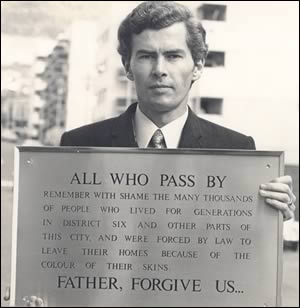
"I once received a phone call," Bishop Storey writes, "in the early hours of the morning telling me that one of my black clergy in a very racist town sixty miles from Johannesburg had been arrested by the secret police. I got up and drove out there, picked up another minister and then went looking for him. When we found the prison where he was and demanded to see him, we were accompanied by a large white Afrikaner guard to a little room where we found Ike Moloabi sitting on a bench wearing a sweatsuit and looking quite terrified. He had been pulled out of bed in the small hours of a freezing winter morning, and dragged off like that. I said to the guard, 'We are going to have Communion,' and I took out of my pocket a little chalice and a tiny little bottle of Communion wine and some bread in a plastic sachet. I spread my pocket handkerchief on the bench between us and made the table ready, and we began the Liturgy. When it was time to give the invitation, I said to the guard, 'This table is open to all, so if you would like to share with us, please feel free to do so.' This must have touched some place in his religious self, because he took the line of least resistance and nodded rather curtly. I consecrated the bread and the wine and noticed that Ike was beginning to come to life a little. He could see what was happening here. Then I handed the bread and the cup to Ike because one always gives the Sacrament first to the least of Christ’s brothers or sisters— the ones that are hurting the most— and Ike ate and drank. Next must surely be the stranger in your midst, so I offered bread and the cup to the guard. You don’t need to need to know too much about South Africa to understand what white Afrikaner racists felt about letting their lips touch a cup from which a black person had just drunk. The guard was in crisis: he would either have to overcome his prejudice or refuse the means of grace. After a long pause, he took the cup and sipped from it, and for the first time I saw a glimmer of a smile on Ike’s face. Then I took something of a liberty with the truth and said, 'In the Methodist liturgy, we always hold hands when we say the grace,' and very stiffly, the guard reached out his hand and took Ike’s, and there we were in a little circle, holding hands, while I said the ancient words of benediction, 'The grace of our Lord Jesus Christ, the love of God and the fellowship of the Holy Spirit, be with us all.'"2

The fellowship of the Holy Spirit be with us all. Here is a man who is doing the saintly work of that crazy bird Jesus, who is


Loving his enemies, doing good to those who hate him, blessing those who curse him, and praying for those who abuse him and his friends.

His friend Ike has been taken violently from his home for no other reason than the color of his skin. And yet, he with the smile of assent of Ike, takes the moment to offer grace to the guard who represents the system of oppression they live under. And he shows that to do this work, he isn't becoming some sickly sweet spineless guy, not like that picture of the saint with the halo, but someone filled with the Holy Spirit to stand up for the least of these. This is how to become a saint.

Luckily for us, we are a people who believe in the work of the Holy Spirit. The text from Ephesians reminds us this morning that we


were marked with the seal of the promised Holy Spirit.

Marked. That is such a strong word to me, reminding us of the power that is in our baptism as Christians. It reminds us that whether or not we think we can do it, the Holy Spirit moves among us and within each of us to make us holy, to make us even love our enemies, as Bishop Storey did.

So let's look again into that mirror that shows us what a saint in our own community looks like. What are ways that we can be saints together? So many of you already do saintly work each and every day. Think of your Vacation Bible School work! This is a true example of what Jesus ends his how-to of sainthood:


Do to others as you would have them do to you.


Here you are, reaching out to the community around you to bring a little light into children's lives, to give to these children what we all hope to give to our own: the love of Christ. It is also standing up, I think. Standing up to the culture of disconnect that we live in. Do you know what I mean? We live in a culture where no one knows our neighbors. Where one of the richest counties in the nation where I am living while I go to school is only sixteen miles from Newark where one in three children live in poverty. To open your church doors to the children in the community is such a gift. It is acting as Bishop Storey did in a way of standing up to the culture to be that picture of saints that Jesus describes in the Sermon on the Plain. It is living into, as is written in Ephesians,


the hope to which he has called you, what are the riches of his glorious inheritance among the saints.


I don't know how many of you attended the District's Vacation Bible School Celebration several weeks ago. It was a powerful moment of communion with the saints in this area. One thousand children participated in the Vacation Bible school programs across the district, making the connectional church a reality. Here there were churches from across the district sharing resources to make real ministry and real sainthood possible. I saw the face of God in those children singing their bible school songs to us at this celebration service.

Too often, we think that Saints can only be perfect people that we have only seen in pictures. But we know that there is another image of a saint that we can look at in our own mirrors. And remember, as we celebrate this All Saints' Day, saints don’t always know they’re saints, or feel saintly all the time.

My prayer for each of you this day, is that you allow those holy things to happen in your lives. Be a saint. Allow the Holy Spirit to use you.

Thanks be to God.

Faithful God, Our True Witness,
Give us the strength and wisdom to live lives
of love, peace and acceptance
in a world fraught with hatred, dissension and exclusion.
Help us to reach out and love
both those who are oppressed and those who oppress.
Guide our journey
that we may live as saints
in remembrance of those saints who have lived before,
those saints who live among us, and those who are to come.
In the name of Jesus, Amen.3
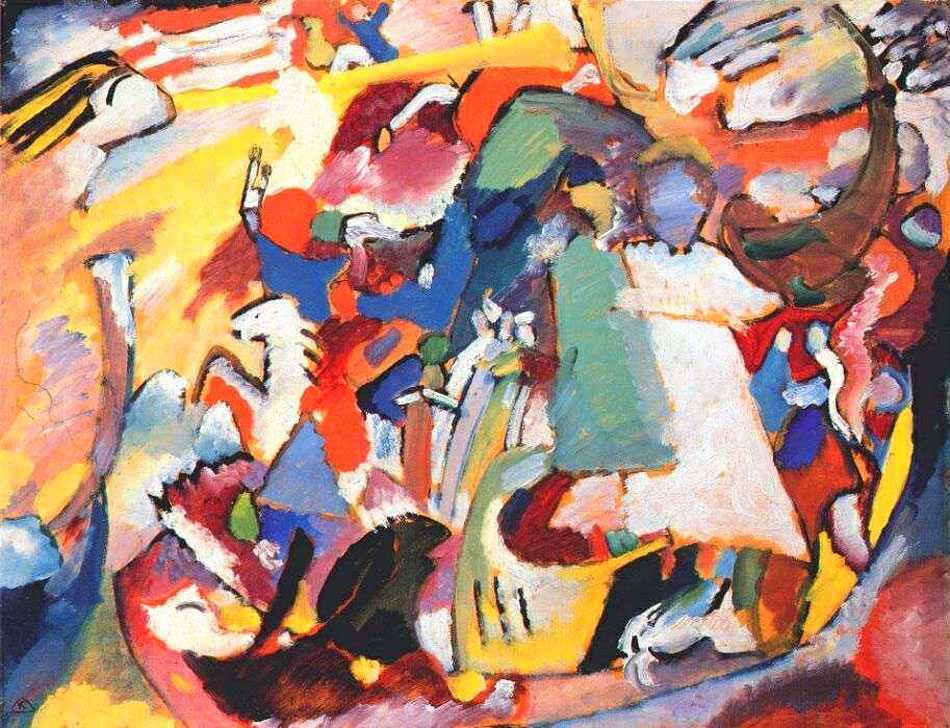
All Saints Day I (1911) by Wassily Wasilyevich Kandinsky


***

1Taken from the "Who's out in the conversation?" lectionary series for All Saints' Day. http://www.hrc.org/scripture/?page=11-01-07

2Peter Storey, "Table Manners for Peacebuilders: Holy Communion in the Life of Peacemaking," Conflict and Communion: Reconciliation and Restorative Justice at Christ's Table, ed. Tom Porter (Nashville: Discipleship Resources, 2006), 61-62.

3Prayerfully Out in Scripture, from All Saints Aren't Dead Saints, http://www.hrc.org/scripture/?page=11-01-07

Biblical quotations are from The Harper Collins Study Bible: New Revised Standard Version. San Francisco: Harper Collins Publishers, 2006.

Believing Out Loud Together

So this post is a while in coming (it is one of those semesters): October 9-11, 2010 was the weekend of the first Believe Out Loud Power Summit, a space in which people from across denominations and secular organizers (! what a crazy partnership!) came together to brainstorm, plan, and organize for change, to make the Christian church inclusive of all of God's children, including those of all sexualities and gender identities. It was also the kickoff for Reconciling Ministry Network's Believe Out Loud Together Campaign intended to change the Discipline, our United Methodist book of laws, in 2012 at our General Conference.

Always be ready to make your defense to anyone who demands from you an account of the hope that is in you.
-1 Peter 3:15


In 2008 I didn't realize just how surrounded I was with progressive Methodists, so I was terribly naive and so was stunned at just how horrible a loss we suffered. I was going to a reconciling church, becoming involved in the global UMC, looking "secretly" at seminaries, and I could not believe the strength and maliciousness of the Right. Here I was thinking that the UMC, though not nearly as welcoming at the Unitarian Universalists or many United Church of Christ folks, was close to being there, and yet, at General Conference, we could not even pass a statement saying "we are not of one mind on the issue of sexuality." That is a sad testimony of the state of Christianity and the United Methodist Church.

But at the Power Summit, surrounded by veterans and new folks of the welcoming movement across mainline denominations, I felt so uplifted. It was a renewal, but one that was focused, one with a purpose and tools to accomplish our goal of an inclusive church. Now, I know I am surrounded by a community that will change things in 2012. And we will hold each other accountable. Because we cannot afford to live under the hateful policy of our church.

One of the moments in the conference where we as United Methodists really saw where our denomination is was when they lined up the denominations in terms of how welcoming they are. The UMC was far behind everyone else because now the Episcopalians, the UCC, the Lutherans, the Presbyterians--- all of these mainline churches have welcoming policies. And the UMC policy is still that homosexuality is incompatible with Christian teaching. To see the differences in polity were striking.

But we also saw how well organized we are compared to many of the denominations. And Rev. Troy Plummer, the executive director of RMN, pointed out that you can change the legislation top-down all you want but will that really change the church? Rather, we ought to be working from the ground up. And we are.

I am going to school in the Greater New Jersey Conference where the lack of reconciling congregations is absolutely appalling, especially given the seemingly general friendliness and openness of most folks towards the issue of sexuality. But openness and friendliness of individuals is not enough. After all, if you aren't deliberately including, you are excluding people. So one of the most important things as organizers in the church that we have to do is get people to believe OUT LOUD together. Seventy percent of clergy say they are supportive of LGBTQIA issues, but only 7 percent have said anything about it in the pulpit. Right now, for us, we need to be focusing on that 63 percent of people who are supportive but not talking. Part of this means creating a supportive network so people don't feel alone when they speak out, but part of it is holding people accountable. Saying that it is not acceptable for us as Christians to stay silent.

Another piece of this work of believing out loud together, though, for me, is that we have to remember, as Beth Zemsky reminded us, that we have learned about difference and about how to make people into the Other through people we love and trust. So that is why we are going about changing the church through stories (see one of mine here). We are about changing the church through relationships, from the ground up.

As Rev Debra Peevey said, the secular world is hiding behind the church, using the church as an excuse for bigotry. And we let them. But I, for one, am not going to let the church be a place of hatred and exclusion. I am committed to changing the hearts and minds of those in my faith community so that when we say Open Hearts, Open Doors, Open Minds, we mean it.
Reconciling United Methodists at the Power Summit!

To learn more about RMN's campaign and some more details about the Power Summit, check out Audrey Krumbach's refection.

Monday, October 11, 2010

Disarmament

So this post is a long time in coming, and I apologize for its lateness, but it has been a crazy semester. Father John Dear, Jesuit priest and activist, came to speak at Drew and I was so inspired by him, I had to write something. This is me trying going back to his words and thinking about what was most meaningful to me.

God will judge between the nations
and render decisions for many countries.
They will beat their swords into plowshares
and their spears into pruning hooks;
one nation will not raise the sword against another,
and never again will they train for war.
-Isaiah 2:4


Father John Dear, Jesuit priest and activist, was arrested after he, along with Philip Berrigan, hammered on the head of an F-15, a nuclear fire-bomber, as a demonstration to show how you can beat your swords into plowshares. Since, then he has been arrested over 75 times in demonstrations against this country's war machine (to learn a bit more, see his interview with Democracy Now!). He says, "Social change happens wen enough people break bad laws." So he continues to break bad laws because he knows what unfortunately so few USAmerican Christians know anymore:

War is not the will of God.


John (he said not to call him Father Dear because that sounds weird) came to Drew to speak on nonviolent action and contemplative spirituality, often seen as opposite sides of the spectrum. But he has come to realize that the spiritual life is the road to peace because peacemaking starts with prayer. It starts with the realization that we are loved. Only then, only after we begin the process of realizing that we are loved can we become peacemakers.

You have to disarm your heart, he said.

I get frustrated with talk of spirituality often because it seems useless to me without some imperative to act. Yet John's life is an example of how looking into oneself and repenting of one's own violence requires us to resist war and the culture of war. It requires us to live vastly different lives--- because the peace we seek is not that of this world. So we need to disarm our hearts of racism, classism, sexism, nationalism, heterosexism--- free ourselves of a world addicted to violence. To beat our swords into plowshares.

John quoted great spiritual leader Father Henri Nouwen, leaving the words to hang in the room as he ended the lecture: "Nobody can be a Christian today without being a peacemaker...Peacemaking belongs at the heart of a Christian vocation."

I wanted to write about Father John Dear because I was so inspired by him. He is a Christian peacemaker. Since I heard his lecture, I have been haunted by the image of him hammering on an F-15. That, for me, is what being a Christian looks like, but it is so far a picture from what I look like.

So as I go forward, I am thinking of ways I can bring my own life as a Christian to better resemble a vocation in which peacemaking is at the center. I hope to join a Christian Peacemaker Team delegation in the next few years. I plan to attend more demonstrations, talk to more activists, really feel that urgency one feels in these public actions. And I will continue to educate myself about the militarism within my community and how we can eradicate it so that my children and my children's children can live in a world where F-15's have been beaten into plowshares, and drones into pruning hooks, one nation will not raise the sword against another, and never again will we train for war.

Monday, September 20, 2010

Limiting God

This past Saturday, I participated in Reconciling Ministries Network's Called to Witness training, part of the interdenominational Believe Out Loud campaign. The following is one of my public narratives* identifying why I am an inclusive Christian.

I have always been a religious person. I grew up a preacher's kid, usually liked going to church--- especially if there were snacks at Sunday school. But God was always just a word to me, an intellectual concept really, until I was sixteen and sitting outside of a bullet-ridden home in a village in southern Bosnia and Herzegovina. It was here, when I was on a United Methodist Volunteers in Mission trip to Bosnia and Herzegovina in 2004, that I saw God, heard God, felt God in all God's messiness and recognized it as God through the person of a seventeen year old girl named Ðana.

Ðana was one of our translators, beautiful with a strong Eastern European accent. My sister Kate, who was fifteen at the time, and I both got along well with her because we were the only young people on the team. However, Kate and I had also never been out of the country before, so we were not used to the food, which concerned our host Saja, who decided we were wasting away. We weren't, but try telling a Bosnian that. So me, Kate, and Ðana went off without the team to Saja's friend's house for a special dinner. On the outskirts of the little town where we stayed, there were many small, stucco homes lining the mountains. Grape vines snaked up the bullet-stained porch and a little table and a few stools sat beneath them. A shy, voluptuous woman had set a few bowls on the table and waved as Saja raced into her driveway.

Kate and I were quiet. We sat down on the stools with Ðana and Saja, smiling and saying hvala (thank you) as our plates were heaped with fruits and vegetables. Saja talked away, with Ðana translating intermittently and the other woman laughing. Being on a strange continent with strange people who didn’t speak our language eating strange, but surprisingly tasty, food should have been terrifying, especially after we had gotten all those "Bosnia? Why would you want to go there?!"s by people at home. But there was a warmth to the evening. Kate and I sat thigh to thigh on a tiny bench and ate lubenica (watermelon) and cantaloupe, listening to the drone of the huge Balkan bugs that zoomed around the porch light as well as the music of the almost-guttural Bosnian language. And in the midst of this, Ðana reached over and hugged us to her.

I love you!

She said.

Ðana, a Muslim woman who had grown up during a war in a country that most USAmericans cannot locate on a map, a woman I had only known for two days--- it was in that moment of her telling us that she loved us that I felt God telling me that God loved me.

Still I am amazed at the path down which such a moment has propelled me. I think it is part of our USAmerican religious narrative that we continually express surprise whenever, for instance, economically poor people demonstrate immense generosity, or people of another faith offer their hands in the peace of friendship. We are so isolated in our social locations** that we cannot imagine God's grace acting through we deem less fortunate. But God continually, constantly, incessantly works through those we least expect. Think of old Abraham and Sarah and their slave Hagar as the parents of nations, think of Moses a bad public speaker as the leader of a people into freedom, think of a foreign widow named Ruth supporting her mother-in-law as the foremother of a great king, think of our redeemer born in a feeding trough for animals.

Yet we as Christians continue to ignore the stories of scripture to reject those through whom God works. We segregate our churches by race and class, we tell women it is God's will that they stay in abusive relationships, we burn Qur'ans. And we deny pulpits and membership to people if they are open about loving people of the same sex. It's like we don't even read the bible.
The bridge in Mostar, Bosnia and Herzegovina, destroyed by people calling themselves Christian in an act of terrorism against the Bosnian Muslim people.

How many have we told that God is incapable of working through them the way, that God worked through Ðana? In what ways have we limited God?

God has shown me grace through a woman who has become my best friend, though we don't share the same faith, citizenship, language. Yet so many in the church work to keep that grace out, either by refusing hospitality to those who are different or refusing to see God's face in one that is not like theirs. The church needs to change. We need to change. To stop our communities from keeping God's presence from moving among us.

I am called to inclusivity because I follow a God who showed me how much I am loved through a Bosnian Muslim woman I had known for all of two days. What kind of God do you follow?

***

*In training, we hone our stories into short testimonies we can share, breaking the silence in a way that is not threatening but often deeply moving. This piece is too long, but, because I am using it here in a blog post, I thought the length could be forgiven.

**Not only are we isolated, but we are so indoctrinated in white imperial heteropatriarchy that we believe the stereotypes promoted by classism, racism, sexism, ableism, homophobia and heterosexism.

Wednesday, September 8, 2010

The tragedy of 9/12

Reflecting on 9/11 and Islamophobia in this country

People say that you will never forget what you were doing when you hear about a national tragedy. I was stuck in the hallway during class change and heard about the planes crashing into the World Trade Center from the lips of immature teenage boys. I didn't believe it. When I got to health class, it was on the TV. We went to lunch early and we're allowed to sit by the windows--- in case of the probable? attack on a rural school in Maryland or something. We went home early. I was 13.

Now, I feel rather removed from the events of 9/11. I didn't know anyone in the state of New York let alone Manhattan. I didn't know anyone in the Pentagon, I didn't know anyone in the plane that crashed in Shanksville, PA. I was never one for patriotism either, particularly after the election of George W. Bush. But, especially today as we approach the anniversary of 9/11 amidst the controversy over building an Islamic cultural center a few blocks away from where the towers stood, I sum up my feelings about 9/11 using the words of slam poets Issac Miller and Christian Drake in their poem "Nine Twelve."

"To be honest, I stopped mourning 9/11 years ago. But I will never forget the tragedy of 9/12, the day we could have become a nation of outstretched hands and were asked only to shut up and salute.The moment we could have proven to our enemies that we are not what they think we are. We were almost America."


We were almost America.

I live in a country today where a "church" in Florida is burning Qu'rans in commemoration of the ninth anniversary of 9/11. Where a New York taxi driver was stabbed for being Muslim. Where a mosque in Tennessee was set on fire. Where an Islamic cultural center is part of a national debate because it has been slated to be built a few blocks from where the two towers were. And I am really struggling to understand how this Islamophobia is acceptable, how it fits with the ideals spouted in our idealistic version of USAmerican history.* The Onion, news satire, poked fun at those who equate Islam with terrorism in a joke article that actually reflects a sad truth:
"I almost gave in and listened to that guy defend Islam with words I didn't want to hear," Gentries [the man who already knows all he needs to know about Muslims] said. "But then I remembered how much easier it is to live in a world of black-and-white in which I can assign the label of 'other' to someone and use him as a vessel for all my fears and insecurities."
A sad but true commentary on what is an acceptable viewpoint among USAmericans today.

Tuesday, we had a chapel service at Drew dedicated to addressing "the mosque controversy." The Christian church bears responsibility in part for this Islamophobia, so the Drew community came together as a community asking for guidance. We sang songs of peace, looked to calls for justice, peace, and unity in the Qur'an, and saw clips from popular media interpreting this climate that we live in. We ended with a reflection from Dr. S. Wesley Ariarajah, our professor of world religions. I want to share two of his points in particular as we come up on this ninth anniversary.

First of all, we must stand up against those who use 9/11 as a tool to manipulate the public. Returning to the poem, if 9/11 could have become a tool of unity and a call for peace but instead became a rallying cry for ultranationalists, an excuse to hate Muslims and people in color in general.

Secondly, when a nation begins to identify minority communities as the enemy, as the problem, we are walking on the same slippery ground that let to the Holocaust. Ascribing collective guilt to a particular group of people is never an acceptable response to tragedy. Never. That is how genocide mentality functions! And we, particularly Christians, need to stand up voice this.

Rather, we need to welcome religious diversity, as a Christian community in Cordova has done. Let's, as Gainesville, Florida, mayor did, declare 9/11 Interfaith Solidarity Day. We need to live what God has commanded of us:

O you who believe, stand out firmly for God, as witnesses to fairness, and let not the hatred of others cause you to swerve toward wrong and depart from justice. Be just, that is closer to piety, and be conscious of God, for God is well-acquainted with all that you do.**


So as anti-Muslim sentiment climbs higher this week of 9/11, let us instead remember the tragedy of 9/12, that time when we could have used our pain for peace but instead shut up and saluted. Let us stand out firmly for God as witnesses to justice in our communities and this nation.


***

*Of course, it does fit with the reality of a USAmerican history of genocide, racism, and colonialism. But that is another post for another day.

**Qur’an 5:8. The Qur'an and Sayings of the Prophet Muhammad: Selections Annotated and Explained. Annotation by Sohaib N. Sultan. Translation by Yusuf Ali, revised by Sohaid N. Sultan. (Woodstock: Skylight Paths Publishing, 2007).

Saturday, September 4, 2010

Supervised ministry angst

Here is my theologically-inflected life update complete with some angstiness. Hey, when you need to write, you need to write. Things make more sense to me after I write them down.

Masters of Divinity students at Drew have supervised ministry in their second year. I have not yet started working at my supervised ministry placement yet, but I am still questioning it. You see, my ministry placement is not a traditional one; instead of working out of a church, I will be working part time out of Protestant Community Centers, Inc. (PCCI), a non-profit that has worked with children and youth in Newark since 1964, and part time out of the United Methodist District office for the Greater New Jersey Annual Conference's Gateway North District on their Urban Initiative Project. The purpose of this placement is to do creative urban ministry, which I am excited for. However, I am still nervous about this choice not to be in a church.

I see the churches as a space of radical potential for living as free people, particularly smaller churches in urban or rural communities. Churches could be a way to make community into family, to live out what it means to be children of God. In this image of church as community (not church-as-entertainment or church-as-assuaging-guilt or church-as-waiting-for-the-rapture which are far more common), the church is a space of action and of accountability. I am relying on liberation theology here, on visioning the church as an Exodus community. So wouldn't I want to take this year of supervised ministry to play around in the church? Why am I not connected to a particular congregation?

Perhaps one reason I was excited about this urban ministry project is fear that working in a church (particularly a suburban one) would kill this utopian understanding of church within me (and Christianity is a pretty utopian religion, when one actually looks at what Jesus taught, so I won't apologize or admit naivete on that one). Churches today are so isolated from one another and the world that it is difficult to live into that vision of freedom, which is why it is important to think of creative ways to link them together. So, though I have my doubts about the effectiveness of non-profits and the United Methodist bureaucracy to do radical work, I think we can use such organizations to help with our healing work. The idea of a connectional system is a good one if we could actually get it to work. And, though I feel as though I'm treading water, unsure of what this year is even remotely going to look like, I know this is a great opportunity to try ministry in a bit of an unusual way.

After all, Jesus' example of ministry was not one in a house of worship, but one that created a house of worship in dissonant situations in the streets, on fishing boats, eating with sinners, and on a cross with other dying criminals.

Monday, August 23, 2010

"God will protect us, even from Sarkozy"

Crossposted at OnFire.

Immigration is not just a USAmerican "problem"

I began to understand the importance of comprehensive immigration reform not in interactions with immigrant communities in the USA, with whom I had little contact despite living in a farming community, but in studying abroad in France and traveling across Europe. In France, I took sociology and history classes that touched on the social impact of migration of maghrébins (North Africans primarily from Algeria but also Morocco and Tunisia)--- a particularly salient issue as there have been riots in these ethnic communities that have received national attention (in 2005 mostly, but this is not new or over--- watch the film La Haine [Hate] for an artistic exploration of this social dynamic). I spoke with my host family and other French people about Islam and immigration. And I began to see how across Western Europe, immigration is a hot button issue--- from the insanity of the border security in the UK (I stood in line once as the only white person in a long line of brown men in Heathrow for "random" security checks--- I was the evidence that they were supposedly not racially profiling), to the debates over whether or not Turkey should be admitted into the European Union, to learning about Turkish immigration to Germany and initial attempts to prevent Muslims from becoming citizens. In October 2008, one of my best friends, a Bosnian woman (so a woman from the "other" Europe and a Muslim---read: not white enough), was supposed to come visit me but her ticket was revoked when it turned out she needed a visa in order to land in Germany twice (she had two layovers in Germany and would have spent a grand total of two hours in the country). So I began to study the insanity of xenophobia (fear of the foreign) in my own country (you can check out some of my reflections here).

The news today turned me back to the mess that is xenophobia in Europe. Last month, French president Nicholas Sarkozy announced mass deportations of Roma immigrants (more commonly, though derogatorily, known as gypsies--- for more of an explanation check out the Slate article called "Why do the Roma wander?").

"Hey, hey Sarkozy why don't you like the gypsies?" (VAMA feat. Ralflo's "Sarkozy versus Gypsy")


This is nothing new, of course: Italy, for example, declared a state of emergency in 2008 "due to the presence of Roma" and, let's not forget, during the Holocaust, the Nazis exterminated 220,000 Roma in its attempt to "purify the race."

And, for the French government, such despicably racist and xenophobic policies are nothing new. They are forever trying to ban the veil and blaming young men of color for everything wrong in the world. Last September, police invaded and dismantled a migrant camp in Calais. This event has stuck with me these past months because I have often wondered where those families went and what it was like to live through such a traumatic experience of loss.

Thursday and Friday, French police began the ethnic cleansing* program, resulting in the removal of some 700 people and a dismantling of 40 Roma camps, according to the BBC. Robert A. Kushen, executive director of the Budapest-based European Roma Rights Centre, pointed out in an interview for the New York Times that "Mass expulsions based on ethnicity violate European Union law...and the failure of France to do individual assessments of each case--- as opposed to cursory examinations of papers by the police--- also violates European Union rules." Sound familiar?

If that does not sound familiar what about this story from the UK's The Guardian:
Although [an unnamed 27-year-old Romaian man] has lived in Marseille since he was child, he still has no papers, and cannot get a job. "This discrimination will not go away. France has become the opposite of liberty, equality and fraternity," he said. Asked about any friends and acquaintances among the 1040 people to have gone home "voluntarily" from Marseille to their native countries since January last year, he said he doubted they would have gone happily. "Even in Romania you had discrimination," he remembered. "No one wants us. There is no place for us. Not in Romania, and not in France."

I read these articles and am constantly reminded of the stories of refugees denied asylum in the USA, of immigrants who arrive in the USA as children and know nothing of their "home countries" and yet are deported, of USAmerican politicians who are attempting to overturn the fourteenth amendment to deny citizenship to USAmerican-born children of immigrants. Xenophobia is not exclusive to the USA, which is something we must remember as we are fighting for comprehensive immigration reform in our own country. The reason for the French government's stance on immigration is an appeal to the populist vote--- much like the increase secure-the-border furor in the USA. This is a problem across the world--- and not just in the global North: in South Africa, for example, there have been violent attacks against immigrant communities. While we do need to focus on policy and reforming immigration law step by step in the USA, we need to be thinking globally of how we can create a world in which we welcome strangers rather than demonizing them.

"Come, you blessed of my Abba God! Inherit the kindom prepared for you from the creation of the world. For I was hungry and you fed me; I was thirsty and you gave me drink. I was a stranger and you welcomed me; naked and you clothed me. I was ill and you comforted me; in prison and you came to visit me...The truth is, every time you did this for the least of my sisters and brothers, you did it for me."**


***

The title of this blog, comes from a quote in a New York Times piece from Ioan Lingurar.

* I know a lot of activists reject using the term ethnic cleansing when talking about Arizona's SB1070 and other anti-immigrant policies because its connection to the Bosnian genocide such a term brings with it. I am not suggesting that we forget that the term ethnic cleansing served as a euphemism for genocide. However, I am asking that we look at the definition of ethnic cleansing--- the forced removal of an ethnic group from a geographical area--- and use the weight of the term to name the reality of anti-immigration policies like France's.

**Matthew 25: 34-36,40, The Inclusive Bible: The First Egalitarian Translation, Priests for Equality (Sheed and Ward 2007).


***
UPDATED November 9, 2010 with the "Sarkozy versus Gypsy" song.

Sunday, August 22, 2010

Cleared for take off

I have flown commercially often, and have been in quite a few smaller planes used to go back and forth from Bosnia and Croatia or from one island in Hawai'i to another. These smaller plane experiences have not been my favorites as the pressure changes are horrendous, the seats are far too cramped, and the plane seems easily tossed in turbulence. So the chance to fly in an even smaller aircraft, one that seats four people, was not one I had always dreamed about. Yet, this week I found myself in a Mooney M20 and loved it! I thought I would write a little bit about the experience to kind of shift gears from political issues (though of course, everything is political, and I can't fly without noticing class dynamics) to just share the experience of being in flight, of "partaking in the miracle of flight."


Aaron Harrington, the person with whom I've shared the last seven and a half years, has wanted to fly since his grandmother brought him to a little airport in Laurel, Maryland, every Friday as a kid. They used to eat tuna fish sandwiches and watch the planes take off and land. She created a monster, really--- he eats sleeps breathes airplanes and has since then. We watch movies about airplanes, he reads books about airplanes, he got his Bachelor's and is working on his Master's in aerospace engineering. And as soon as he had enough money to begin taking lessons to become a pilot, he jumped at the opportunity. After several months, our schedules finally clicked and I was able to go with him on one of his lessons with his kick-ass instructor Nizar Bechara (I would like to write this man's biography one day) of Royal Air FlightTraining.

I was expecting the flight to be, well, rather rough. I don't know why, but I was expecting it to be a lot more like perpetual turbulence would feel in a bigger airplane. I grabbed a handful of hard candy on the way out to the plane and popped one in my mouth as soon as the engine was on, but it was totally unnecessary this time around. It was a beautiful flight. It was Aaron's first time flying a complex aircraft (ask him to explain the difference), so there were times when I could tell he was just trying to get used to the way the plane responded to him, but honestly, I was too busy gawking out the window as we flew along the eastern shore of Maryland. I loved looking at the shape of the earth, where it met the water, even seeing the leaves on the trees as we began descending a bit. And on the way back, I really enjoyed being so close to the ground we could see everyone's pools! I love traveling that way.

Some people asked if I was afraid or flying, especially in such a small aircraft. Fear was never an emotion I encountered flying--- I was with Aaron and he was flying, which is what he likes best in the world! In fact, I was so comfortable that with the added the gentle vibrations of the plane and the sun warming the cabin, I almost fell asleep!

Flying this way, surrounded by windows so you can see on all sides, is amazing. I feel like before in a bus or train, I was looking at pieces of a huge painting close up, but, in the plane, I am able to see just how beautiful the picture is when all the pieces are put together.

Friday, August 13, 2010

we keep our confessions long, but when we pray we keep it short

There is no experience quite like a concert. Live music does something to a person. Tuesday night I to the Ottobar in Baltimore to see (one of) my favorite band(s) mewithoutYou (and got the added benefit of hearing Buried Beds and Murder by Death open). Always after going to a good concert, I feel more whole--- not whole in the sense of complete, but whole in the sense that implies some kind of healing has taken place. Art does that.

Now my friends often comment that the art I like is horribly depressing, and this is certainly true. mewithoutYou's early work especially is most certainly not happy (though their latest album is decidedly more uplifting). I think I am drawn to the sadness because there is realness to it that is not found in much popular culture entertainment. The sadness is just part of what it means to live in this world post-Holocaust, post Vietnam. We need to break out of the apathy of this culture in which we live, and good art--- particularly that which confronts us with our own brokenness--- can help us do that. When I was younger, I used to want to be a politician because I wanted to change things, but as I got older I realized it wasn't the politicians who make change. It is artists who are the prophets of change, who can galvanize people to move. So even when the images described by music, poems, paintings are horribly depressing there is a healing to real art, I think, because of the truth within it.

Here is an example of what I mean. Samuel Bak is a prolific painter and a survivor of the Holocaust. He has worked on a series of paintings based on the picture of the Warsaw ghetto boy (check out this article [PDF] about it). When you look at these images, you don't feel warm and fuzzy inside the way you might looking at entertainment. That isn't healing. But Bak's work gives voice to the horror that is genocide in a way that touches me deeply. He reveals our brokenness and forces us to face it. Now Bak is not an artist who suggests solutions to our brokenness but his art does hold us accountable to the horrors that we have committed. Healing cannot happen without this accountability because it is the beginning of the path to reconciliation.

mewithoutYou has touched me in a similar way on this path to reconciliation. Even since my friend David introduced me to them, I was relieved to find religious art that was not shallow the way praise music (which is not art) is, but that dipped into doubt, into the struggle of being human. This is intensified live, even in the happy songs from it's all crazy! it's all false! it's all a dream! it's alright!. Though I love singing in church, even good old hymns full of bad theology, I can never just raise my hands in worship the way I did when mewithoutYou played.


Messes of Men*

"I do not exist," we faithfully insist,
sailing in our separate ships and from each tiny caravel---
tiring of trying, there's a necessary dying,
like the horseshoe crab in its proper season sheds its shell

such distance from our friends,
like a scratch across the lens,
made everything look wrong from anywhere we stood
and our paper blew away before we'd left the bay
so half-blind we wrote these songs on sheets of salty wood
caught me making eyes at the other boatman's wives
and heard me laughing louder at the jokes told by their daughters
I'd set my course for land, but you well understand
it takes a steady hand to navigate adulterous waters

the propeller's spinning blades held acquaintance with the waves
as there's mistakes I've made no rowing could outrun
the cloth low on the mast like to I say I got no past
but I'm nonetheless the librarian and secretary's son
with tarnish on my brass and mildew on my glass
I'd never want someone so crass as to want someone like me
but a few leagues off the shore, I bit a flashing lure,
and I assure you, it was not what I expected it to be!

I still tastes its kiss, that dull hook in my lip
is a memory as useless as a rod without a reel.
to an anchor-ever-dropped-seasick-yet-still-docked
captain spotted napping with his first mate at the wheel
floating forgetfully along, with no need to be strong,
we keep our confessions long, but when we pray we keep it short
I drank a thimble full of fire and I'm not ever coming back
Oh, my G-d!

"I do not exist," we faithfully insist
while watching sink the heavy ship with everything we knew
if ever you come near, I'll hold up high a mirror
Lord, I could never show you anything as beautiful as You


I felt more whole, even among all the sweaty, tattooed people crammed into the Ottobar. Because there is a truth to the words, to the way Rickie Mazzotta, framed up there on stage by a kind of sweat halo as David says, throws his whole body into drumming to the way Aaron Weiss bends awkwardly over the microphone...I can feel it. The last song, "In a Sweater Poorly Knit," people emptied the floor to get up on the stage until the stage was full, everyone singing “I do not exist, I do not exist, only You exist." It's a healing that helps you wake up, even if it's only for a few minutes, from a world where so many of us feel alone, feel guilty for doubting, feel powerless. Art is healing in the way it can help knit us--- an individual us, yes, but ultimately a collective us) back together. It's like we drank a thimble full of fire and we're not ever going back.

***

*Didn't find many good live versions of this song (too many shaky videos with bad sound), but this is a pretty awesome performance!

Monday, August 2, 2010

To be liberated creatures committed to the freedom of humanity

Crossposted at the Beatitudes Society blog.

Reflecting on what I mean when I claim for myself the name Progressive Christian*

According to a Gallup poll released this month, 54 percent of adults nationally are unsure of what the word “progressive” means. Add the word Christian after it, and I'm sure people become even more confused. These past eight weeks I have been working through what it means to be a progressive Christian with six other Beatitudes fellows in DC. Defining progressive Christianity is perhaps an impossible task but I am going to explore here what I mean when I claim that name as my own.

Progressive Christianity is, as I understand it, a movement of the Spirit. It is a radical renewal that points us back to our roots (radical) to better seek the kindom of God. The vision of the kindom on earth as it is in heaven (Matthew 6:10), Jesus Christ's call to live abundantly (John 10:10), seeking the shalom of the city (Jeremiah 29:7)--- this, for me, is what drives progressive Christianity. We hold onto the idea that we as Christians are called to work within this world for social change.

This radical vision is a rejection of the Christian voice that has within my lifetime been the primary voice in the USA--- that of the religious right. The religious right is a criminal distortion of the Christian faith in so many ways because it has become merely a way to anchor USAmerican imperial, white, male, middle and upper class hegemony rather than a movement that follows the teachings of the historical Jesus of Nazareth. I reject the idea that salvation is only individual, or the idea that being a Christian is defined by opposition to abortion and non-normative sexuality and a blind support of free market capitalism. I claim the name progressive Christian in part to separate myself from this blasphemy.

Progressive Christianity as a movement really came out of the horror of the 2004 election. People of faith woke up and realized that the outcome of the election had been dominated by voices of the religious right--- voices that did not speak for so many of us. This is when organizations like Faith in Public Life and the Beatitudes Society emerged to work together to voice this opposition to the nationalism, militarism, racism, and materialism of the religious right. It was a revival, God's answer to our plea: “Won't you revive us again, so that your people can rejoice in you?” (Psalm 85:6).

Though there is still much to do, the tide has turned. Rev. Jim Wallis of Sojourners, a leading voice for progressive Christians points out that the religious right peaked in 2004, but now the religious right has lost its children because so many young folks are more interested in reclaiming the social justice in the gospel message than participating in the culture wars over abortion and sexuality.

This reclamation of the gospel message of social justice is not, for me, centered on favorite lefty scriptural passages like the Lukan blessings and woes 6: 20-26 (the more radical version of the Beatitudes), but rather on the greatest commandments described in Matthew 22:37-39.
You must love the Most High God with all your heart, with all your soul, and with all your mind. That is the greatest commandment. The second is like it: You must love your neighbor as yourself.


Within these two commandments is a threefold love of God, self, and neighbor that is central to living the kindom vision of the Gospel. The Phoenix Affirmations are a beautiful progressive creed of sorts that are organized according to the greatest commandments. I will highlight three of these affirmations to illustrate:

Loving God includes: Celebrating the God whose Spirit pervades and whose glory is reflected in all of God's Creation, including the earth and its ecosystems, the sacred and secular, the Christian and non-Christian, the human and non-human. (Affirmation 3)
We live in a disconnected culture in which we are often blind to the ways in which God is manifest in everything around us. Progressive Christianity recognizes God’s movement among us, even in spaces like the environment that have been devalued in the evolution of Christian tradition.

Loving our neighbor includes: Standing, as Jesus does, with the outcast and oppressed, the denigrated and afflicted, seeking peace and justice with or without the support of others. (Affirmation 6)
Our God is the God of the oppressed. We see that over and over throughout the Hebrew and Christian scriptures. Progressive Christianity puts this revelation back into the definition of what it means to follow Jesus Christ.

Loving ourselves includes: Claiming the sacredness of both our minds and our hearts, recognizing that faith and science, doubt and belief serve the pursuit of truth. (Affirmation 10)
Progressive Christianity is a movement that does not demand compartmentalization of body and spirit in order to participate! Particularly moving to me here is the mention of doubt. When I claim the name progressive Christian, I am acknowledging that I doubt. We have grown up being told that doubt is negative, but I believe that the moment you stop doubting, you have let a vital revelation slip through your fingers.

My exploration of what I mean when I talk about progressive Christianity is constantly evolving. My own understanding of progressive Christianity is that it is (a) movement. But what I have written today is my first attempt to put it to paper. I am always looking for new language through which to understand my relationship with God, so please engage me here.

I want to end with James Cone’s definition of being a Christian from God of the Oppressed because I think it says hauntingly what I am stumbling to find my own language to say here.


To live as a Christian simply means being what God has made us, namely, liberated creatures committed to the freedom of humanity.


***

All scripture passages are quoted from The Inclusive Bible: The First Egalitarian Translation, Priests for Equality (Sheed and Ward 2007). The last quotation comes from James H. Cone, God of the Oppressed (Harper San Francisco 1975), 207.

*This summer I am a Beatitudes Fellow at Faith in Public Life. The Beatitudes Society is a progressive Christian resource center for and network of faith leaders that offers seminarians like me internships at key national social change organizations. Faith in Public Life is one of those organizations, focusing on "advancing faith in the public square as a positive and unifying force for justice, compassion and the common good," a lot of which is in making the progressive faith voice audible in the media. I believe God has called me to parish ministry, yet I felt strongly that I needed experience outside of parish ministry if I want to be an effective pastor working for a just world. I have not been disappointed with this decision.

This is my final reflection on this experience and I dedicate it (yes, I know that sounds hokey, but this reflection comes from so many of our discussions this summer) to the six other DC Beatitudes Fellows of 2010.