Tuesday, July 5, 2011

Seeking Shalom

This is a sermon I preached July 3 at the combined worship service for Delta and Bryansville United Methodist Churches. These churches are involved in the Tri-Village Shalom Community of Delta, Cardiff, and Whiteford, with whom I am interning along with the York City Communities of Shalom this summer, and so I preached on the concept of shalom and designed a kind of shalom service for them.

It was a difficult sermon to write first of all because I have preached rather infrequently from the Hebrew Scriptures. But more than that it was difficult because though I see the beauty in the text, it is a letter to a people being ethnically cleansed--- and Jeremiah is telling them that it is punishment but that they are to make the best of it and use it for good. It is like all those places in scripture where we read God has a plan for us, and we realize that such a thought is less a comforting thought than a time to question that if God really has these sorts of violent plans for us do we really want to worship that kind of God? And this is not an aspect of the text I confront in this sermon. I chose the text because we use it as the Communities of Shalom scripture. I just say all of that to let you in on the struggle and acknowledge that there is a dark side to this text that I shy away from. What made it easier was using a story I've used in sermons before, but I figured that I might as well reuse my favorite stories now since I won't be able to when I am preaching in the same church every Sunday!


Call to Worship: A Litany of Shalom by Ruth Duck
ONE: Two things we know about the vision of shalom. Shalom is a gift to us from God. And Shalom is our mission.
ALL: Shalom is a personal relationship between God and all God's earthly children.
ONE: Shalom is the home that we seek, the goal of our spiritual journeys, and the valley of our delight.
ALL: Shalom is our sense of security, of being cared for and loved.
ONE: Shalom is the source of our courage and strength for which we so earnestly yearn.
ALL: Shalom is the harmonious relationship with God, which then expresses itself in our thinking, feeling, and doing with ourselves, others, and God.
ONE: Shalom is reconciliation: a body and soul become whole, a house once divided becomes a home again, the lion lies down with the lamb.
ALL: Shalom is justice for all that we so easily forget when we are in control.
ONE: Shalom is our Christ, God's Hoy Child, whom we crucify and bury, but who will not die.
ALL: Shalom is a gift to us from God. Shalom is our mission.

Scripture: Jeremiah 29:4-7 1

(NRSV, adapted: This scripture comes from the prophet Jeremiah. I will be reading from the New Revised Standard Version, but I have adapted it by “untranslating” to include the original word shalom. As we read in the opening litany, the Hebrew word shalom is a rich rich word for which we have no good translation. So we translate it many different ways. The dean of Drew Theological School, Jeffery Kuan, says that shalom is one of those Hebrew words you should never translate because so much gets lost in translation. So look over your shalom litany again and recall those definitions here as I read our scripture this morning.)


Thus says the Lord of hosts, the God of Israel, to all the exiles whom I have sent into exile from Jerusalem to Babylon: Build houses and live in them; plant gardens and eat what they produce. Take wives and have sons and daughters; take wives for your sons, and give your daughters in marriage, that they may bear sons and daughters; multiply there, and do not decrease. But seek the shalom of the city where I have sent you into exile, and pray to the Lord on its behalf, for in its shalom you will find your shalom.


Children's Sermon: Check out Enemy Pie by Derek Munson about a little boy who gets rid of his enemy by making him his friend. It fit in well with trying to figure out what it means to seek shalom in exile.

Sermon: Seeking Shalom

Will you pray with me?
Patient Teacher,
We give thanks this morning for this time to come together and worship.
And we ask for you to stand with us today, to let these words from my mouth
and the meditations of all our hearts show us what your shalom really means. Amen.

This is a beautiful scripture that we read from the prophet Jeremiah this morning, but it is a difficult one. Sometimes the Gospel stories are difficult because Jesus' time just seems so totally different from our own, so far from our own, but here we are reading something written over 500 years before Jesus' birth! Who was this Jeremiah guy and what was this exile he's talking about anyway? We don't really learn the very ancient history of Israel in one of our high school history classes, after all. So this seems as good a place as any to start to figure out what is going on here.

The book of Jeremiah is Jeremiah's witness to the destruction of Israel by Babylon and the beginning of the Babylonian exile. Jeremiah is a priest, not a bullfrog in case some of you were wondering. For forty years, Jeremiah was a priest and prophet who led Israel, who pastored them through this painful and terrifying period of Israel's history. What we read today is a part of a letter written by Jeremiah to the exiled community, an attempt to breathe a little hope into their despair.

But what Jeremiah tells them is not what they want to hear.
Build houses and live in them; plant gardens and eat what they produce.
Take wives and have sons and daughters; take wives for your sons, and give your daughters in marriage, that they may bear sons and daughters; multiply there, and do not decrease.

Here the exiles are, waiting. They are waiting to see how God is going to liberate them from their Babylonian oppressors. I imagine them sitting alongside the dusty road, their bags still packed. They are watching, waiting, suspended in the moments since being dumped there in Babylon. But they aren't just waiting for something, anything to happen; no, they are waiting to return to Israel. So when Jeremiah's letter gets to them, when they hear God wants them to settle down, can you imagine their horror? They want to go home, but God is telling them to make this new, foreign place their home by building homes and growing food and getting married. But this is not just any new, foreign place: this is the place of their exile, the home of their oppressors, of their enemies.

Jeremiah's message is not a revolutionary one, folks. Jeremiah wasn't telling the Israelites to stand together and revolt against the tyrants who forced them into exile. That's really difficult for me, personally. I want stories where Moses is standing up to Pharaoh, saying "Let my people go!" I want Jesus in the Temple turning over tables and throwing out the money lenders. But in this particular place and time, God has given Jeremiah another message to share with the exiled community:
But seek the shalom of the city where I have sent you into exile, and pray to the Lord on its behalf, for in its shalom you will find your shalom.


Shalom. We have already talked a little about this word this morning (see the litany above). Translators have used all of the following English words to describe shalom: welfare, completeness, to cause to be at peace, to make peace, peace offering, at rest, at ease, secure, safe, to prosper, to be whole.2 And it is this word heavy with meaning for holistic living, peaceful living that Jeremiah uses here in his letter to the exiles. He is not saying, just build houses and duck your heads down and plow on ahead through the exile: he is saying build houses and while you do, build God's beloved community right there in exile. Rather than longing for the past, rather than waiting for God to do something Exodus-style like send plagues upon the enemy until they throw in the towel and send the Israelite's back to their homes, Jeremiah called the exiles to live as God’s people where they find themselves, whether it is a time and a place and a circumstance of their own choosing or not.3

Not many of us today in this room this morning know the pain of exile the way these Israelite's did. Dr. Wil Gafney, translates verses two and three of this chapter, which we didn't read this morning because the names are unfamiliar and a little confusing, into our own terms: "Our national government has just collapsed as the result of an invading foreign power. There is no remnant of the military. There is no government. The President, First Lady, Cabinet, and Congress have all been exiled. All of the artists in New York and steel workers in Pittsburgh were separated from their families and exiled as well." We have not experienced such an upheaval here in Delta, though there are so many places around the world suffering such a fate. Many of us have roots deep in Harford County and South Central Pennsylvania and cannot imagine building house and planting gardens elsewhere.

But I think perhaps we know what it is like to feel isolated and alone, to feel that all of what we were certain of has been taken away whether through our own sin or someone else's, or just some catastrophe. Some of us know what its like to live in a hostile environment, as well, whether it be in our own home or in our neighborhood. Often, it is easy to just put our heads down and plug along. It is easy to keep isolating ourselves.

So when we read Jeremiah, it speaks to us even though we are outside of this context of exile. When we read Jeremiah's letter and see God calling us out to live in community, we want to be incredulous, check God's forehead to see if God's sick, you know? It is just a crazy thing to demand of us, to go out and build community among people we don't even know or even consider to be enemies. But here we are, sitting around miserably as those exiled Israelites were on the side of the road, bags still packed, and we realize that we have to make a change in the way we have been living or we will continue to be miserable.

As Christians, we are a people called to abundant living as Jesus said in John 10:10, "I came that they may have life, and have it abundantly." God through Jeremiah was calling the Israelites to abundant living too. That's what shalom is about; shalom is abundant living. It is about looking at the circumstances around us and instead of retreating inside ourselves, shutting ourselves off from everyone around us, we live as God's people by building God's beloved community.

One of the stories I keep coming back to that really illustrates for me this call from Jeremiah to seek the shalom of the city where I have sent you into exile, and pray to the Lord on its behalf, for in its shalom you will find your shalom, comes from Peter Storey, a Methodist Bishop from South Africa. Many of you may remember apartheid in South Africa, the racist system of white governance over the majority back Africans. It was a terrorist government, really, forcing all people, black and any whites who thought the system was wrong, to live in fear. Hear this story from Bishop Storey in his own words:

"I once received a phone call," Bishop Storey writes, "in the early hours of the morning telling me that one of my black clergy in a very racist town sixty miles from Johannesburg had been arrested by the secret police. I got up and drove out there, picked up another minister and then went looking for him. When we found the prison where he was and demanded to see him, we were accompanied by a large white Afrikaner guard to a little room where we found Ike Moloabi sitting on a bench wearing a sweatsuit and looking quite terrified. He had been pulled out of bed in the small hours of a freezing winter morning, and dragged off like that. I said to the guard, 'We are going to have Communion,' and I took out of my pocket a little chalice and a tiny little bottle of Communion wine and some bread in a plastic sachet. I spread my pocket handkerchief on the bench between us and made the table ready, and we began the Liturgy. When it was time to give the invitation, I said to the guard, 'This table is open to all, so if you would like to share with us, please feel free to do so.' This must have touched some place in his religious self, because he took the line of least resistance and nodded rather curtly. I consecrated the bread and the wine and noticed that Ike was beginning to come to life a little. He could see what was happening here. Then I handed the bread and the cup to Ike because one always gives the Sacrament first to the least of Christ’s brothers or sisters— the ones that are hurting the most— and Ike ate and drank. Next must surely be the stranger in your midst, so I offered bread and the cup to the guard. You don’t need to need to know too much about South Africa to understand what white Afrikaner racists felt about letting their lips touch a cup from which a black person had just drunk. The guard was in crisis: he would either have to overcome his prejudice or refuse the means of grace. After a long pause, he took the cup and sipped from it, and for the first time I saw a glimmer of a smile on Ike’s face. Then I took something of a liberty with the truth and said, 'In the Methodist liturgy, we always hold hands when we say the grace,' and very stiffly, the guard reached out his hand and took Ike’s, and there we were in a little circle, holding hands, while I said the ancient words of benediction, 'The grace of our Lord Jesus Christ, the love of God and the fellowship of the Holy Spirit, be with us all.'"5

This story for me is evidence of what living shalom looks like in exile. It isn't about giving in, but it isn't about taking up arms either. It is about finding your shalom by praying for your enemies and by helping them find theirs. Here, the Bishop was a patient teacher of this white Afrikaner guard, seeking his own shalom and Ike's shalom through leading the guard to live more abundantly. Despite the horror of the apartheid system, the Bishop used such a little action, communion--- a simple life-giving action like building houses, planting gardens, and getting married--- to act our what it looks like to be part of God's people even in an ugly time. This is an example for us as we seek our shalom wherever we are. Again, we see how we are called to live as God’s people wherever we find ourselves, whether it is a time and a place and a circumstance of our own choosing or not.6

We see this morning in Jeremiah, in this example from Bishop Storey, our interconnectedness, which is where the revolutionary message is in this text. This is a new way of living for us, this way of shalom, and it is counter to the way we have been living. And those of you who have heard about Communities of Shalom, the grassroots, faith-based, community development network, know that this is what we are trying to do. We recognize that to live abundantly as Jesus called us, we can't just sit at home, or go to church, without reaching out to the community around us, without actively praying for them, building relationships with them, learning to love them until there isn't an us and them anymore, there is just one community.

Let us pray,
Gracious and loving God,
We give thanks for the opportunity to glimpse your message of love this morning.
Pour your Holy Spirit on us gathered here, enable us to live out that message,
to seek the shalom of the city wherever we are,
to be the people of God in all times and places. In Jesus' name we pray. Amen.


Thursday, June 23, 2011

Ants in My Pants

"Doubts," Pastor Judy Walker at Delta United Methodist Church announces Sunday morning, "are the ants in the pants of faith. They keep it awake and moving." She was quoting Frederick Buechner and preaching on a little piece of Matthew 28:17: "but some doubted." Matthew 28:16-20 is usually called the Great Commission, the story in which Jesus tells the Eleven to, "Go therefore and make disciples of all nations." But before Jesus commissions the Eleven, we see that not everyone believed that he had resurrected from the dead. And Pastor Judy focused on that, knowing that so few of us have heard it admitted in church that some doubted. Some still doubt. I shivered a little when I realized that she was preaching on the merits of doubt for faithful people: my answer to the provisional membership question for United Methodists seeking ordination concerning my personal experience of God was about the importance of struggle in my faith journey, and I even compared myself to Doubting Thomas, wanting to place my hands in the wounds of the Resurrected One.

But then Pastor Judy asked us to write down on a note card we had in our bulletin our answer to the question: What are the ants in your pants? There are times when naming holds a crushing kind of power, and naming through written word holds even more of that power for me. So here I am, preparing to be ordained in the Church, doing community organizing for a summer internship out of churches, thoroughly enjoying seminary, attributing my radical politics to my faith, and yet the first question that comes to my mind, the question that I have really been struggling with since first recognizing my call to ministry, is

What difference does Christianity make?

Notice that my question is not about if God's really there or who this Jesus guy is. It's not "What difference does Christ make?" I was thinking about why this was the other day while I was listening to mewithoutYou, and in "The Sun and the Moon," Aaron Weiss sings, "I used to wonder where you are. These days I can't find where you're not." That is how I feel. I have not always felt that way, certainly, and probably will not always feel that way, but now I can usually close my eyes and breathe in deeply, and then when I open my eyes again I see God in the laughter of a baby or the purring of a cat or in the mountains or even in the eyes of my sisters. Finding God is not the problem. I see God all the time, whenever I open my eyes even half-way--- the problem, for me, is that I often have difficulty seeing God in the Church.

In the sermon "Causes of the Inefficacy of Christianity" on Jeremiah 8:22, a heartbreaking sermon written later in his life, John Wesley asks, "Why has Christianity done so little good in the world?" He saw, as so many of us have seen and continue to see, that despite the teachings of Jesus that show us a new way of living together, a way of wholeness and love, our world is just as unjust, as oppressive (if not worse) today as it was over two thousand years ago as Palestinians struggled under the yoke of the Roman Empire. But I think we have to expand the question out even more: not only why has Christianity done so little good in the world, but why has Christianity done so much evil in the world? People who call themselves Christians can often be such ugly people. I can often be such an ugly person, you know? So what's the point? What's the point of this whole organized Christianity thing if it is often the author of the ugliness in the world?

This is not a question I want to be asking myself as I seek to become a pastor.

And I can't end this blog post with an answer. I did not have some magical revelation that made Christianity, that made the Church, make more sense to me this week. I still hurt when I am rummaging through my bag and find that folded up piece of paper. I don't even read the question, but I see it in my mind, staring at me, asking me, What difference does Christianity make? But, though I still doubt, my heart was touched this week, soothed just a little bit so I don't hurt quite so much when my thoughts return to that question. And this story might not soothe you, but here it is.

On Wednesdays, I volunteer to work with the elementary school kids at York City Day Camp. I am super awkward with kids, though I love them, because I have always just let Kate and Suzanne work their magic on kids and considered myself not gifted in that department. Also, I am not even a little bit cool. So I usually let the kids make the first move, let them decide if they like me before I try and just get disappointed. Luckily for me younger elementary school kids are much more gracious to the uncool, and so I found myself sitting at breakfast with a bunch of six year olds who decided that we were friends. They just kept talking and laughing and being cute until one little girl started to sing. And then the rest of them joined in. It took me a moment to register what she was singing. It wasn't a silly song, it wasn't a camp song, it wasn't an upbeat praise song either. No, she was singing "Sanctuary."

Lord prepare me to be a sanctuary,
pure and holy, tried and true,
with thanksgiving, I'll be a living sanctuary,
for you.


Thank God I did not cry because then I would have really given away how uncool I really am, but I did choke up. See, I learned the song "Sanctuary" when I was in Bosnia and Herzegovina the first time in 2004. I always associate that song with my first intense spiritual experience, when I was assured of God's love for me (which I have written about here and here). And here were these children singing this song out of the blue in their slightly off-key fairy voices. I usually don't have as strong a reaction to the song when I hear it in church, but I had never heard it coming from just children before--- it's not one I've usually heard taught to kids, though they had learned it last year at the Day Camp.

And I don't know what it means, but now every time my fingertips brush against that folded-up index card, I hear those little fairy voices singing about being living sanctuaries. And maybe that's enough for me in this moment.

Saturday, June 18, 2011

Reviving the Stones

Every time I land at the airport in Sarajevo, the same thing jumps out at me when we land. The buildings there are filled with holes, silent witnesses to a war that happened fifteen years ago. You drive along the road south from Sarajevo to Mostar and you still see damage from the shelling in town after town.

But the difference between Bosnia as I know it today in 2011 and back when I first visited in 2004 is huge. While there is still a heavy police presence in places like Sarajevo, gone are the SFOR and EUFOR troops that were around every corner in 2004. There are more roadsigns, better roadsigns. And there has been rebuilding. Though the bank remains as it did then, a skeleton, the old Turkish bath house has been rebuilt, though what it is now I don't know. And 2004 itself marked an important milestone in the rebuilding when the Mostar Bridge, a bridge that stood as a symbolic link between the Croatian and Muslim sides of the river, was rebuilt. I had thought for some strange reason when it reopened that they had fished the old stones from the river and used them to rebuild the bridge when in actuality they used stones from the same quarry, but I still like to think of those stones as bathed clean by the river. Indeed, the rebuilding of the bridge reminds me of how Nehemiah organized the people to rebuild the wall in Jerusalem, restoring Jerusalem: they have revived the stones out of the heaps of rubbish--- and the burned ones at that (Nehemiah 4:2).

But in the process of rebuilding, stones are not the only things to be revived but it is people who must pick up the burned and ravaged pieces of themselves and their homes to rebuild their lives. One of the ways communities are rebuilt comes through weddings. Coming from a culture of Say Yes to the Dress and Bridezillas, seeing a wedding as rebuilding is not a natural way to see a wedding. Weddings are usually productions to entertain (though sometimes also to celebrate). But Đana and Enis' wedding was different. It was a coming together of families and the community.

Now I don't want to completely idealize this wedding. The culture is patriarchal (as ours is) and one of the places in which that plays out most is in weddings. Women move to live with their husband's families the majority of the time, and the ritual reflects that. But all in all, the focus on coming together in this wedding, traditional though it was, really overpowered those more patriarchal elements. The party starts at her house. She waits in a room, visited by neighbors and family all congratulating her, but she stays in the room until family members from his side come to bring her out of the room (where they also give money to her family) and out to the front porch of her house where they have a banquet for her family and friends. Then, she leaves with her witness and her fiancé and his witness and the rest of his family who came to get her and they begin the journey to his home, where they will have the religious and civil ceremonies followed by the reception.

And it is a long day of eating and more eating. But it was such a cool drink of water as I think about Aaron and I getting married soon. Despite the fact that Suzanne got a little snippy because she didn't eat all morning and then we didn't know who was driving us to the wedding, this day seemed more stress-free, more community oriented than ours (as portrayed in the media) are. Đana didn't have to make any food (which was good because the week leading up to the wedding was filled with people coming to visit her until almost eleven in the evening!) or decorate, friends and family chipped in. It was a real coming together, which was important to everyone since Đana is such a presence there in their village near Mostar. She will be missed so much, and she will miss them so much, though she will probably be back often.


The whole day just felt as though we were all coming together to build something. Taking pieces of ourselves and offering it forward to the community. All night Suzanne and I laughed, sitting with Đana's cousins, taking funny pictures and drinking juice and eating cheese. It might sound weird to say it, but it was a spiritual experience for me. That laughter was an indicator of how different life could be, about how even when life may be sad, joy breaks through. Always. And I guess why this metaphor from Nehemiah of reviving the stones was so important to me was because I really felt run down after a year of taking too many classes, being too far away from Aaron, and having a challenging supervised ministry assignment. This wedding felt like not only a creation of Đana and Enis's new family, but it felt like Suzanne and I were drawn in too. I already had seen all of these people as my family, but the wedding felt as much a joining of my family with theirs with the way Suzanne was welcomed as a joining of Enis and Đana's families. And I needed that.

When the wall around Jerusalem was rededicated, the book of Nehemiah tells us that, "The joy of Jerusalem was heard far away" (Nehemiah 12:43). Đana and Enis' wedding was a day in which our joy was heard far away, I think. And many people around the world, from Bosnia and Herzegovina to Norway to Chicago to Maryland to South Carolina entered into that joy as well.

Sunday, May 8, 2011

In the Breaking of the Bread

So I know last month I said was my last sermon at Bernardsville United Methodist Church in New Jersey, where I have been preaching once a month as part of my supervised ministry, but I was lucky enough to preach another Sunday. I give thanks for the wonderful people at that church for loving me and welcoming me. They gave me a going away gift and were just so affirming! And I thank Rev. Dr. Tanya Linn Bennett, my supervisor, for inviting me to be a part of this church community this last semester. It has really been a healing and empowering experience for me.

Now, this is one of those weeks where there are a million things to preach about in response to current events. And the text for this week is such a rich text that you can preach on so many different aspects of it. And today is Mother's Day. So this week when I began preparing the sermon, all these things were rolling around in my mind, which certainly affected how I read a text. So if it seems strange to you that when I first read this passage from Luke I thought of the ways our Christian family comes together, just bear with me and let's see where it goes.


Scripture: Luke 24: 13-35 1 from the Inclusive Bible Translation

That same day, two of the disciples were making their way to a village called Emmaus--- which was about seven miles from Jerusalem--- and discussing all that had happened as they went.

While they were discussing these things, Jesus approached and began to walk along with them, though they were kept from recognizing Jesus, who asked them, "What are you discussing as you go on your way?"

They stopped and looked sad. One of them, Cleopas by name, asked him, "Are you the only one visiting Jerusalem who doesn't know the things that have happened these last few days?"

Jesus said to them, "What things?"

They said, "Jesus of Nazareth, a prophet powerful in word and deed in the eyes of God and all the people--- how our chief priests and leaders delivered him up to be condemned to death and crucified him. We were hoping that he was the One who would set Israel free. Besides all this, today--- the third day since these things happened--- some women of our group have just brought us some astonishing news. They were at the tomb before dawn and didn't find the body; they returned and informed us that they had seen a vision of angels who declared that Jesus was alive. Some of our number went to the tomb and found it just as the women said, but they didn't find Jesus."

Then Jesus said to them, "What little sense you have! How slow you are to believe all that the prophets have announced! Didn't the Messiah have to undergo all this to enter into glory?" Then beginning with Moses and all the prophets, Jesus interpreted for them every passage of scripture which referred to the Messiah. By now they were near the village they were going to, and Jesus appeared to be going further. But they said eagerly, "Stay with us. It's nearly evening--- the day is practically over." So the savior went in and stayed with them.

After sitting down with them to eat, Jesus took bread, said the blessing, then broke the bread and began to distribute it to them. With that their eyes were opened and they recognized Jesus, who immediately vanished from their sight.

Then they said to one another, "Weren't our hearts burning inside us as this one talked to us on the road and explained the scriptures to us?" Then they got up immediately and returned to Jerusalem, where they found the Eleven and the rest of the company assembled. They were greeted with, "Christ has risen! It's true! Jesus has appeared to Simon!" Then the travelers recounted what had happened on the road, and how they had come to know Jesus in the breaking of the bread.


Sermon: In the Breaking of the Bread

Let us pray:
Patient Teacher, you come again to us this week,
walking along the road with us though we don't recognize you.
May you walk alongside us now, as we explore this scripture together this morning. Amen.


Two people are walking along the road together. The text calls them disciples, so I at least think the text is referring to one of the twelve until we hear the name Cleopas. Hmmm. Peter, Thomas, a couple of Judases then a couple of Jameses, John, Andrew, Philip, Matthew, Simon, and my personal favorite because it is the least common name Bartholomew. No Cleopas in there. So Cleopas is one of the many who, like the women who are mentioned but so rarely named, are there following Jesus alongside the Twelve Disciples. And so is his companion, of whom we have even less information. All we know of these characters then is that they are followers of Jesus.

So our next question is where is it that they are going? Emmaus, the text tells us. A village seven miles from Jerusalem. We don't know much at all about the village itself, even today. And we do not know why they are going. Is that where these two disciples are from? We just don't know. So we have to imagine. I thought maybe they running from all the despair turned confusion in Jerusalem. But why would they run away from the other disciples? Of course, it is always unfair to read too much into the text. We have no idea why they were leaving Jerusalem. But in approaching this text on Mother's Day, I couldn't help but see these disciples leaving Jerusalem as them leaving the other disciples, leaving their family. As we have seen throughout the Gospels, Jesus calls the disciples to leave families and not look back. In the Gospel of Luke, we read,
To another [Jesus] said, "Follow me." But he said, "Lord, first let me go and bury my father." But Jesus said to him, "Let the dead bury their own dead; but as for you, go and proclaim the kingdom of God." Another said, "I will follow you, Lord; but let me first say farewell to those at my home." Jesus said to him, "No one who puts a hand to the plow and looks back is fit for the kingdom of God."2
These are harsh words we think today, but they illustrate for us that this estrangement between family and home would force the disciples to make a family of their own choosing, a family out of those who followed Jesus.

Now this was a dysfunctional family, to say the least. Simon Peter was impulsive, and I always pictured him as an attention seeker and loud. The twelve disciples argued amongst themselves--- even over who was the greatest.3 This collection of people ranged from fishermen, to the formerly possessed, to tax collectors, to wives of politicians--- it was quite a motley crew. And perhaps the moment in which the family was most dysfunctional, as is the case for so many of our families, was the moment in which they needed each other most: death, the crucifixion of Jesus. But many were in hiding. Many were still silent. Many were in denial.

And so perhaps Cleopas and his companion left Jerusalem because Jesus was dead, and so there was nothing left holding them to the other disciples. Yes, they had heard rumors that Jesus was alive, but the last thing they say to this stranger on the road about what had happened to Jesus in Jerusalem was, "but they didn't find Jesus." The body was gone, yes, but they didn't find Jesus. So maybe, Cleopas and the other disciple are leaving this confusion, leaving the dysfunctionality, to try and move on with their lives. Maybe they were going to go back to their old lives, trying to return everything to normal, the way it was before they met Jesus.

If that is the case, Jesus is not so interested in letting everything return to normal. And so he walks with them along the road. He questions them, draws out of them their story of all that has happened. And he shares his own interpretations of the scripture to shed light on what has happened. Then, he turns to go, but he is stopped.

Stay with us.

They have not yet recognized Jesus as their teacher. But they do recognize something familiar within this strange companion, something that makes them reach out to him, to bring him into their home, to invite him to supper. To make him family. Because that is what they are doing here. Hospitality was an important aspect of Near East culture at that time, but taking the concept of hospitality and expanding it to cover not just family and community members but the lowest of the low was something Jesus had taught them. And here they were inviting a complete stranger in with them to eat. I see echoes here of Jesus' teachings, like this one for Matthew: Truly I tell you, just as you did it to one of the least of these who are members of my family, you did it to me.4

Maybe that family thing really did stick with them. And maybe Jesus' presence there on the road that day was a mothering presence, one to help the disciples remember that they have had a glimpse of the kingdom, a glimpse of how to live together as a family, and so they cannot go back to life as it used to be.

This semester I had a kind of road to Emmaus experience. I took a class at Edna Mahan Correctional Facility, New Jersey's only women's prison. Drew has a program in which Drew professors will teach classes in the prison, half the class will be "outside" students, and half will be "inside" students, inmates at the prison. This class was called Race, Ethics, and Women's Lives, and we talked about everything from clothing and food to violence, breast cancer, and sexuality. One class was devoted to motherhood. We were asked the question what mothers you? A lot of us were confused by this question at first, but the point was that there are many people and aspects of culture that mother us, that give birth to us, form us, and nourish us. Now mothering is not always a positive thing--- for instance, my professor thought that prison could be a mother, a formative experience whose lessons are not healthy ones.

But this class in the prison mothered me in a healthy way this semester. At the beginning of the year, I felt like I imagine those disciples did. While I never wanted to throw in the towel or anything, I wasn't happy the beginning of the year. I was taking too many classes in the fall, doing supervised ministry, I didn't get to see Aaron, who is my partner, or the rest of my family very much. I was stressed and I just wasn't taking care of myself. Because of this, seminary became not the joyful challenge it was my first year, but rather something I had to get through, something I had to get over. And there were many things like working here this semester that has made the Spring much more happy for me, but this class in the prison was one of the places in particular along the road where I felt like Jesus was walking beside me. Like I was being pushed not to spend so much time studying alone in my room trying to just get this year over with, but being out with family, with friends. Remembering that Jesus calls us now and not after we are finished school. I felt like I was being nudged back to face Jerusalem--- not just to get through the rest of seminary but to really start living that kingdom vision I saw Jesus to be calling me to--- that kingdom vision I saw in class.

The women in the class were Jesus, walking alongside me on the road throughout the semester, showing me great hospitality, even though I was worried we would have little in common. The women in the class, both inside and outside, opened my eyes to seeing God in new places, like within the khaki uniforms of incarcerated women. I felt that driving from Clinton after class every week with the other outside students, we would say to one another, "Weren't our hearts burning inside us as these women talked to us on the road and explained the scriptures to us?" As we heard the stories of these women, as they greeted us with hospitality, sharing their little juice boxes and packets of off-brand Nilla Wafers that had a weird aftertaste, I felt what those disciples must have felt on the journey to Emmaus when Jesus showed up and broke bread with them.

My mom in her Mother's Day sermons sometimes quotes this piece that begins with a verse fro the Gospel of John that she read in a magazine years ago:
"In truth I tell you, no one can see the kingdom of God without being born from above. What is hope if not belief in rebirth -- our own and our neighbors? Because we glimpse another kingdom, we live with different expectations. Caught in stormy passages, we are part of a birthing that is beyond our control and our imaginings. We are all in labor. We are all midwives."5
I think this quotation is beautiful and really fits with my understanding of what happened in that prison class for me this semester. It was one of the many moments of renewal and rebirth in my life. Jesus calls us to these moments of rebirth--- of ourselves and our neighbors. Too often, we like those disciples on the road to Emmaus are tired and confused. We might know that Jesus is alive, but maybe we can't find him. Those moments of rebirth are when we see that he is walking along the road with us. And yes, it is often stormy, and always out of our control, but those moments of rebirth remind us that as Christians we have glimpsed another kingdom, another way of living as a family, and we cannot let that vision go. And so we all have to enter into labor, we all have to become midwives to bring in that vision of new living that Jesus has shown us.

As Jesus is teaching Cleopas and the other disciple on that road to Emmaus, they were reborn and reminded that they are midwives. They can't leave the work that needs to be done, no matter how confused or scared they are. And they realize that, even before they realize who Jesus is, that is why they say, "Stay with us," when it looks as though Jesus will go on ahead. They are remembering that work that begins with the hospitality, with making Jesus part of their family by breaking bread with him as he taught them to do.

And it was in the breaking of the bread that their eyes were opened. In this communion moment where we who are many become one body, become one family, dysfunctional as it may seem, called to the work of bringing in the kingdom of God. Cleopas and the other disciple turned right around that night to go share the Good News with their brothers and sisters.

Then the travelers recounted what had happened on the road, and how they had come to know Jesus in the breaking of the bread.

Let us pray,

Help our hearts to be Spirit-filled, O Christ.
Help us to burn with passion for you and for your people throughout the world.
May our passion ignite flames of justice and hope in the midst of hopelessness, pain, and confusion.
May the warmth of our fire be a sign of your mothering presence in the world.
In the name of the Risen Christ, Amen.6


Friday, April 29, 2011

Lighting the Cave

This is my adapted final sermon from my introductory preaching course with Dr. Gary Simpson. We had to write an Easter or Resurrection sermon. I still am working out the beginning of the sermon, but here it is as a little resurrection for the week after Easter. And away we go...

Scripture: John 20:1-18 1

Early on the first day of the week, while it was still dark, Mary Magdalene came to the tomb and saw that the stone had been removed from the tomb. So she ran and went to Simon Peter and the other disciple, the one whom Jesus loved, and said to them, "They have taken the Lord out of the tomb, and we do not know where they have laid him."

Then Peter and the other disciple set out and went towards the tomb. The two were running together, but the other disciple outran Peter and reached the tomb first. He bent down to look in and saw the linen wrappings lying there, but he did not go in. Then Simon Peter came, following him, and went into the tomb. He saw the linen wrappings lying there, and the cloth that had been on Jesus' head, not lying with the linen wrappings but rolled up in a place by itself. Then the other disciple, who reached the tomb first, also went in, and he saw and believed; for as yet they did not understand the scripture, that he must rise from the dead. Then the disciples returned to their homes.

But Mary stood weeping outside the tomb. As she wept, she bent over to look into the tomb; and she saw two angels in white, sitting where the body of Jesus had been lying, one at the head and the other at the feet. They said to her, "Woman, why are you weeping?" She said to them, "They have taken away my Lord, and I do not know where they have laid him."

When she had said this, she turned round and saw Jesus standing there, but she did not know that it was Jesus. Jesus said to her, "Woman, why are you weeping? For whom are you looking?"

Supposing him to be the gardener, she said to him, "Sir, if you have carried him away, tell me where you have laid him, and I will take him away." Jesus said to her, "Mary!" She turned and said to him in Hebrew, "Rabbouni!" (which means Teacher).

Jesus said to her, "Do not hold on to me, because I have not yet ascended to the Father. But go to my brothers [and sisters] and say to them, 'I am ascending to my Father and your Father, to my God and your God.'"

Mary Magdalene went and announced to the disciples, "I have seen the Lord"; and she told them that he had said these things to her.


Sermon: Lighting the Cave

This text presents us with the picture of Mary Magdalene, eyesight blurred by tears, stooping down to look into the tomb, bent over to look into that empty place that is supposed to hold Jesus' body. This image of Mary bending over to look into the tomb, which was essentially a cave, was one that spoke to me when I first read this passage. I don't know how many of you have been in caves, but picturing the tomb as this carved out cave really captured my attention.

My family went on vacations across the USA when I was a kid, and we would go to different caves opened as parks to the public--- we weren't like spelunkers or anything--- and without fail in the middle of the tour, the guide would shut off all the lights and tell us that in the world you can only experience absolute darkness in two places, the bottom of the ocean and in a cave. And the guides would then always say that a person cannot survive in absolute darkness very long. They told of cavers whose candles or later flashlights would go out, leaving them stranded underground. They would go blind, eyes constantly searching for some sort of brightness that just did not exist inside the cave, and slowly they would be mentally consumed as well, minds craving sunlight as the body did. This kept running through my head as I bent down with Mary to look in the tomb.

And so, will you pray with me:
God-With-Us, this Holy Week we read of a time of confusion and fear,
culminating in this Easter morning moment. As we explore this text together,
might we remain open to the workings of the Spirit,
actively listening for the ways in which you are leading us.
In the name of the Living One. Amen.


In the Gospel of John, which we read today, Mary Magdalene comes to the tomb alone. She has lived in fear the last few days, wondering as so many of us did at the quick turn around from Palm Sunday to the terror of Maundy Thursday and Good Friday. She has lived through the abandonment of the disciples named the Twelve in the gospels2--- those who are supposed to be Jesus' closest friends and companions. She has stood watching with her own eyes the crucifixion of her teacher. And then there was Saturday. She must not have been able to wait any longer. She slipped out of the house where she must have been staying with other followers of Jesus, making a pilgrimage by herself to see the body. At this point, it was all she had. Jesus' crucifixion was someone blowing out the candle in the cave, and she has been searching for a little light. Finding the lifeless body there would not be that light, but she did not know what else to do.

So when she approaches the tomb in that early morning and she sees the stone had been removed from the tomb, I imagine her heart stopping, sinking into the pit of her stomach, and her lips mouthing no. The way you feel when you feel like the world has done its worst to you but then it throws out one thing more. Mary is robbed of even the shell of a memory. Even that has been taken from her. At this moment, the fear is just too much, and she can't stay in that place. So she runs to Simon Peter and the other disciple, seeking someone to stand with her in her grief and confusion. But she is left alone again weeping at the mouth of the tomb, unwilling to go in, just crouching down, tears filling her eyes. And her tears do not slow even when she sees down into the darkness two figures seated where the body should be.

"Woman, why are you weeping?"

"They have taken away my Lord, and I do not know where they have laid him."


She needs to see the body, to touch the body again, but it is gone and she does not know where it is. She is so preoccupied with finding this body again, preoccupied with finding this object of her grief that she does not respond to the fact that these are angels in the tomb. These angels could be those spots of brightness in the absolute darkness of the cave, but they aren't for Mary. Not even angels can pierce through her grief.

So she turns away from the tomb. Perhaps it is too difficult for her to sob in that crouched position, looking down into the darkness. But in turning away, she faces yet another who asks her, "Woman, why are you weeping? For whom are you looking?" She thinks it is the gardener. Who else would be out here at this time of the day when everyone else had abandoned her. She ignores the gardeners questions, instead, head down, wringing her hands asks slowly so as not to belie the fear and confusion she feels through her voice. "Sir, if you have carried him away, tell me where you have laid him, and I will take him away." She will not ask questions, all she wants, all her bereaved mind can think of now is fulfilling the purpose for which she came here on this morning.

But Jesus reaches through that grief, that confusion, and calls her by name. "Mary!" And it is the sound of his voice, the sound of that familiar voice she has heard day after day teaching her, loving her, this voice she hasn't heard since Friday when it came from him in great gasping breaths as his life left him--- left her, standing there watching. This is the moment where her eyes stop straining for light even when she closes them because it is there in front of her. This is the moment when her eyes begin to drink in the light after her days in the absolute darkness of the cave.

The text, while not describing in detail her response, leads us to believe it was a physical one, her reaching out to hold onto that body she has so longed to see, to touch, to invoke her memories of what these not only past few days but past few years of her life with Jesus, to figure out what that has meant. Because all morning, she was left to think that it meant nothing. Even Peter and the other disciple had left her alone, sobbing outside the empty tomb of her teacher. But then she hears his voice, and she hears his voice saying her name, calling her out of her grief, calling her to discover that he is still with her, though she feels so alone.

Her response is one that I think is so common with those of us who are pulled out of suffering by good test results or speedy recovery--- we want to hold onto that which is calling us out of suffering. We want to stare unblinking into the light after being alone in the darkness of the cave. But Jesus says, "Do not hold on to me..." And I think it would have been so easy for Mary to reach out and attach herself to Jesus and never let him out of her sight, let everything else go just to create this little world of the two of them, a safe world, one in which he will never get taken away from her again. But Jesus says, "I have not yet ascended to the Father." Not yet. See, his time with her now is to break through that fog of grief, to help her to move on with the work he has called her to do, reminding her that his presence will always be with her. He is the light within her that will not go out.

So Mary's joy at feeling Jesus' presence is redirected outward. She cannot sit still in the cave, transfixed by the light her eyes have so longed for. No, she must use that light to find a way out, towards living that kindom vision that Jesus her Rabbouni, her teacher, had taught her. And so, after Jesus urges Mary to go out to her brothers and sisters, to remember that his presence is not for her alone, she becomes the first witness to Easter morning. She is not the only one grieving, though so often in our grief we feel as though we are the only ones. Rather, hearing Jesus call us out of our suffering, feeling Jesus' presence again after this great loss beckons us to continue to work for the living.

Jesus is reaching into our grief and our confusion, calling us by name.
How will we respond?
 

Thursday, April 28, 2011

Can't We Leave Jesus Out?

Crossposted at OnFire for the #Why MFSA campaign April 25-May 4 (the approximate dates for General Conference next year) during which a whole host of different people are blogging about why they are connected to the Methodist Federation for Social Action (MFSA). It's about getting ready to change the Church folks!

When I turned eighteen, I thought it would be a good idea to get a cross and flame tattoo on my back. I had grown up United Methodist and attributed much of my radical politics to my mother, who is a pastor, and because of that, I also attributed those radical politics to The UMC. Both my parents taught me social justice as a Christian value. So I was pretty surprised after I turned eighteen to see that The UMC was not as radical a place as I thought it was. I was appalled to find out that The UMC did not ordain what the Discipline names self-avowed, practicing homosexuals.

Later, after becoming a lay delegate to Annual Conference as a Junior, I was appalled at the opulence of the hotels our conference is held in and the slow-moving bureaucracy that is our church. So I wondered: what were some of the ways I could transform that tattoo into something else, something no longer Methodist-related? But then I went to Student Forum, where I learned about MOSAIC and OnFire, the young adult chapter of MFSA. Here were places where I saw hope for making The UMC into that church I thought it was growing up, that church that practiced the justice that Jesus taught us.

As a seminarian at Drew Theological School, I have had the opportunity to participate in the OnFire Borderlinks immersion trip to the border between the USA and Mexico and later to mobilize with others, including so many United Methodists, on Washington for immigration reform. Those moments were moments where I was proud to be United Methodist, amidst these people working for justice in the world and in our church.

Last semester, I researched Methodist publications for their reactions to the Red Scare, in light of the fearmongering in our time, and was so inspired by what I read about MFSA. In the new history of United Methodism, for instance, the authors write,
"In 1953 [Rev. Jack] McMichael [of the Methodist Federation for Social Action] appeared before the [House Committee on UnAmerican Activities] and challenged its accusations of Communist subversion with such telling references to the ministry of Jesus that an aggravated committee member shouted, 'Can't we leave Jesus out.'" 1
MFSA has shown me that Jesus' ministry is one of subversion, and that The United Methodist Church can live into that same ministry with the help of a few folks committed to justice. Why MFSA? Because they won't leave Jesus out of it; they are working to bring the church into that vision of justice Jesus taught us.

1 Russell E. Richey, Kenneth E. Rowe, and Jean Miller Schmidt, The Methodist History in America: A History, vol. 1, (Nashville: Abingdon Press, 2010) 420.

Sunday, April 17, 2011

Who is this?

The monthly sermon post! This is a sermon for Palm Sunday, that I first used on my preaching class with Dr. Gary Simpson at Drew. Today, I preached it at Bernardsville United Methodist Church in New Jersey, where I have been preaching once a month as part of my supervised ministry. It is a very small congregation, and the people are so wonderful and friendly. I thank them for their support of me as a student pastor and will be sad to go, since this was the last Sunday I will preach there. But that means supervised ministry is almost over and I will have some time to write something for my blog other than a sermon!

Scripture: Matthew 21:1–11 (from the Inclusive Bible translation)1

As they approached Jerusalem, entering Bethphage at the Mount of Olives, Jesus sent off two disciples, with the instructions, "Go into the village straight ahead of you, and immediately you will find a tethered donkey with her colt standing beside her. Untie them and lead them back to me. If anyone questions you, say, 'The Rabbi needs them.' They they will let them go at once."

This came about to fulfill what was said through the prophet:
"Tell the daughter of Zion,
Your sovereign comes to you without display,
riding on a donkey, on a colt---
the foal of a beast of burden."


So the disciples went off and did what Jesus had ordered. They brought the donkey and her colt, and after they laid their cloaks on the animals, Jesus mounted and rode toward the city.

Great crowds of people spread their cloaks on the road, while some began to cut branches from the trees lay them along the path. The crowds--- those who went in front of Jesus and those who followed--- were all shouting,
"Hosanna to the Heir to the House of David!
Blessed is the One who comes in the name of the Most High!
Hosanna in the highest!"


As Jesus entered Jerusalem, the whole city was stirred to its depths, demanding, "Who is this?"

And the crowd kept answering, "This is the prophet Jesus, from Nazareth in Galilee!"


Sermon: “Who is this?”


I saw Godspell at Bernards Township High School a few weeks ago. It is one of my favorite musicals--- I prefer hippie musicals. And, though the song "Prepare Ye the Way of the Lord" is a John the Baptist song, calling people to repent, I always hear this song and think of Palm Sunday. If you have seen the musical live, you may associate the rushing forward in the song--- which at the high school due to that large cast sounded like a herd of elephants--- with the forward motions of the crowd, proclaiming as loudly and joyously as you have to do to sing "Prepare Ye the Way of the Lord."

And so this is the image I have in my mind of Palm Sunday, a rushing forward, a joyous preparation of Jesus coming to Jerusalem to assume his role as King, really. The occasion is one of such brightness and color that we almost skip over that verse, the one that is foreshadowing the events coming later in the week. You see,

As Jesus entered Jerusalem, the whole city was stirred to its depths,
demanding, "Who is this?"

Who is this guy riding a donkey with her colt alongside her into our city? Who is this person that has so invigorated the masses? Who is this and what does he want? What does he want with us?

Will you pray with me?

Gracious God, Patient Teacher, we ask your presence among us as we gather here. May the words of my mouth and the meditations of all our hearts bring us closer to understanding who is this Jesus and how can we become better followers of him. Amen.


Thoughout my study of this passage this week, the question I kept coming back to was that "Who is this?" question. The text, though, makes it pretty clear who this is. In the beginning of the passage, we see Jesus as a great teacher, as one who gives instructions that are followed, as one who says "you will find a tethered donkey" there and it is so. And the author of this gospel tells us that this happened to fulfill what was said through the prophet. So who is this Jesus? The Promised One. The One the people have so longed for. The sign of this king was not a warhorse, not chariots drawn as Caesar would have it, no the sign of this promised one given to the people by God through the prophet was that a simple man would ride in without display on a dinky old donkey, still tied to her young colt. The people are clear that this man on the donkey is prophesying a change, and that is why they shout Hosannas.

I think the scene was one so like what we saw in Egypt. The people so overflowed with joy at the thought of their freedom. They stood in Tahrir--- which means liberation--- Square, together surging forward with a vision of the end of oppression and the beginning of a new way to be Egypt together. The whole city stirred to its depths is the world, people glued to the TV wondering what will happen next, asking who are these people?

But too often the asking of the question who is this? is the signal of fear. It is clear from the passage that Jesus has come to Jerusalem to change some things--- we can say that before he even overturns the tables in the Temple, which in the Gospel of Matthew, he does the same day as his entry into the city. A Palestinian man, who must be obviously poor, obviously dusty from extensive travel, sits on top of a donkey, rides through the streets, and is given the welcome of a great king. This is frightening for those in power; this is the time when their fear translates into a need to quash the uprising. Yet others are out in the streets shouting Hosannas.

The whole city is stirred to its depths as it is presented with a choice, to continue with the old way of living, the way of warhorses, or to try to do something new. To follow this strange man on a donkey.

The Who is this? question is really one about what truths we will admit to ourselves, about whether or not we are willing to let the God who is stirring us to our depths do something new in our lives or whether we are going to quash it within us, close our eyes, turn our backs on the processional.

We all have these who is this? moments in our lives, these moments when we see God and know who God is but we have to ask if we are willing to admit that to ourselves.

One of the most important Who is this? moments for me in my life happened when I went to Bosnia and Herzegovina on a mission trip for the first time. My sister and I were picky eaters, but we certainly were nowhere near starving, but our host, a tiny firey woman named Saja decided we were wasting away and so whisked us away from the rest of the group, bringing with us one of our translators named Ðana since Saja herself knew little English, to the home of her friend for a special dinner. Now, I was sixteen, out of the country for the first time, sitting at a table outside a home still riddled with bullet holes and shrapnel from the war, listening to three strange women chatting in Bosnian. Bosnian is not a language like French or Spanish where a lot of the words are similar to English either. But despite the confusion of the situation, my sister Kate and I just sat quietly, absorbing it all. Ðana became quiet soon too, and then she reached over to Kate and I and told us she loved us. She had known us for two days, and here she was telling us she loved us.

Who is this?It had to be God. I had known the woman for two days. I had lived an extremely sheltered life and spent my childhood planting pumpkins in my backyard that didn't grow until the year we moved, playing with kittens, and writing science fiction. Ðana spent her childhood hiding from the Serb and Croat armies. Her father was killed during the war and every day she leaves her house she passes the marker along the road where he had been murdered. She had never spoken English outside of class before she met us, and the only Bosnian word I knew at that point was the number 8 because it sounds like the word awesome. She was a Muslim whose people were targeted by Christian genocidaires and I was a USAmerican Christian in a post- 9/11 world. And yet the God within her reached out to me beyond all of those barriers and loved me.

And this is one of the moments in my life where I did recognize God, and that I still today rely on as the assurance that God loves me. Me of all people. This is what I imagine those folks along the road that day celebrating. Of course, my who is this? moment is not completely parallel to that of Palm Sunday. There, God had given them this radically different picture of kingship, but in that picture they felt God saying, as I felt in Bosnia, I love you. And I have a better way of living planned for you.

But with this recognition comes a call to a change. Are we going to be those people shouting Hosannas, or are we going to insist that we do not know the answer to the question Who is this?

Of course, even when we are in that crowd, shouting Hosannas on a Sunday,

where do we end up that Friday?


For sometimes we shout Hosannas on Sunday only to go into hiding Friday or even become the bloodthirsty crowd. We must remember that not all revolutions end peacefully. Right now many of us are praying for Libya, mowed down by a dictator. This is not another Egypt revolution, which though it did come under siege briefly by Mubarek's thugs, was overwhelmingly peaceful and joyous. But Libya resembles less this joyous parade to Jerusalem than it does the way Jesus left Jerusalem on Good Friday. We read in Matthew,
On their way out [of Jerusalem], they met a Cyrenian named Simon who they pressed into service to carry the cross. Upon arriving at a site called Golgotha--- which means Skull Place--- they gave Jesus a drink of wine mixed with a narcotic herb, which Jesus tasted but refused to drink.

Once they had nailed Jesus to the cross, they divided his clothes among them by rolling dice; then they sat down and kept watch over him. Above his head, they put the charge against him in writing: "This is Jesus, King of the Jews."2
Jesus' entry into Jerusalem is a scene of rich color and vibrance, not the darkness pressing down on us of the scene of Jesus leaving Jerusalem.

Both scenes are full of topsy-turvery reversals: in the first, a man is given the welcome of a king, though he comes without display, riding a donkey; in the second, a man is named a king mockingly as he is killed as a political criminal. But this Jesus is just as much our king here in this Good Friday scene as he is on Palm Sunday. This Good Friday scene is a fulfillment of that Palm Sunday picture. It shows that the answer to the Who is this? question is the one that got him killed.

We are in our last week of Lent, a time of renewal, a time of bringing life from ashes. We are spending this season of Lent, particularly this Holy Week, preparing ourselves for the Way of the Lord. And when we are preparing ourselves for the Way of the Lord, we have to prepare ourselves for those Fridays too, prepare ourselves to be willing to answer the question Who is this? even when we are stirred to our very depths.

Sunday, March 27, 2011

Inside and Out

Yes, pretty much all I write now are sermons, but do not worry because I have a bunch of story ideas wandering about in my brain. Hopefully after this crazy semester, I will have a chance to write! Ha.

This is a sermon on John 4:5-42. I preached it at Bernardsville United Methodist Church in New Jersey, where I preach once a month as part of my supervised ministry. It is a very small congregation, and the people are so wonderful and friendly. I thank them for their support of me as a student pastor, especially when I change up the service a bit due to the length of the scripture reading and make them learn a bunch of new songs at once!

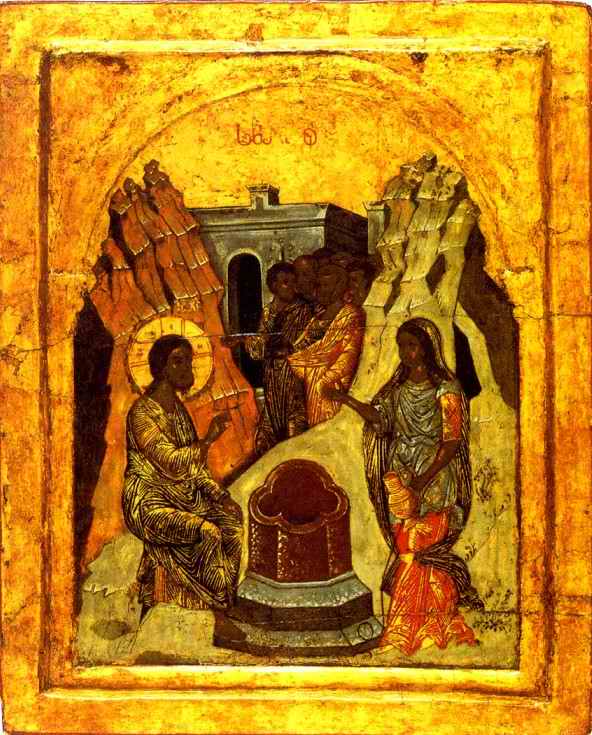
This sermon was difficult for me to write, as I mention in the sermon itself, because I don't like Jesus in this story. When I first read this passage, I said to myself that there are a few passages from John that I really like--- why couldn't this week's reading be one of those? I thought, give me the Jesus who said about the adulterous woman that you who are without sin throw the first stone.1 That's the kind of Jesus I can get behind. I thought, give me the Jesus who puts mud on people's eyes to make them see.2 A Jesus who heals using dirt, who gets messy--- I like that kind of Jesus. Give me the Jesus who weeps when he gets to Bethany after the death of Lazarus and sees the tear-stained faces of Mary and Martha.3 A compassionate Jesus, one moved by our pain, that's a Jesus I believe in. So this week, I read the text and found at first an evasive Jesus and I kinda wanted to shake him. To tell him that's not how he's supposed to behave. But I was really intrigued by the character of the Samaritan woman, so I couldn't get the passage out of my head this week.

from Hermanoleon clipart http://bit.ly/hwWCDN


Scripture: John 4:5–42 4, from Eugene Peterson's paraphrase The Message

He came into Sychar, a Samaritan village that bordered the field Jacob had given his son Joseph. Jacob's well was still there. Jesus, worn out by the trip, sat down at the well. It was noon.

A woman, a Samaritan, came to draw water. Jesus said, "Would you give me a drink of water?" (His disciples had gone to the village to buy food for lunch.)

The Samaritan woman, taken aback, asked, "How come you, a Jew, are asking me, a Samaritan woman, for a drink?" (Jews in those days wouldn't be caught dead talking to Samaritans.)

Jesus answered, "If you knew the generosity of God and who I am, you would be asking me for a drink, and I would give you fresh, living water."

The woman said, "Sir, you don't even have a bucket to draw with, and this well is deep. So how are you going to get this 'living water'? Are you a better man than our ancestor Jacob, who dug this well and drank from it, he and his sons and livestock, and passed it down to us?"

Jesus said, "Everyone who drinks this water will get thirsty again and again. Anyone who drinks the water I give will never thirst— not ever. The water I give will be an artesian spring within, gushing fountains of endless life."

The woman said, "Sir, give me this water so I won't ever get thirsty, won't ever have to come back to this well again!"

He said, "Go call your husband and then come back."

"I have no husband," she said.

"That's nicely put: 'I have no husband.' You've had five husbands, and the man you're living with now isn't even your husband. You spoke the truth there, sure enough."

"Oh, so you're a prophet! Well, tell me this: Our ancestors worshiped God at this mountain, but you Jews insist that Jerusalem is the only place for worship, right?"

"Believe me, woman, the time is coming when you Samaritans will worship the Father neither here at this mountain nor there in Jerusalem. You worship guessing in the dark; we Jews worship in the clear light of day. God's way of salvation is made available through the Jews. But the time is coming— it has, in fact, come— when what you're called will not matter and where you go to worship will not matter.

"It's who you are and the way you live that count before God. Your worship must engage your spirit in the pursuit of truth. That's the kind of people the Father is out looking for: those who are simply and honestly themselves before him in their worship. God is sheer being itself— Spirit. Those who worship him must do it out of their very being, their spirits, their true selves, in adoration."

The woman said, "I don't know about that. I do know that the Messiah is coming. When he arrives, we'll get the whole story."

"I am he," said Jesus. "You don't have to wait any longer or look any further."

Just then his disciples came back. They were shocked. They couldn't believe he was talking with that kind of a woman. No one said what they were all thinking, but their faces showed it.

The woman took the hint and left. In her confusion she left her water pot. Back in the village she told the people, "Come see a man who knew all about the things I did, who knows me inside and out. Do you think this could be the Messiah?" And they went out to see for themselves.

In the meantime, the disciples pressed him, "Rabbi, eat. Aren't you going to eat?"

He told them, "I have food to eat you know nothing about."

The disciples were puzzled. "Who could have brought him food?"

Jesus said, "The food that keeps me going is that I do the will of the One who sent me, finishing the work he started. As you look around right now, wouldn't you say that in about four months it will be time to harvest? Well, I'm telling you to open your eyes and take a good look at what's right in front of you. These Samaritan fields are ripe. It's harvest time!

"The Harvester isn't waiting. He's taking his pay, gathering in this grain that's ripe for eternal life. Now the Sower is arm in arm with the Harvester, triumphant. That's the truth of the saying, 'This one sows, that one harvests.' I sent you to harvest a field you never worked. Without lifting a finger, you have walked in on a field worked long and hard by others."

Many of the Samaritans from that village committed themselves to him because of the woman's witness: "He knew all about the things I did. He knows me inside and out!" They asked him to stay on, so Jesus stayed two days. A lot more people entrusted their lives to him when they heard what he had to say. They said to the woman, "We're no longer taking this on your say-so. We've heard it for ourselves and know it for sure. He's the Savior of the world!"


Sermon: Inside and Out

I want to confess today to you that I do not like the Gospel of John, and I don't mostly because of stories like this one we read today about Jesus and the Samaritan woman at the well. Jesus in this story rubs me the wrong way--- he won't answer people's questions directly, he is not even a little bit humble, frankly, I think he is kind of a jerk in this story. At least, that's what I thought the first time I read this story.

But then I reread the passage and began to see the story unfold differently. I saw a Jesus who was tired, but who was willing to engage in theological discussion with not only someone he was raised to believe was ethnically inferior but also a woman. And I saw in that woman a firey example of how we are to respond to Jesus. This was a scandalous conversation, one that invites us to enter into scandalous conversations as well.

Will you pray with me?
Holy One-in-Three who enters into the midst of our emptiness and quenches our thirst,
may you enter into these words I speak today and into the reflections of all of us here today, that we might better understand your truth that is living water.
Amen.


Now that I've opened our exploration of this text this morning with rather honest description of my original reaction to the text, I want to return to it, try to get a better picture of this story. Jesus in this story is leaving from Jerusalem for Galilee, journeying through Samaria, which is a big deal that we in our modern times don't often recognize. See Jews and Samaritans both descended from ancient Israel, and even practiced similar religions, worshiping the same God. Yet there was a hostility between them that was so strong Jews would often go out of their way to avoid crossing through Samaria even though that added miles to their route!5

Samaritans are often used as unexpected foils to those we expect to be good religious folk throughout the gospels, as you will remember in the parable of the Good Samaritan. Jesus' and the gospel writer's audiences would just hear the word Samaritan in these story and sneer--- and then be incredulous when they realized the Samaritan was the good guy! A good Jew would avoid Samaria, and if he or she could not, then he or she would have to avoid contact with Samaritans at all cost. Jews couldn't even buy from Samaritans.

Our unnamed Samaritan woman at the well knows this. She can tell that Jesus is a Jew, and so, given her history with Jewish people, she is suspicious. And she calls Jesus out on it. She says, "How come you, a Jew, are asking me, a Samaritan woman, for a drink?" She comes from a group of people marginalized by another ethnic group, the Jews, who are themselves marginalized under the Roman Empire. Because of this doubly outcast status, the Samaritan woman is wary when someone of a group who has oppressed her approaches her. When Jesus answers her, he doesn't respond to her question, instead giving her a cryptic response about living water. If I were her, I would say, "Listen mister, you asked me for water. Now you are the one offering it? Make up your mind." Her response to him, while perhaps is not as uppity as mine would have been, is still guarded. In my imagination, her words are hard. She asks Jesus if he has a bucket hidden somewhere to fetch the water, and then if he presumed himself greater than Jacob. She isn't gullible. And if Jesus is going to play games with his evasive answers, she can play them right back.

But when he speaks again of living water, I believe she drops her hard exterior a bit, just enough to reveal to us and to Jesus that her thirst is real, when she says, "Sir, give me this water so I won't ever get thirsty, won't ever have to come back to this well again!" Let us remember that she is coming to this well at noon, not an ideal time to get water because you wouldn't want to be carrying back the heavy jar of water in the heat. She really could be desperate, a marginalized woman looking for the comfort of a cool drink of water that does not wear off. And Jesus knows this.

Some interpreters see the turning point of the story to be the next exchange in the story, the one where Jesus reveals to her that he know about her husbands. This woman has had five husbands and now lives with a man who she is not married to. But I like Eugene Peterson's interpretation of her response. She seems sarcastic here: "Oh, so you're a prophet!" She says. The turning point for me comes in her next question. Here, she finally engages Jesus' theological conversation, and she does it with what seems to me a little jab at the divergence of their ethnic religious traditions. "Well, tell me this: Our ancestors worshiped God at this mountain, but you Jews insist that Jerusalem is the only place for worship, right?"

This woman is the first character in the Gospel of John to engage Jesus in serious, theological conversation.6 And Jesus takes her seriously! This is a big deal. The first character to challenge Jesus theologically in this Gospel, and I don't mean challenge in a bad way, but challenge in the sense of growth, is a Samaritan! And, not only that, but she's a woman! That is, after all, what scandalizes the disciples when they return to the well to find Jesus having a theological discussion with this unnamed woman. In the New Revised Standard translation of this passage, we read that the disciples were "astonished that he was speaking with a woman."7 And they make the situation so awkward really that the woman leaves them, even neglecting to bring her water jar back to town with her.

And then compare Jesus' conversation with the disciples with that of Jesus' conversation with the woman. We read this morning from The Message that They couldn't believe he was talking with that kind of a woman. No one said what they were all thinking, but their faces showed it. The New Revised Standard version gives us insight to some of the questions running through the disciples minds even though these questions are never voiced: "What do you want?" or "Why are you speaking with her?"8 These disciples we see are not like the woman who told Jesus what she thought.

What would this situation look like today in our world? Though talk of Samaritans and the lack of women's rights seems out of place often today, when broken down we see the same troubles in our world. There are barriers that are physical, like the Wall on the border between the USA and Mexico. Jesus traveling from Jerusalem to Galilee through Samaria is a little like someone from this area going to vacation in Cancun, but to get there rather than taking a plane and bypassing the poverty and the violence on the border, that person decides to walk through the desert, on roads controlled by drug cartels. We avoid those areas, but Jesus seeks them out. And not only does Jesus seek such places out, but he sits himself down by a well to rest there and gets caught up in conversation with someone the disciples would not approve of.

I don't know if any of you have heard of the organization Borderlinks; it is an experiential educational program run out of Tucson, Arizona, and Nogales, Mexico, to teach people about life on the border. I had to opportunity to go in 2009 with a group of other young adults.9 One of the most powerful parts of the experience was when we spent the night in a migrant shelter in the dusty town of Altar, one of the gateways people take into the desert to go North. It is a place where you can find guides to take you across the desert.

In the courtyard of the shelter, there was a huge barrel of water with a flag reaching way up into the sky coming out of it. This shelter is one of those wells for people, a place where people can stop, rest, and get a drink and a meal. Before dinner, we shared songs to welcome tired souls as people came in. We met Pedro, a man in Altar looking for money to buy a prosthetic leg as his old prosthetic was splitting. He said he needed the leg so he could work harder. We met José, an eighteen year old, small, quiet, who sang softly along with us even when he didn't know the words. We met Juan, who came for dinner but did not stay the night as he was going to begin to cross the desert that night. He told us he had been deported fifteen times. What kind of desperation is it that someone who had been deported fifteen times would be getting ready to again cross the desert? It is a physical desperation like the Samaritan woman at the well had.

But as our story tells us that the Samaritan woman was looking for more than fulfillment of their physical thirst. The moment of change for the woman was engaging in theological conversation with Jesus. So the moment of change with her was that moment that Jesus affirmed her self worth, affirmed her by engaging her, and by not judging her. I think we all have a need for that, don't we? We need someone to just be there and affirm our humanness, help us remember that we are made in the image of God. When we were at the migrant shelter, people came into the shelter so exhausted and down, but we were there playing music, asking them about themselves, and just trying to be present with them.

The story of the Samaritan woman at the well becomes more though than just a story of a woman who pushes back against Jesus. It is this very conversation in which she pushes back against him, in which she questions Jesus, that she comes to know him as the Messiah. Samaritans, too, believed in the coming Messiah, and in their conversation, she attested to her own belief and hope that all would be made known when the Messiah comes. When Jesus tells her that indeed he is more than a prophet but the Messiah for whom she waits, she is tongue-tied--- for once! She does not respond to him again, and instead leaves when the disciples arrive. But when she returns to the village, she begins to talk to others saying as much to herself as to them, "Come see a man who knew all about the things I did, who knows me inside and out. Do you think this could be the Messiah?"

The good news, the reason why this woman is spreading the word about this man she met at the well, is that, if he was indeed the Messiah, he knew her inside and out and still loved her, still wanted to share with her the living water, the meaning of abundant life. It wasn't that he could figure out how many husbands she had. In fact, though the Samaritan woman is often referred to as a prostitute by preachers, there is no place in the text where that assumption comes from other than the fact that she is a woman, essentially.10 Her husbands could be the result of a Levirate marriage, a custom in which if one brother died without giving his wife children, his brother would marry her, of which there are several stories in the Old Testament. There are many reasons why she could have had so many husbands in her life, but the numbers remind us that women in her day were dependent on men. And Jesus never once condemns her or even judges her in this story.

Rather, Jesus knowing her inside and out meant that he knew she was a Samaritan, he knew she was a woman, he knew she was a little uppity, he knew what she had lived through. He also knew that the hour is coming and is now here that God will neither be worshiped on a mountain or in Jerusalem, but in spirit and in truth. He knew her inside and out and still saw her as one of those who could leave the mountains and Jerusalem temples behind to instead worship in spirit and in truth. And she does: she invites her own people to enter in on this scandalous conversation with her to come and see what it is like to be known and still offered this living water, this promise of life abundant.

She is inviting us too. Shall we go hear for ourselves?


Sunday, February 20, 2011

“The Most Subversive Protest of All”

This is the sermon on Luke 5:38-48.1 I first preached it in my preaching class with Dr. Gary Simpson at Drew. I preached at Bernardsville United Methodist Church in New Jersey, where I preach once a month as part of my supervised ministry. It is a very small congregation, and the people are so wonderful and friendly. I thank them for their support of me as a student pastor!

Matthew 5:38-48:2


You have heard that it was said, An eye for an eye and a tooth for a tooth. But I say to you, Do not resist an evildoer. But if anyone strikes you on the right cheek, turn the other also; and if anyone wants to sue you and take your coat, give your cloak as well; and if anyone forces you to go one mile, go also the second mile. Give to everyone who begs from you, and do not refuse anyone who wants to borrow from you.
You have heard that it was said, You shall love your neighbor and hate your enemy. But I say to you, Love your enemies and pray for those who persecute you, so that you may be children of your Father in heaven; for he makes his sun rise on the evil and on the good, and sends rain on the righteous and on the unrighteous. For if you love those who love you, what reward do you have? Do not even the tax collectors do the same?And if you greet only your brothers and sisters, what more are you doing than others? Do not even the Gentiles do the same?
Be perfect, therefore, as your heavenly Father is perfect.


I don't know how many of you have been following the revolution in Egypt but one image in particular from this popular uprising really struck me. You may have seen it, but if not, here it is, a woman kissing a police officer during the protests.3


This week as I preparing the sermon, this image was just stuck in my head. Like when you have a song stuck in your head and you can't get it to go away. So I'm asking you today to hold this image in your mind as we explore this passage together.

Will you pray with me?


Patient Teacher, one who calls us to be hearers and doers of your Word, open us up to the movement of your Spirit as we gather here. May we be so bold to find the Word that lives within us today. Amen.


You know those scriptures you hear all the time, but are never explained? This is one of those passages for me. It is from what the Gospel of Matthew calls the Sermon on the Mount, which, if you have been following the lectionary for the past few weeks, you have been reading. This passage in particular includes two of the (what are called) antitheses in the Sermon on the Mount: these are places where Jesus tells us something we have heard said (you have heard it that it was said), and then tells us to do the opposite. And these things we've heard, they make sense. I want to focus on that first part of the scripture this morning, on how we've heard the saying "take and eye for an eye and a tooth for a tooth."

Recently I was reminded that this rule was really used to be merciful rather than vindictive.4 If someone knocks out your tooth, allowing you to knock out their tooth brings a kind of equality and prevents people from killing those who have wronged them just by knocking out a tooth, you know? In principle, international rules of war operate on this same idea, calling it proportionality. For instance, according to the law of proportionality, if some lone person launches a hand grenade into your country, you can't declare nuclear war on their country. It is the same idea in our criminal justice system that the punishment should fit the crime, meaning that if you murder someone you get more time to serve than if you steal something from a store. Makes sense, right? It is about fairness.

Only, and I think this is what Jesus is pointing out, this eye for an eye system of handing out justice to one another doesn't work. You've heard Ghandi's saying, "An eye for an eye makes the whole world blind." More often than not, an eye for an eye means that you have little Palestinian boys throwing stones at an Israeli soldier, and the Israeli soldier retaliating by shooting at them. You have a woman put in jail for a long time after killing an abusive partner, but big bankers swindling millions of USAmericans get bailed out by the government. When we read Jesus' call to turn the other cheek, we think that he is asking us to do something that is too hard--- without looking at our failed attempts to follow that system we see as reasonable, an eye for an eye.

This is not to say that turning the other cheek is easy in comparison. But I think when we read passages like this, we often write Jesus off as some hopeless idealist, asking us always to do the impossible, but Jesus here is not about making us feel inadequate. Eugene Peterson in his contemporary language paraphrase of the bible called The Message presents this scripture as saying:


Here's an old saying that deserves a second look: "Eye for eye, tooth for tooth." Is that going to get us anywhere? Here's what I propose: "Don't hit back at all." If someone strikes you, stand there and take it. If someone drags you into court and sues you for the shirt off your back, giftwrap your best coat and make a present of it. And if someone takes unfair advantage of you, use the occasion to practice the servant life. No more tit-for-tat stuff. Live generously.5

Live generously, that's what Jesus is asking us to do here. It isn't about doing the impossible. It is about living into the abundance that God became incarnate in Jesus to show us how to do.

Living with an eye for an eye mentality ends up being so shallow. It ends up being about payback, a payback that seems no matter how many times you pay it still doesn't bring any sort of healing. We can't keep up with our own misplaced sense of fairness, thinking maybe it will bring us happiness or something. But it turns out that rather than caring for people and relationships, we are keeping a tally, only caring about that tit-for-tat stuff. It is not about living generously. We know from experience if we think about it that this attempt to follow an eye for an eye turns into this vicious cycle.

Now some of you might read this passage and say, well I don't think that being walked all over is living generously either. Because isn't that how we read it sometimes? After all, in The Message, Eugene Peterson paraphrases Do not resist an evildoer, which in and of itself seems to be all wrong as, Don't hit back at all. We can easily read this as meaning that we ought to just smile and take it. This is that notorious passage that has been used time and again to tell people to go back to abusive spouses. They use these verses to say that passivity and nonaction are good things. This reading in effect says then to take yourself out of an abusive situation, to liberate yourself, is against the will of God.

But how is this living generously? Giving in to abuse does not fit with the end vision of the kin-dom, the end vision of how humanity will live together as whole, healed persons, Jesus is painting for us in these verses. Though it is easy to look at these verses and see that a literal understanding of them is calling us all to be pushovers, in fitting these pieces in with our readings of other scripture and our experience of God as a liberating God we know that on a much deeper level, these verses are pointing to something much different.

Clarence Jordan, New Testament scholar, farmer and Habitat for Humanity founder, translates Do not resist an evildoer in the Cotton Patch Gospels, as


But I'm telling you, never respond with evil.6

The living generously comes out of this refusal to respond to evil with evil. By turning the other cheek, we are not passively avoiding conflict, but we are standing up for a vision of living that is much different from the world as we see it today. We are responding, but our responses don't fit into those rules society has come to see as true and sensible.

Here's a big picture example what turning away from tit-for-tat, eye-for-an-eye living looks like. I've spent a lot of time in Bosnia and Herzegovina, starting with mission trips and then continuing to go back because of the relationships I developed there, so I've read a lot about the history and it just so clearly shows that tit-for-tat system at its worst. See, during World War II, Serbs and Muslims were put in concentration camps by Croats. And then during the Bosnian genocide in the early 1990s, in the north of Bosnia, Croats and Muslims were put in concentration camps by Serbs. And in fact, the Serbs used the cultural memory of a battle lost to the Ottoman Empire in 1389 to rally people to commit genocide against Muslims. Today, the country is still economically destitute and every few months I see a report from the BBC asking not if but when the Balkans will erupt again. Or just during the European Cup a couple years ago some young man was killed in the ethnically dividing uproar over the Croatia-Turkey game.

Yet there is hope in the actions of those who move to break this cycle of retaliation. I have worked with a support group for Muslim women survivors of concentration camps. I go and sit with women who lived through the genocide and listen to their stories and the horrors they lived through, yet they don't look at their Croat or Serb neighbors with violence. In fact, they see in the other women the same pain and fatigue that reside in their own eyes. Their response to the wars they have lived through is not to teach their children that they have been wronged and so must wrong those who hurt them. No, they want to educate, to tell their stories, to make that much-talked-about but little-done-about mantra, Never Again true for their community. They are turning the other cheek, not by rolling over and staying silent, but by choosing to use their experiences to educate their community about the horrors of war and encourage them to instead come together to return evil with good.

Turning the other cheek, giving our coat in addition to the shirt off our backs, then are not some passive action, a nonaction that we so often think they are. Rather it is a conscious decision to look in the face of evil and say, I will not. I will not stoop to that level. I will not continue living in this world of cold supposed fairness that doesn't work. Jesus has shown us another way, a way of abundance.

This is the revolutionary kind of living Jesus is calling us to, a generous way of living breaking free of the old way. Let it be so for you and for me. Amen.