Monday, February 25, 2013

Let Your Heart Take Courage


I preached this sermon the week I announced I would be reappointed from Deer Creek Charge to Presbury United Methodist Church. While I know the Spirit is present in the midst of the move, it is still a very difficult one. And Psalm 27 was a comfort to me this week.
 
Scripture: Psalm 27
The Lord is my light and my salvation; whom shall I fear? The Lord is the stronghold of my life; of whom shall I be afraid?
When evildoers assail me to devour my flesh— my adversaries and foes— they shall stumble and fall.
Though an army encamp against me, my heart shall not fear; though war rise up against me, yet I will be confident.
One thing I asked of the Lord, that will I seek after: to live in the house of the Lord all the days of my life, to behold the beauty of the Lord, and to inquire in his temple.
For he will hide me in his shelter in the day of trouble; he will conceal me under the cover of his tent; he will set me high on a rock.
Now my head is lifted up above my enemies all around me, and I will offer in his tent sacrifices with shouts of joy; I will sing and make melody to the Lord.

Hear, O Lord, when I cry aloud, be gracious to me and answer me!
“Come,” my heart says, “seek his face!” Your face, Lord, do I seek.
Do not hide your face from me. Do not turn your servant away in anger, you who have been my help. Do not cast me off, do not forsake me, O God of my salvation!
If my father and mother forsake me, the Lord will take me up.
Teach me your way, O Lord, and lead me on a level path because of my enemies.
Do not give me up to the will of my adversaries, for false witnesses have risen against me, and they are breathing out violence.

I believe that I shall see the goodness of the Lord in the land of the living.
Wait for the Lord; be strong, and let your heart take courage; wait for the Lord!

Sermon:
Let us pray:
God, our stronghold, shelter us this morning.
Bring us in close to you, that through the reading of this scripture
we may see your face. Amen.
I looked to Psalm 27 this week and felt its waves of assurance wash over me as the psalmist names God our stronghold. I felt the praise of power and beauty, and wanted to join with the psalmist in his pursuit of beauty. But this is not where the psalm ends. There is an abrupt change in the psalm, where we go from praise to lament. It has caused some scholars to wonder if these were two or more different psalms stuck together. In any case, the tension between these two sections is awkward. In college I worked at a writing center, helping students hone their papers, and one of my primary critiques to everyone was that they needed to work more on transitions. There is no transition in this psalm from praise to lament between verses six and seven. You’ll notice in Cheryl Ann Toliver’s rewrite, which I included in your bulletin (see here), she finds it more convenient to skip the praise all together then try to explain this tension.

And it is one this to have this unresolved abruptness exist in the psalm. It is another thing to see the direction of it: praise to lament rather than lament to praise. In reading it I wanted to point out to the psalmist that it is more compelling to “begin with a wavering, almost desperate faith, more longing than hope” and then concluding with “a strong statement of conviction,” more compelling to move from “doubt to certainty, dark to light.” As one commentator on this psalm wrote, after all isn't this how faith and life are supposed to work? A tidy, seamless journey from doubt to certainty. Yet, as we at this church know in our personal journeys as well as in our corporate journeys within this congregation, neither our lives nor our faith journeys are so tidy.1

We waver. Sometimes we go from the strong sure claims of salvation and fearlessness, to crying out for God to hear us and back again in a day, let alone how jumbled we find ourselves in our lifetimes. The psalmist goes from joy in verse six, saying that he will sing and make melody to the Lord, to painfully imploring God in verse seven: Hear O Lord, when I cry aloud, be gracious to me and answer me!

This tension in this psalm has always spoken to me, drawing me to want to preach it long before I knew anything about an appointment. It is a perfect psalm for Lent, for “the Lenten journey can be a foray into the soul, offering us a good time to look deeply within ourselves in order to understand the [sometimes dark, always mysterious] realities that beset us.”2 It is a journey where we ask ourselves how we can fear anything when God is the stronghold of our lives, when at the same time we ask why God is hidden from us. And it is a journey that is not linear, that wavers between our praise and our lament, between doubt and certainty.

At the very heart of the abrupt tension in this poem, though, at the very heart of this praise and lament is fear.

Throughout scripture, we are told not to be afraid. Abraham in our scripture this morning is told not to fear. We hear over and over again the angels at Christmas time telling us not to fear. Jesus tells us not to fear when he rises to life. I have always thought this was one of the most important messages of scripture, this constant whisper that we ought not to fear. Our psalm even asks rhetorically how, if God is holding us up, how we dare fear? But in this one little psalm, the abrupt change from joy to lament reminds us in Lenten fashion that even when we know intellectually that we are not to fear, our hearts don’t always get the message. We fear being abandoned by God. We are paralyzed by this fear, no matter how we try to let go of it. Just because we have intimately known God does not mean we don't find it easy in moments of crisis to feel abandonment.

Even Jesus himself cried out to God not to abandon him on the cross.

And so, in the spirit of Lenten self-reflection, I began to reflect on my own fear. I turned to the uncertainty I was feeling my first overnight at the hospital when I was a student chaplain. My first page was to labor and delivery, where a couple had just learned that twenty weeks into the pregnancy that they had lost the baby. Pregnancy is one of those moments in which there is often that kind of joy described by the psalmist, a confidence in God’s provision, a time in which we want to behold God’s beauty all around us. But such joy was abruptly brought to an end. What should have been a time of praise turned very quickly into a lament.


What first struck me when I walked into the room was that they were good looking people. The father had just come from work, still wearing a suit, though he had lost the jacket. He and the mother wanted to talk briefly, but after I prayed with them, they told me I could come back and check in later. When I did, the grandparents of the baby were there, so they gave me a brief update, and then thanked me in a “you can leave now” kind of way. I ended up being extremely busy that night, spending hours with another family who had lost someone, but that first family stuck with me. I pictured them spending the night together pleading with God, “Do not cast me off, do not forsake me, O God of my salvation.”

I was the one who prayed that, who, in the same moment I knew God was cradling that family in God's hands through the care of the nurses, through the hugs of the grandparents, through the strength of the father as he held onto his wife--- in that same moment I could not see God, could not understand why such a thing could happen. I feared abandonment, feared that this family was lost in their lament, lost in those heartbreaking words of the psalmist struggling to see God’s face.

In the morning I did not want to go back, but I knew I had to, so I went up the room and could not help but be relieved when I saw it empty. But I went to the nurse's station and the nurse said, “Oh I'm glad you're here. They are in the recovery room.” Then she led me in to sit with the parents, who thanked me for coming and talked a little bit with me. I could not really understand what the mother was saying because she spoke so softly. The father said they were both doing much better that day. But then when I asked about the baby's name, which they had told me was Olivia, the father said. “It was going to be Olivia before we started having kids, before we even got married. It was always Olivia.”

The father did not rail against God, though he would not be in the wrong to do so. He never even asked why. He never seemed fearful. He certainly was not joyous, but he had a quietness around him that reminded me that the end of the psalm is not that fear, uncertainty, doubt. The end of this family's story was not the loss of a child. It was a father reminding himself of their love story, of how they were a family and would continue to be a family. It isn't an overwhelming perseverance in the face of tragedy. It was a name and an affirmation that his family was not over. As it had been, so it would continue.

Maybe I'm reading a lot into this father's words. But the quietness of that room, that room I so feared, was not the quietness of lament. It was the quietness of verse thirteen.
I believe I shall see the goodness of the Lord in the land of the living.

I may not see goodness in this moment, the psalmist says, but I believe it exists. I believe I shall see it in this life, not just when I get to heaven. I may not feel God's presence now, but I know it is there and that I will experience it again. I cannot boldly proclaim my confidence in this moment, as the psalmist could at the beginning of the psalm, but I proclaim that one day I will be confident again.

Our stories are not these linear tales from doubt to faith. Our stories are journeys from doubt to faith to doubt to a glimmer of hope back to doubt and hopefully again to faith. They are these circuitous paths in which we can lament and praise in the same breath, but paths where even in the depths of lament there is that direction from God, that reminder that we will see goodness again.

And finally the psalmist encourages us:
Wait for the Lord; be strong, and let your heard take courage; wait for the Lord.

Waiting is not the glamorous kind of courage we seek in the face of our fear. In fact, we see waiting as annoying not as heroic. But this is our task as Christians. To wait. Not passively, of course. We can't just sit back in our armchairs and wait for the rapture. But we do, in the midst of the dark and difficulties in our lives, survive our fear by waiting through the darkness to feel the light again. Waiting for the hope of things not seen.

Psalm 27 “is not a psalm about how God answers our prayers,” about how God brings us out of our sadness and darkness into joy again. Rather, “it [is itself] a prayer, even a plea, for patience, for trust, for the ability and the endurance to wait for the Lord, even when the Lord's arrival is a long, undetermined way off.”3 There are times in all of our lives, even sometimes just in one day, where we must courageously wait for the Lord. Where we must know, even when we don’t feel it, that goodness will return. Such waiting is a part of our Lenten journey as we come ever closer to the story of Jesus’ death.

So I encourage all of you this week to pray Psalm 27, even if you don’t feel the tension between doubt and faith, even if you are not fearful in this moment. Pray it for your friends or family who are journeying through dark places. Pray that you may have the ability and endurance to wait for the Lord in the midst of struggle. For God is there beside us in the midst of our struggle, being a light to us. May we open our eyes to see it.

Let us pray borrowing words of Cheryl Ann Toliver’s poem:
Now help us to wait for you, Lord God.
Help us to be strong and unafraid when we feel overwhelmed.
We ask this so we might endure the coming metamorphosis,
so we can become the people you call us to become. Amen.4

1See Richard C. Stern, Homiletical Perspective on Psalm 27, Second Sunday in Lent, Feasting on the Word: Preaching the Revised Common Lectionary Year C, Volume 2 Lent through Eastertide, eds. David L. Bartlett and Barbara Brown Taylor, (Louisville, Kentucky: Westminster John Knox Press, 2009) 57.
2Samuel K. Roberts, Theological Perspective on Psalm 27, Second Sunday in Lent, Feasting on the Word: Preaching the Revised Common Lectionary Year C, Volume 2 Lent through Eastertide, eds. David L. Bartlett and Barbara Brown Taylor, (Louisville, Kentucky: Westminster John Knox Press, 2009) 56.
3Richard C. Stern, Homiletical Perspective on Psalm 27, Second Sunday in Lent, Feasting on the Word: Preaching the Revised Common Lectionary Year C, Volume 2 Lent through Eastertide, eds. David L. Bartlett and Barbara Brown Taylor, (Louisville, Kentucky: Westminster John Knox Press, 2009) 59.

4 Cheryl Ann Toliver, “Psalm 27,” The Works of Cheryl Ann Toliver, 2003 reposted 19 February 2013, http://cherylanntoliverworks.blogspot.com/2013/02/psalm-27-worlds-gone-mad-our-god-given.html.

Thursday, February 14, 2013

Dance Then Wherever You May Be

Blogging, what? Prepare yourselves for a bunch of sermons to appear sometime, but for now:

"Dance then, wherever you may be!"

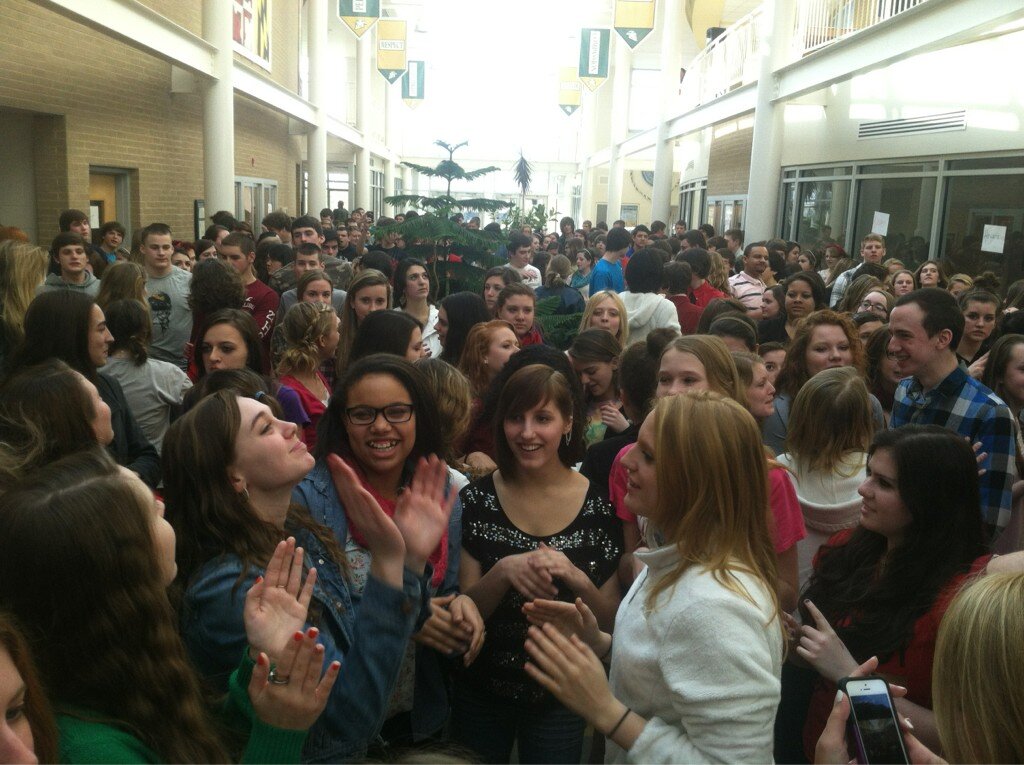
Dancing is not my strong suit. You should have seen me out there today, attempting to follow the simple choreography the students at North Harford High School put together. But my soul has been dancing ever since, dancing to the tune of new world possibilities.

If you had told me eight years ago that I would be spending VDay 2013 at North Harford High School, my alma mater, in Harford County, Maryland, I would have laughed in your face. My high school is in a conservative, isolated community--- not one that you would think would foster VDay festivities. When I say VDay, I don't just mean Valentine's Day. I mean the reimagining of VDay to include a fight to end gender-based violence. This reimagining began with Eve Ensler, famous playwright of The Vagina Monologues.

I began my love affair with Eve Ensler's work when I first read The Vagina Monologues in high school and my drama teacher Ms. Green allowed me to do my playwright project on Eve Ensler. Since then, I have seen productions of The Vagina Monologues all over, including a production in French! I have helped organize performances at Dickinson College and Drew Theological School. The performance at Drew Theological School was one of the proudest moments of my life--- and was the best performance of The Vagina Monologues I have ever seen. That performance was for VDay 2012, the year I also saw the official Occupy Wall Street Vagina Monologues in New York City featuring Eve Ensler herself.

So after the high of VDay 2012, if you would have told me even last year that I would be spending VDay 2013 in the high school I graduated from, I would not have laughed at you, I would have been sad.

See VDay 2013 is a big deal. Eve Ensler explains:
This February 14 2013, V-Day will be 15 years old. It was never our intention to be around that long. Our mission was to end violence against women and girls, and so we planned to be out of business years ago...So less than a year ago, we announced One Billion Rising, a call for the one billion women and all the men who love them to walk out of their jobs, schools, offices, homes on Feb 14, 2013 and strike, rise and dance!
I wanted to rise up and dance. I saw myself at Times Square or in DC--- not the community where I grew up in the high school where my angsty teenage self located so much that was wrong in the world. And yes, my community still suffers from isolation and is often limited by a conservative value system, but I could not imagine a better place to participate in One Billion Rising.

Going to North Harford High School to see over 250 students crammed into the school atrium, holding up their pointer fingers to signify One Billion Rising--- this reminded me that this is the kind of work that matters most. My teacher Ms. Green was the one who got the event off the ground, opening space for these students the way she did for me as I studied Eve Ensler ten years ago. Here, I saw how teachers work with young people (even when I was too angsty to see it when I was a teenager) to create spaces in which they can begin to imagine a different world, a more healthy and loving world in which no one lives in fear of abuse or assualt.

Every third woman was given a card with the number 3 and asked to stand up to help their fellow students visualize how many women are beaten or raped in their lifetime. These students were given space to begin to understand the pervasive nature of violence across the world. And they were shown that they don't have to be a part of that cycle of violence and control. They can resist.

As I stood next to the principal, who is supportive, and saw my former teachers, and a few students I recognized from church dancing, I have never been prouder to be an alum of North Harford High School. I have never been more inspired to be part of a movement to rise up and say enough is enough. We are over violence. We were, in Eve Ensler's words, "Dancing up the will of the world to end violence against women and girls."

And when we wake up tomorrow, we cannot go back to our silence and our ignorance. We will not go back to being part of households, communities, or a world that condones violence against women. We will continue our dance, wherever we may be, even though it will be difficult with the specter of violence on our backs.

Inspired by those teenagers at North Harford High School and their amazing teachers, I, as a pastor, will speak on gender-based violence from the pulpit on Sunday. I will make a more concerted effort in the future to create space in my churches that looks a bit more like that atrium at North Harford, filled with people creating a different world. A world in which we are all safe and free.

How will you join in the dance?

One picture of the flashmob from @laxingirl79

Sunday, February 3, 2013

Absolute Truth

This is the manuscript for my sermon to the Deer Creek Charge on a Sunday (which happened to be Ravens Superbowl Sunday--- we had purple communion bread!). This was the final part of sermon series on 1 Corinthians 12 and 13.


Scripture: 1 Corinthians 13
If I speak in the tongues of mortals and of angels, but do not have love, I am a noisy gong or a clanging cymbal. And if I have prophetic powers, and understand all mysteries and all knowledge, and if I have all faith, so as to remove mountains, but do not have love, I am nothing. If I give away all my possessions, and if I hand over my body so that I may boast, but do not have love, I gain nothing.

Love is patient; love is kind; love is not envious or boastful or arrogant or rude. It does not insist on its own way; it is not irritable or resentful; it does not rejoice in wrongdoing, but rejoices in the truth. It bears all things, believes all things, hopes all things, endures all things.

Love never ends. But as for prophecies, they will come to an end; as for tongues, they will cease; as for knowledge, it will come to an end. For we know only in part, and we prophesy only in part; but when the complete comes, the partial will come to an end. When I was a child, I spoke like a child, I thought like a child, I reasoned like a child; when I became an adult, I put an end to childish ways. For now we see in a mirror, dimly, but then we will see face to face. Now I know only in part; then I will know fully, even as I have been fully known. And now faith, hope, and love abide, these three; and the greatest of these is love.

Sermon:
The last two weeks we have been talking about the apostle Paul's first letter to the Corinthian Christians, focusing mainly on how we are to care for each other as the body of Christ. On how we are to build the kingdom of God here and now.

It might seem that the imaginative and creative image of a many-membered body of believers caught up in mutual care for one another would be enough to imagine that we were already in heaven, or at least close. But Paul isn’t finished. He says, if you think this is something, let me pull back the curtain a bit and let you in on an even more fantastic vision of the Christian life as prepared for us by the Spirit of God.”1

First Corinthians chapter thirteen, this even more fantastic vision, is perhaps one of the most famous passages in scripture. Even if someone does not go to church, he or she is bound to hear this passage at weddings, see it up on walls. When I was growing up, we had a similar picture to the one I brought in here that Aaron and I have hanging in our bedroom hanging up in our bathroom. Perhaps a strange place to keep such a scripture reading, but the point is that by associating 1 Corinthians 13 with weddings and homes, we domesticate it. We forget that Paul is talking about a radical love here, not marital love, not familial love--- though certainly those loves can be radical too and reflect the love Paul is describing. But what Paul is talking about is a totally different way of acting with every person we encounter, a Christ-centered life that should not be relegated to our homes alone.

So let us pray together:
Patient teacher, come alongside us this morning
as we focus on this scripture together. Teach us the meaning of this love
you call us to. Amen.

When I was in my first year of college, I was part of a campus Christian organization that had dynamic worship on Friday nights. I loved the music we sang, and we all sounded so good together. After singing and prayer, the leaders of the group invited a preacher, usually from the surrounding community, to come and preach.

Well one week a man came to preach about Absolute Truth. I don't remember what scripture he preached from, but I do remember his lesson and it still pains me to this day. He said that Absolute Truth was marriage between a man and a woman. Now, I know that many of you may believe that marriage should be between a man and a woman. My point is not how we ought to define marriage this morning. My point is that the Good News we read in the bible, the Absolute Truth we read here is not a definition of marriage. Not even close, and it makes me so sad that here were forty or so college students, broken people in a campus culture that had little room for Christ-centered living, being told not of the poetic love of God but lectured on a narrow political hot-button issue.

Because friends the Absolute Truth we should have named that night is summed up in 1 Corinthians 13: Love. Love Never Ends. Not a tame love that sounds nice at weddings and poetry that looks nice on your living room wall. Rather, a powerful love that is modeled off of Jesus' own love for us. This love patterned off of Jesus' own love for us is the key to the whole gospel.2 So today, let's focus on Paul's words about love to un-domesticate them.

It is worth remembering that these past few weeks we have spent on Paul's first letter to the Corinthians have only focused on chapters twelve and thirteen. So what was Paul talking about before he got to love? Well, he was adjudicating arguments that kept popping up all over the place in the young Corinthian church. People were arguing over which mentor and teacher to follow, about what kinds of food they could and should eat, about how to worship, about who had the most important spiritual gifts, about marriage and sex. You know, easy stuff that we certainly never fight about today.

Paul addresses these arguments. But chapter thirteen is something different. I feel as Paul has been writing he takes a moment to set aside his letter, cover his head with his hands, and pray harder for these troubled and argumentative Corinthians than he has prayed before for them. And so when he comes back to the letter, he is renewed, and he points them and us to the real way to get in on the gospel. You see, the real practice that is the key to the gospel is not what teacher we follow, Calvin or Wesley, Mark Driscoll or Adam Hamilton. We have not unlocked the gospel if we discover whether contemporary worship or traditional worship styles are better. We do not unlock the gospel when we define marriage, and we do not unlock the gospel when we polish our spiritual gifts. Certainly all these things are important questions as we explore our faith, but they are not the Absolute Truth of the Gospel. Rather, what unlocks the gospel for us is the practice of the discipline of love. We cannot discern our other questions properly unless we first start with love.

Rev. Lauren Winner, Episcopal priest and professor of Christian spirituality at Duke, used that term the discipline of love in a sermon I heard this week and so I had to use it. Too often we don't think of love as a discipline. We think of love as magical, using phrases like “love at first sight” and talking about how we “just know” when we find the right person for us. The discipline of love reminds us that love is something we should grow at with time, something that we must focus ourselves to do, center ourselves. It is something that we should model on Jesus' love for us. Lauren Winner describes this as, “God's love for us. A love expressed in creation and a love expressed on the cross. And it is a love that is always Other-directed, or, more accurately, a love directed to Two Others: to one's Beloved and to the God who created her and sustains her.”

Love, of course, can become an occasion for sin. And that's why Paul explained what he was talking about when he was talking about love, why he defined love for us. Too often we seem to be attending to our Beloved, but we are using the other to make ourselves feel good. And sometimes we love the other person for what we think they should be or could be, rather than for who they are. Romantic love seems to be particularly susceptible to these problems, I think.

But Paul saves the definition of love from the limited definitions of romantic love, conjugal love. He corrects our selfish forms of love through his definition of love as patient and kind. He tells us that jealousy is not really love, that insisting on our own way is not really love. But when we read 1 Corinthians 13 at weddings, we sometimes miss that part. To really take it seriously, we have to recognize that Paul is not talking about marital love here, but Paul is talking about the love we should have for everyone as Christians. About how our every action should be rooted in love--- a love that reflects not our own selfishness, but that reflects God.

I came across this story by Charles Moore, a former seminary professor who now lives in a Christian community. The story is about the transforming love that Paul is talking about here. As a student at Cal Poly, Charles met a physics major named Alan. Alan was virtually blind, able to get around well enough, but he struggled with reading and needed to rely on others to drive him places. He was a straight-A student, later returning to Cal Poly as a physics instructor.3

Now, Alan was very happy to discuss religion, but he was extremely skeptical of anything religious, especially Christian. He was well read and well versed, and he argued his doubt like a scientist. He said he was an agnostic: there simply wasn't enough evidence to warrant belief in God. Charles and his friends trued to convince Alan, give him some kind of “proof,” but Alan would gently explain that he needed an assurance of truth.

What was intriguing about Alan, according to Charles, was that he liked to hang out with Charles and Charles' “Christian friends.” They reached out to him, always inviting him to the beach or midnight runs to Taco Bell or whatever else they were doing.

One evening, Charles' group of friends had a praise night on the beach. Alan said he would go to enjoy the sunset and roaring bonfire. But by the time the evening was over, Alan had made a commitment to follow Jesus. No one had spoken to him, nor did anyone even know at first.

“You see,” Alan explained to Charles, “while everyone was singing around the fire, I realized that whenever I am around you Christians I am happy. Even when we disagree with each other, I find myself liking to be with Christians.”

Charles, not understanding, said, “But, Alan, I thought you were never going to become a believer unless there was first enough evidence.”

“Yes,” he replied, “and I still require it. But that's precisely why I now believe. It's how you all love each other that strikes me most. I never considered that evidence before. A good scientist, you know, considers all the facts. I simply haven't found the love you Christians have for each other anywhere else. That's evidence enough for me that Jesus is Lord.”

That's what Paul is talking about when he's talking about love. What makes a difference in people's lives in not whether we speak in the tongues of mortals and of angels, or whether we have prophetic powers, or even faith--- it is about love for all our brothers and sisters, a simple patient love. I say simple, but certainly this discipline of love is not possible for any of us without the Spirit's aid. Certainly it is a practice we will have to work at all our lives. But friends, love is our call as Christians. So let us go forth to love, each and every day.

Benediction:
Friends, may we go forth from this place remembering our calling to love. Let us remember in the difficulties of the week ahead, and in the joys, that love never ends. Jesus' love never ends. May that give you strength. So let us go out and embody Christ-centered love for all whom we meet. Maybe even fans of the 49-ers. Amen.
 
1James Boyce, Commentary of the Second Reading: 1 Corinthians 13:1-13, Fourth Sunday after Epiphany, Working Preacher, 3 February 2013, http://www.workingpreacher.org/preaching.aspx?lect_date=2/3/2013&tab=3
2Much of this sermon is inspired by or borrowed from Lauren Winner, “Corinthian Cross-Stich,” Sermon given at Duke Chapel on 31 January 2010, http://www.youtube.com/watch?v=aVMgzALSG34
3Charles Moore, “The powerful witness of community,” Beyond Argument, Intervarsity 1997 http://www.intervarsity.org/slj/wi97/wi97_beyond_argument.html.

Sunday, January 13, 2013

Baptism of the Lord Communion Liturgy

This Great Thanksgiving is written by Shannon Sullivan, 2013, for Baptism of the Lord Sunday at Deer Creek United Methodist Church. It is written using language from The United Methodist Baptismal Covenant, The UM Service of Word and Table, and scripture, particularly Isaiah 43:1-7 and Luke's gospel.


Remembering Our Baptism and Holy Communion
It is a holy day indeed when we celebrate our two sacraments together. This morning we remember the sacrament of our baptism as we partake in the sacrament of communion. One celebrates birth and new life, and the other, our continued nourishment and growth as we live into all Christ calls us to be.

RENUNCIATION OF SIN AND PROFESSION OF FAITH
When we approach the font or the table, we first renounce the power of wickedness in our lives. And so, let us confess together:

Nourishing God, you tell us not to fear for you are with us. But we are so full of fear that we cannot love you with our whole heart. We use the freedom and power you have given us, not to resist evil, injustice, and oppression, but to rebel against your love to hurt our neighbors and ignore the cries of the needy. Cleanse us of our fear. Feed us the courage to put our whole trust in your grace.

ASSURANCE
The Holy Spirit has not abandoned us. We are still God's beloved, and the Holy Spirit continues to work within us.

We remember our baptism are thankful!

And now we come to the table, for God continues calling us each by name to bring us into the fullness of the new life we glimpsed at our baptism.

We offer ourselves anew to God, listening for the guidance of the Spirit!

PASSING OF THE PEACE: Now let us share signs of that peace which we find in Christ with our neighbors!

THE GREAT THANKSGIVING
The Lord be with you.
And also with you.
Lift up your hearts.
We lift them up to the Lord.
Let us give thanks to the Lord Our God.
It is right to give our thanks and praise.

It is right, and a good and joyful thing,
always and everywhere to give thanks to you, Almighty God,
creator of heaven and Earth.

In the beginning, darkness covered the face of the deep, but You swept over the face of the waters and brought forth abundant swarms of life. And you blessed them, seeing that it was good. You watered the face of the ground and formed a human creature from the dust and mud, breathing life into it and leading it to life in a garden. You created a second earth creature so it would not be alone, and man and woman were created. But these earth creatures, these humans turned their backs on you, and were expelled from the lush garden.

Yet you did not abandon them then, and you do not abandon us now. Throughout our history, you have come through the sustenance of water and bread to call us back to paradise. In the days of Noah, you saved those on the ark through water, and after the flood you set in the clouds a rainbow. When you saw your people as slaves in Egypt, you led them to freedom through the sea, and then sustained them with manna, bread that covered the dessert like dew. Their children you brought through the Jordan to a land flowing with milk and honey.

And so, with your people on earth and all the company of heaven, we praise your name and join their unending hymn.

Holy, holy, holy Lord, God of power and might,
heaven and earth are full of your glory.
Hosanna in the highest.
Blessed is he who comes in the name of the Lord.
Hosanna in the highest.

You told us when we pass through the waters, you will be with us. You told us that you love us so much, because we are precious in your sight, you will redeem us. You saved our biblical ancestors and us through water, but the story never ends there. You continue to nourish us through the fullness of time, sending Jesus, nurtured in the water of a womb.

When he grew up, your Spirit descended on him like a dove, proclaiming his belovedness as he emerged from the water. He began his ministry preaching new life because the time of redemption had come. He healed the sick, fed the hungry, and ate with sinners.

Yet so many feared and still now fear the new birth he offers all of us. We reject the fullness of the feast he give to us. And so we turned our backs on Jesus, on the nourishment he offered. And we gave him up to die, even after sitting at table with him.

On his last night with us, Jesus sat at a table and fed his disciples as he feeds us now. He took bread, blessed it, broke it, and shared it with us, saying “This is my body, which is given for you.”

When supper was over he took the cup, blessed it, and shared it with us, saying, “Take, and drink. As often as you do this, remember me.”

The cup reminds us of the new covenant, a covenant by water and the Spirit in which God reminds us again of our belovedness and calls us to new life.

And so, in remembrance of these, your mighty acts in Jesus Christ, we offer ourselves in praise and thanksgiving as a holy and living sacrifice, in union with Christ's offering for us, as we proclaim the mystery of faith.

Christ has died; Christ is risen; Christ will come again.

Pour out your Holy Spirit to bless this gift of water and those who receive it. Pour out your Holy Spirit on us gathered here, and on these gifts of bread and wine. May these two gifts, the water and the meal, redeem us again by washing away our sin and filling us with good things.

By your Spirit, incorporate us into God's new creation, making us one with Christ, one with each other, and one in ministry to all the world, until we all come to the table, cleansed of all hatred and sin to welcome all people in joy and thanksgiving as members of the family of Christ. May your spirit work within us, that being born through water and the Spirit, and fed through Christ's body, we may be faithful disciples of Jesus Christ.

And now, with the confidence of the children of God, let us pray for our daily bread, praying the prayer Jesus taught us: THE LORD'S PRAYER

BREAKING THE BREAD
The bread of life.
The cup that saves us, and sets us free.

GIVING THE BREAD AND THE CUP
The table is set and all are invited. In the United Methodist Church, we practice an open table. This means you don't have to be a member, you don't have to be baptized, you don't have to take classes, you don't even have to be in a good mood. You are invited to come and know that no matter who you are and where you are on your journey, you are a beloved child of God and God's grace is sufficient.

As you approach the Table, you will first come to the Font, where you are invited to remember your baptism and be thankful. And, as you remember your birth through water and the Spirit, you will come to the Table, where you will be offered nourishment to sustain you on that journey of new life. You will be offered a piece of bread, which you can take and dip into the cup. Now come with joy to meet God anew.

BLESSING
The God of all grace, who has called us each by name as Beloved, establish and strengthen you by the power of the Holy Spirit, that you may live in grace and peace.


Marked by Love

My sermon for Baptism of the Lord Sunday at the Deer Creek Charge United Methodist Churches! I had a woman in her seventies tell me that she had never thought of herself as being Beloved of God before. 

See also my communion liturgy used on this Sunday.


Scripture: Luke 3:15-17, 21-22 (The Message)

The Gospel reading this morning will be from a paraphrase of scripture, Eugene Peterson's The Message. Hear now these words:

The interest of the people by now was building. They were all beginning to wonder, “Could this John be the Messiah?”


But John intervened: “I am baptizing you here in the river. The main character in this drama, to whom I'm a mere stagehand, will ignite the kingdom life, a fire, the Holy Spirit within you, changing you from the inside out. He's going to clean house--- make a clean sweep of your lives. He'll place everything true in its proper place before God; everything false he'll put out in the trash to be burned.”


There was a lot more of this--- words that gave strength to the people, words that put heart in them. The Message!...


After all the people were baptized, Jesus was baptized. As he was praying, the sky opened up and the Holy Spirit, like a dove descending, came down on him. And along with the Spirit, a voice: “You are my Son, chosen and marked by my love, pride of my life.”


Sermon: Marked by Love

Let us pray:

Patient teacher, we praise you for your warm embrace,

that in the midst of our fear and doubt, still youhope,  remind us

of your most important teaching: love.

May the words of my mouth, and the meditations of all our hearts,

guide us all to better understand this teaching.

In the name of Jesus, whom you proclaimed your beloved. Amen.


My sister Kate, the blonde one, really changed the way I look at baptism. It was early two summers ago when we were at Norrisville United Methodist Church and there was a baptism. Now, we were preacher's kids, and preacher's kids who went to multiple services on a Sunday, so when the second service rolls around, you pay a little less attention to what's going on. I was goofing off a bit, but when I happened to look at my sister, she was crying. Now Kate did not use to be a very emotional person. For example: when she and I did a presentation on our mission trip to Bosnia, I cried because the trip had been such a powerful experience and I was so in love with the people we had met there. Her reaction to my tears was to tell me in the car on the way to the next service, “I hope you don't cry this time. That was embarrassing to me.” Kate's a real sweet girl.


So when I saw Kate was crying during the service, I thought she was sick or something; I was very concerned and asked her what was wrong. She said through her tears that she just found moments like this baptism so beautiful because they signify our family growing. She was touched by the love in the room, the warmth and the smiles on everyone's faces that just radiated the power of God's love.


I don't think before this moment I really thought about or at least felt baptism in this way. I confess that I am, to the chagrin of my mother (who is a pastor), a bit of an anabaptist. Anabaptists believe in re-baptism, that baptism should be something you choose as an adult to signify your commitment to a new way of life. I also like the idea of rebaptism because I always wanted to be baptized in a river but can't because I have already been baptized. Total immersion, the kind of baptism when you are dunked under water, just seems very glamorous to me. Now, though there is merit to anabaptist's focus on a ritual to signify a new commitment, less so to my desire for glamor, I think my understanding of baptism before seeing Kate cry missed the point of baptism. Baptism is less about us and the work that we do to arrive at the point of making that commitment to God and more about those words that were spoken as the Holy Spirit descended like a dove upon Jesus on the day of his baptism: “You are my Son, the Beloved; with you I am well pleased.” Or, as we read from The Message this morning, “You are my Son, chosen and marked by my love.


When we think of baptism, we usually think more of washing away our sin than we think of entering into a family. And of course, baptism does symbolize how God cleanses us of our sin and offers us a new life. And baptism, though we only do it once, symbolizes how God offers us new life again and again throughout our lives. But the power of baptism is that it doesn't just offer us a clean slate--- because, let's face it, in The United Methodist church we often [but not exclusively, as we will see today] baptize infants who do not need a clean slate at that particular moment in their lives. The power of baptism is that it marks us as beloved children of God, enveloping us in a love that will never let us go.


Of course, we are marked by God's love even without being baptized, but baptism, like communion, is a physical reminder of God's claim on our lives. In most Protestant churches, we celebrate two sacraments: baptism and communion. [And today, at Deer Creek, we're celebrating both!] Sacrament is a fancy word that means an “outward and visible sign of an inward and spiritual grace.” And that definition I just gave was a fancy definition that just means that it is a physical mark that reminds us of God's love for us--- a love that has a past, present, and future component to it. The liturgy tells the story of our past, of those biblical moments that God has acted through water or bread. We are anchored in the present by the physicality of the act, the feeling of the water on our head, the bread in our mouths. And in the practice, we are entering into a future moment, that kingdom on Earth as it is in Heaven that Jesus talks about.1


So this mark of love is a powerful thing, roots extending deep into our history, branches touching us now, budding into something new as we speak. But it is also a ridiculous claim, isn't it? Couldn't we just say, “Oh, when we read Luke, God is talking about Jesus not all the rest of us”? I just jumped to a big conclusion when I skipped from the water to God's words as the centerpiece of baptism. But friends, this is what the Gospel writer does. In both Matthew and Mark's gospel, there is a little phrase about Jesus coming up from the water that is completely omitted in Luke's gospel. In fact, in Luke's gospel, it doesn't even say specifically that John the Baptist baptized Jesus. It just says, “Now when all the people were baptized, Jesus was baptized, and when Jesus also had been baptized and was praying, the heaven was opened, and the Holy Spirit descended upon him in bodily form like a dove.” That's it. One big sentence that reminds us, as Kate's tears reminded me, what baptism is really all about.


And, you may be saying now that neither of these two textual differences, removing John the Baptist from the action and omitting the water, are a huge deal. They certainly don't seem to be a huge deal, except that the effect of them is to remind us that it is not humans who baptize, or humans who choose baptism, but it symbolizes the work God is doing. And it is not the water that is important, but what the symbol ultimately points to: God's love for each and every one of us.


So, yes, though claiming that in saying Jesus was beloved, we all are beloved, seems a bit outrageous, this is what Luke focuses the true meaning of baptism on in his Gospel. And it is this focus on identity proclamation, on naming and claiming that makes all the difference for what we are called to do next. One commentator I read for this week explains:

I am God’s beloved. That’s an outrageous claim. Who am I to deserve God’s love? But that claim, that identity, is what we celebrate with this...story of the baptism of Jesus. We move from Luke’s birth narratives to his account of an adult Jesus in the water of the Jordan, and we hear the words “You are my Son, the Beloved.”


With his identity proclaimed, Luke sets the stage for Jesus’ work in the world. From this identity comes all the rest:

  • his audacious claim that God is here, now, within each one of us, if we but have eyes to see, that God claims us all as beloved, if we but have ears to hear;
  • his daring promise of justice and compassion, a new way to be found outside the walls of the temple and beyond the influence of empire;
  • his healing touch that broke taboos of status and gender and race.

All that comes from this first claim, this foundational identity: you are my beloved.2


This is what baptism is all about, for Jesus, for us. It is about naming who we are and whose we are so that we may go out into the world living into that identity. This is why my sister Kate was so touched that Sunday as we welcomed another child into her true identity as Beloved of God. Baptisms, I saw in that moment, are a time to shower one another in love, to claim one another with love, as God has claimed us.


My mom is having her congregation this morning repeat after her: “I am God's beloved child...called and sent to make a difference in the world.” I thought this was a terrific idea. Being marked with God's love doesn't just end with smiles and a warm feeling, it demands action. So we're all going to say this together: “I am God's beloved child...called and sent to make a difference in the world.”3 Get that stuck in your head this week. Pray those words this week, and as we [remember our baptisms]/[baptize Sue and Patty today]. Can you imagine what the world would look like if we were all rooted in our belovedness? If we all recognized how much God loves us? If we went around acting as the beloved children of God we are?


Let us pray:

Spirit, fill us to overflowing with your love today and everyday. And guide us to love others, to widen the embrace of our church family even more every day. Help us to make a difference in the world, God. In the name of Jesus, Your Beloved. Amen.

1The idea behind this paragraph is stolen a little from my mom's baptism sermon, “A Baptism Shaped Life,” preached at Norrisville and St. Paul United Methodist Churches on 5 September 2010.
2Ann Howard, “Beloved Together,” A Word in Time, The Beatitudes Society, 7 January 2013, http://www.beatitudessociety.org/blog/28-beloved_together.
3Melissa McDade, “Who We Are” preached at St. Paul and Norrisville United Methodist Churches on 13 Jnauary 2013.