Tuesday, September 17, 2013

On Faithfulness

This is the sermon I preached at Presbury United Methodist Church as we continue using the Narrative Lectionary. It was a frightfully difficult sermon to write as this is a Text of Terror (see Phyllis Trible), and I wish I had preached this amazing message from Teri Peterson on what the Word of the Lord is, but retelling Abraham's story as I did, reminding the congregation of where we are in this story, really worked. Check it out:
 
Gospel Reading: John 1:29-36

The Binding of Isaac: Genesis 21:1-3, 22:1-19 (NRSV)
.
The Lord dealt with Sarah as he had said, and the Lord did for Sarah as he had promised. Sarah conceived and bore Abraham a son in his old age, at the time of which God had spoken to him. Abraham gave the name Isaac to his son whom Sarah bore him..

After these things God tested Abraham. He said to him, “Abraham!” And he said, “Here I am.” He said, “Take your son, your only son Isaac, whom you love, and go to the land of Moriah, and offer him there as a burnt offering on one of the mountains that I shall show you.”
 
So Abraham rose early in the morning, saddled his donkey, and took two of his young men with him, and his son Isaac; he cut the wood for the burnt offering, and set out and went to the place in the distance that God had shown him. On the third day Abraham looked up and saw the place far away. Then Abraham said to his young men, “Stay here with the donkey; the boy and I will go over there; we will worship, and then we will come back to you.” Abraham took the wood of the burnt offering and laid it on his son Isaac, and he himself carried the fire and the knife. So the two of them walked on together. Isaac said to his father Abraham, “Father!” And he said, “Here I am, my son.” He said, “The fire and the wood are here, but where is the lamb for a burnt offering?” Abraham said, “God himself will provide the lamb for a burnt offering, my son.” So the two of them walked on together. When they came to the place that God had shown him, Abraham built an altar there and laid the wood in order. He bound his son Isaac, and laid him on the altar, on top of the wood. Then Abraham reached out his hand and took the knife to kill his son.

But the angel of the Lord called to him from heaven, and said, “Abraham, Abraham!” And he said, “Here I am.” He said, “Do not lay your hand on the boy or do anything to him; for now I know that you fear God, since you have not withheld your son, your only son, from me.” And Abraham looked up and saw a ram, caught in a thicket by its horns. Abraham went and took the ram and offered it up as a burnt offering instead of his son. So Abraham called that place “The Lord will provide”; as it is said to this day, “On the mount of the Lord it shall be provided.”

The angel of the Lord called to Abraham a second time from heaven, and said, “By myself I have sworn, says the Lord: Because you have done this, and have not withheld your son, your only son, I will indeed bless you, and I will make your offspring as numerous as the stars of heaven and as the sand that is on the seashore. And your offspring shall possess the gate of their enemies, and by your offspring shall all the nations of the earth gain blessing for themselves, because you have obeyed my voice.” So Abraham returned to his young men, and they arose and went together to Beer-sheba; and Abraham lived at Beer-sheba.

Sermon:

Let us pray:
Patient Teacher, we give you thanks,
because even when we don't understand your teachings,
even when it is so difficult to interpret stories about you,
you are beside us, willing to explore with us once again.
This morning we ask that you move among us, so the words of my mouth
and the meditations of all our hearts,
provide a clearer glimpse of your saving work in our lives. Amen.

The summer Tuesday night night small group study focused on the History Channel's miniseries The Bible. Many of us were fascinated by the visual interpretations of the stories, and I was impressed by the way characters were given depth in the New Testament stories. However, there were some places in which I wondered how closely the directors of the film actually read the Bible. One of those places was in the story of Abraham. Abraham is portrayed as strong, sure of himself and of God's presence with him. Many of us here today probably agree with this portrayal, placing Abraham on this pedestal of epic faithfulness. And this story of the binding of Isaac, alongside Abraham's willingness to leave his homeland, is the story we cite to support such a portrayal. See Abraham, so trusting and faithful, he could pass the horrific test God has set before him.
The scene of the Binding of Isaac from The Bible miniseries.


Except when you really read the bible, Abraham is not all that trusting and faithful. I feel like I'm blaspheming when I say that because of the way I have been taught since my Sunday school days that Abraham is the epitome of faithfulness, but just look back at the story with me. Abraham's story begins in the twelfth chapter of Genesis, when he is still called Abram. God says to Abram, “Go from your country and your kindred and your father’s house to the land that I will show you. I will make of you a great nation, and I will bless you, and make your name great, so that you will be a blessing” (Genesis 12:1-2 NRSV). So Abram, his wife Sarai, who will eventually be renamed Sarah, set out with his nephew Lot and their household goods and servants toward Canaan.

We don't know how much time passes, but textually, only six verses after Abram's blessing, in the face of famine, Abram leaves the land God has promised his descendants and goes to Egypt. Leaving the promised land is not the act of unfaithfulness, of course, not in the face of famine. The act of unfaithfulness comes when Abram gives his wife to Pharaoh. Abram claims that because Sarai is so beautiful, if they don't pretend to be siblings, Pharaoh will kill him so he can take her freely. We don't know how true this is, but we do know that giving away Sarai makes Abram very rich. We also see that Abram understands himself to be the sole receiver of God's promise.1 Already, so early in the story, he has misunderstood God and shown himself in not an entirely flattering light, to say the least. But God does not give up on him. God rescues Sarai, restores her as Abram's wife, and Abram and Sarai leave Egypt to make yet another new home for themselves.

Some time later in chapter thirteen and again in fifteen God reminds Abram of the promise first made to them. First God shows Abram the land that will be his and his descendants', then says, “I will make your offspring like the dust of the earth; so that if one can count the dust of the earth, your offspring also can be counted” (Genesis 13:14-17 NRSV). God tells Abram not to be afraid, that he will have a son. Here, though, Abram stands up to God, pointing out that promises are nice and all, but it didn't look like he was going to have a child anytime soon. Then, and I love this detail, God brings Abram outside and says, “Look toward heaven and count the stars, if you are able to count them. So shall your descendants be” (Genesis 15:5 NRSV). Can you imagine sitting under the stars with God? What a spiritual high that must have been?

But the spiritual high, that intense moment of closeness to the Divine--- it does not last. This time it is Sarai, tired of hearing God's promise through the words of a husband who had already discarded her once, whose trust in God slips, and she puts forth her slave woman Hagar to have a child for her. The text does not tell us much about Sarai, but she must be in a dark place because she abuses Hagar so badly that Hagar runs away. Hagar does eventually return, at God's prompting, and gives birth to Ishmael.

But God's promise is not just to Abram, but to Sarai as well, and neither of them seem to understand that. So in chapter seventeen, God comes to Abram again with such power that Abram falls on his face before God. God then renames the couple Abraham and Sarah, and reiterates the blessing of a homeland and multitude of descendants (Genesis 17:1-8,15-16 NRSV). What is Abraham's response? He laughs at God. It was not possible for Sarah and Abraham to have a child together, Abraham informs God, encouraging God just to accept Ishmael as the sole child of blessing. But Ishmael is not the only son for Abraham in God's plan here. So God again says that Sarah will give birth to a son, and in the next chapter even gives a timeline for the birth!

And still Abraham doesn't get it. A new name, a new son with another one promised, an amazing relationship with God, and still, still Abraham makes pretty huge mistakes. He and Sarah become immigrants again in another place called Gerar, and he does exactly as he did in Egypt, lying to the king about Sarah being his wife. So the king takes Sarah for his own wife, and God again is forced to rescue Sarah and reunite her with Abraham. Abraham is looking less and less like a strong, faithful, confident person and more and more like a dunce and not the nicest guy.

But finally Isaac is born, bringing laughter to Sarah and everyone who hears her story. There is such joy at this point--- surely there is room for two children in this happy family, especially if Abraham is to have children as numerous as the stars. Yet Hagar and Ishmael are evicted, sent out to starve in the desert until God rescues them too. Reading through the story, I wonder why God doesn't just give up on Abraham. Wouldn't you? Abraham is looking nothing like that strong, serene, faithful man the History Channel's miniseries and most of our Sunday school curricula have in mind. He's looking more and more like a normal person who makes huge mistakes, who misunderstands God's call, and who is just generally confused.

It is at this point in the story that “God tests Abraham”.2

Now, let us remember that Abraham, for all the faults I have illustrated here, has an intimate relationship with God, one in which they talk and argue and even just sit under the stars together. Over and over again, God comes before Abraham with a promise. When Abraham disbelieves, when he changes direction away from God by abandoning his wife to the harems of kings, God is there to speak the promise anew and reunite Sarah with Abraham. And then finally, God fulfills part of the promise by giving a child to Sarah and Abraham. And yet, in the midst of such a powerful relationship, full of reminders of promise and miraculous saving deeds, Abraham forgets. Abraham walks away from God.

Just like we do.

Have you ever gone to worship or a concert and left feeling this amazing connection to God, only to go back to work and start gossiping about one of your colleagues the very next day? Have you ever had a conversation with a loved one in which your eyes were totally opened to how much God loves you, only to go home and snap at your kids or partner because someone left his or her socks right in the middle of the floor? Have you ever sat on your front porch to watch the sunset and felt God's love wrapped up all around you, only to ignore another's tears the very same night?

God comes to us every day, all the time, offering us words of hope and trying to get us to live into the promise of those words. Sometimes we recognize those moments, but close our eyes because we're too busy to be too concerned with it all or because to acknowledge them would just be too hard and different. Sometimes we recognize those moments, welcome them with wide open arms, but then forget about them in the face of a new challenge or opportunity as Abraham did when he offered Sarah up to the king in Gerar right after falling to his face in worship to God. And sometimes, just sometimes, those moments may change our lives, redirect us back to God and leave us ready to live into the promise.

We read this over and over again in scripture--- David, a man supposedly after God's own heart, is also a murderer and flanderer, and even Jesus' own disciples are totally clueless most of the time. Yet, when we think of church, we think of people who have it all together. On this Back to Church Sunday we need to remember that we come to church not because of some kind of faithful obedience but because we are all just looking for grace.
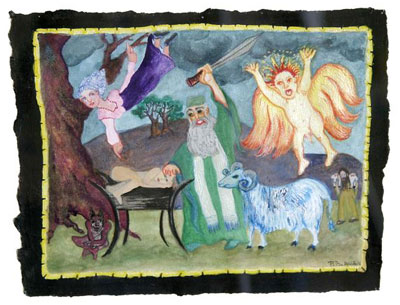
The Akedah by Pat B. Allen


So, even though I really struggle with the story of the binding of Isaac, of this image of a God who would demand the absolute worst of a person, I have come to understand that this is not a story about how we ought to have a blind obedient faith like Abraham, who was willing to sacrifice his only son at God's direction. Rather, it is a story about how Abraham's faith was a struggle as ours continues to be a struggle. Even in the face of miracles, Abraham made mistakes. Even with the words of God ringing in his ears, Abraham forgot God's will for his life. And yet, even when he was not, and even when we are not, faithful to God, God will be faithful to us.

Because, though this story of the binding of Isaac begins with the terrible and confusing words of God demanding an unspeakable evil, it ends with God calling out to Abraham, staying his hand, and providing a sacrificial ram instead. The story ends, as is usual for God and Abraham's relationship, with God speaking words of hope and blessing. “I will indeed bless you,” God says, “and I will make your offspring as numerous as the stars of heaven and as the sand that is on the seashore...and by your offspring shall all of the nations of the earth gain blessing for themselves...” (Genesis 22:17-18 NRSV).

This morning, may you hear hope and blessing in this place, remembering how even when you might mess up, even when you pull away from God, you are in good company. Abraham wasn't perfect either. But God loves him anyway, and God loves us too. God calls us back and offers us opportunities, opportunities as numerous as the stars or the dust on the earth or the sand by the sea, opportunities to reset ourselves so that we can live into that promise of blessing.

1Danna Nolan Fewell and David M. Gunn, “Keeping the Promise,” Gender Power and Promise: The Subject of the Bible's First Story (Nashville, Tennessee: Abingdon Press, 1993), 43.
2See Teri Peterson, “The Word of the Lord??” A Sermon for September 15 (Narrative Lectionary year 4, week 2), Clever Title Here, 14 September 2013, http://clevertitlehere.blogspot.com/2013/09/the-word-of-lord-sermon-for-september.html.

Wednesday, September 11, 2013

Please stop using women and children as excuses to go to war

I wrote this last week in the middle of the night. I updated it after the president's most recent speech. It has been weighing heavily on me, so posting it here today:

Please stop using women and children as excuses to go to war.

In the last few weeks, the leaders of the USA have spoken a lot about our ethical responsibility to save Syria from chemical weapons. As was done by former president George W. Bush in Iraq, rescuing women and children from living under oppressive and violent regimes has emerged as a important motivation for US military action. President Obama opened his remarks on Syria on August 31 by speaking of the fate of women and children. Earlier this week, he again opened by reminding us that “Assad’s government gassed to death over a thousand people, including hundreds of children” (emphasis mine).

On August 23, John Kerry actually spoke of the treatment of women and children as a moral obscenity. He said, “The indiscriminate slaughter of civilians, the killing of women and children and innocent bystanders by chemical weapons is a moral obscenity. By any standard, it is inexcusable.” He is quite right.

Except that it does not make much sense that military action is the proper response, for, as UNICEF has reported, “armed conflict kills and maims more children than soldiers.” Which we have seen in our own military's record on moral obscenities in Iraq, Afghanistan, Yemen, and Pakistan is abysmal. As I listened to John Kerry speak, massacres in Majalah in Yemen where 21 children and 14 women were killed in 2009 US missile strikes echoed in my memory.

So too, our domestic record in which women and children suffer from lack of access to health care, in which women's reproductive health is seen as a political football rather than a human right, in which children's head start programs are the first to be cut in the face of fiscal problems, in which women still in 2013 do not receive equal pay for equal work--- all of this makes plain to me that women and children are not interesting to us as a nation except as excuses to go to war.

And as I write this, I also remember hearing some people in Bosnia and Herzegovina and Kosovo talking in glowing terms about former president Bill Clinton's push of NATO intervention during the genocide in the 1990s. I am not proposing we do nothing as women and children are violently attacked by their own government. Rather, more of us need to echo folks like Rev. Andy Oliver at Reconciling Ministries Network who wrote, “Please stop repeating the story that our wars keep us safe, our killing is justified, our weapons are humane, please stop repeating it because it isn't true.” Or folks like Jim Wallis at Sojourners who wrote, “Old military solutions have clearly failed. It’s time to find a better and more successful way.” There are no easy answers, but there is an imperative to find a new way.

Rather, we need to lead a creative response to moral obscenities in a way that does not do further harm to civilians, particularly women and children. We need actually care for and show compassion for civilians brutalized by any government, rather than ignoring them until we can use them as talking points and rallying cries to justify ramping up the war machine.

Sunday, September 8, 2013

The Process of Revision

This week we had a beautiful outdoor service complete with a baptism to celebration God's work of creation. At Presbury United Methodist Church, we are beginning to use the Narrative Lectionary through Pentecost to better explore the story of our faith. 

Gospel Reading: John 1:1-5
Creation: Genesis 1:1-2:4a (Inclusive Bible translation)
In the beginning,
God created the heavens and the earth.


But the earth became chaos and emptiness, and darkness came over the face of the Deep--- yet the Spirit of God was brooding over the surface of the waters.

Then God said, “Light: Be!” and light was. God saw that light was good, and God separated light from darkness. God called the light “Day” and the darkness “night.” Evening came, and morning followed--- the first day.

Then God said, “Now, make and expanse between the waters! Separate water from water!” So it was: God made the expanse and separated the water above the expanse from the water below it. God called the expanse “Sky.” Evening came, and morning followed--- the second day.

Then Gd said, “Waters under the sky: be gathered into one place! Dry ground: appear!” So it was. God called the dry ground “Earth” and the gathering of the waters “Sea.” And God saw that this was good. Then God said, “Earth: produce vegetation--- plants that scatter their own seeds and every kind of fruit tree that bears fruit with its seed in it!” So it was, the earth brought forth every kind of plant that bears seed, and every kind of fruit tree on earth that bears fruit with its own seed in it. And God saw that this was good. Evening came, and morning followed--- the third day.

Then God said, “Now, let there be lights in the expanse of the sky! Separate day from night! Let them mark the signs and seasons, days and years, and serve as luminaries in the sky, shedding light on the earth.” So it was: God made the two great lights, the greater one to illuminate the day, and a lesser to illuminate the night. Then God made the stars as well, placing them in the expanse of the sky, to shed light on the earth, to govern both day and night, and separate light from darkness. And God saw that this was good. Evening came, and morning followed--- the fourth day.

God then said, “Waters: swarm with an abundance of living beings! Birds: fly above the earth in the open expanse of the sky!” And so it was: God created the sea monsters and all sorts of swimming creatures with which the waters are filled, and all kinds of birds. God saw that this was good, and blessed them, saying, “Bear fruit, increase your numbers, and fill the waters of the seas! Birds, abound on the earth!” Evening came, and morning followed--- the fifth day.

Then God said, “Earth, bring forth all kinds of living soul--- cattle, things that crawl, and wild animals of all kinds!” So it was: God made all kinds of wild animals, and cattle, and everything that crawls on the ground, and God saw that this was good.

Then God said, “Let us make humankind in our image. To be like us. Let them be stewards of the fish in the sea, the birds of the air, and everything that crawls on the ground.”

Humankind was created as God's reflection:
in the divine image God created them;
female and male, God made them.

God blessed them and said, “Bear fruit, increase your numbers, and fill the earth--- and be responsible for it! Watch over the fish of the sea, the birds of the air and all the living things on the earth.” God then told them, “Look, I give you every seed bearing plant on the face of the earth, and every tree whose fruit carries its seed inside itself: they will be your food; and to all the animals of the earth and the birds of the air and things that crawl on the ground--- everything that has a living soul in it--- I give all the green plants for food.” So it was. God looked at all of this creation, and proclaimed it was good--- very good. Evening came, and morning followed--- the sixth day.

Thus the heavens and the earth and all their array were completed. On the seventh day God had finished the work of creation, and so, on that seventh day, God rested. God blessed the seventh day and called it sacred, because on it God rested from all the work of creation.

These are the generations of the heavens and the earth when they were created.

Sermon: The Process of Revision
At the beginning of God's creating God told a story “that became the universe.”1 This beginning was not so much a time so much as a process,2 a process that may be still going on today, as the earth continues to change and adapt, as we change and adapt. This is a story not just about the earth and how it came to be, but it is also a story about us, about how we as people of faith came to be. This is not a literal, civil-engineer certified blueprint for how to create a world. It is a story. But it is a story that shows us the power of Word and Spirit.

When we translate this story from Genesis into English, it seems very straightforward. I had Minister Jackie read from a translation called the Inclusive Bible because it lets some of the confusion of the verses sink in. Where we usually read “formless and void,” in this translation we read something a little bit closer to the Hebrew: “chaos and emptiness.” But these two things together are confusing. My office in my house is chaotic BECAUSE it is not empty but full of stuff I have to organize. And every other time a phrase similar to this occurs in the bible, it signifies ruin and desolation.3 But isn't this the beginning? How could things be ruined already?

The text nurtures our questions but does not give answers to them specifically. Instead, we get another kind of answer. We get the Spirit and the Word. The Spirit of God broods over the surface of the waters, “the way a bird broods over the eggs in her nest...represent[ing] the divine power to recreate and restore that which has been spoiled or destroyed.”4 The story doesn't end with chaos and emptiness. It begins again with Spirit and Word; the power of God is to elicit goodness, to elicit life in the world again. From this brooding, God speaks, and that which God speaks becomes. And God saw that the desolation, the chaos, was transformed into goodness.

In the second chapter and first verse of Genesis, we read, “Thus the heavens and the earth and all their array were completed.” When we read that verse, sometimes we focus too much on the word “completed” and forget the first verses of chapter one that hinted at the processes of revision and restoration that are continually a part of creating.

I, unfortunately, am not a crafty person; when I want to create something, I use words, and used to write a lot more fiction. In an introduction to creative writing class I took in college, I got frustrated with my professor for denying that a story can be “completed,” as we read here in Genesis. He said that we are never wholly finished with a story. We do not attain perfection after receiving feedback from colleagues and writing a certain amount of drafts. We may get to a point where we decide that we cannot work on the story anymore, but we never craft the perfect story.

What made me mad about this point my professor made was that I could theoretically come back to a published story--- not a huge problem for me since I have not published any of my fiction, but it is the principle of the thing--- I could come back to a published story and find a word I wanted to change, or a paragraph I wanted to move around, or even something like a comma that should have been a semi-colon. I found this first hand when I stripped a novella I had written for this class--- at least a hundred pages--- down to a simple, one-page prose poem my senior year of college. All that work, hours of writing, for one single page? But where I was as an eighteen-year-old, fresh from Harford County wondering what the heck she was getting into, was not where I was as a senior who was fluent in another language, had lived in big cities, slept outside of train stations, made new friends, and heard my calling. And so I saw in revising that story how we ourselves are constantly revised.

God is constantly at work among us, revising, restoring, recreating. Always trying to lure us back to that goodness when things seem to get all ruined. Just look at the story of our faith:
  • We're having a good old time with God, but we eat this fruit God told us not to, and so we have to revise our way of living away from the garden;
  • we hurt one another and creation so badly that God sends a flood to kill everything but a small remnant to start over, but such an action makes God so sad that God promises never to do it again;
  • we get caught in the clutches of slavery, and God rescues us and gives us the Law to help us start over;
  • but still we fight and squabble and so God gives us a king to lead us;
  • only the king God gave to lead us becomes inept and corrupt, and we are sent into exile, but God sends prophets to give us words of repentance and of hope until we return home at last.
And those are just some of the moments in our faith story in the Old Testament that demonstrate this process of revision and restoration. We fall away, and God works with us to bring us back to that goodness God proclaimed at the beginning of God's creating. And of course then, in the New Testament, God gives us Jesus to walk among us and teach us and show us a new way to live, helping us revise our lives full of sin and oppression into ones of life and light. These are big moments where God shows us how that creation process really is never complete until the kingdom on earth Jesus preached is fully realized on Earth.

But there are smaller moments where God helps us to revise the story we're writing about ourselves and our community, helps us to revise our own stories from ones about isolation and greed, loneliness and grief, injustice and oppression to ones about goodness, light, and life. Maybe we had a Sunday school teacher like Miss Minnie or Miss Ethel or Baylee who instilled a love of God in us at a young age so deeply that we remembered that love when we were feeling at our worst. Perhaps we heard a song that spoke the gospel to us in such a new way we found renewed energy for life and service. Maybe a stranger offered us kind words in a moment of need that shed light on how we need to shed lives of busy-work for ones of intimacy. Through people and situations, the Spirit of God broods over the chaos and emptiness we may feel in our own lives and helping us create something good out of it all.

Baptism is a type of revision and recreating too. As Methodists, we often baptize children, which can be confusing, for most of us don't view infants as inherently sinful creatures who need to die to the chaos and emptiness within them and be born again in the goodness of Christ. Instead, baptism is a way that we as a community come together to proclaim God's constant recreating and restoring work in our lives. That's part of why we only do it once as Methodists--- if we were baptized every time God was at work in our lives offering goodness and redemption, we'd have to walk around with little baptismal font Supersoakers holstered on our backs or something. And if we chose to be baptized only after experiencing some particularly saving event, we could accidentally forget the power in all the events to follow in which God broods over us. Rather, baptism is a time where we as a community enter into this story of a God who has the power to restore and create us no matter what happens throughout our lives.

Now, we could live our entire lives with God brooding over us but never crack that shell to emerge into a world of goodness. When God creates humans in this story, God gives us co-creating responsibilities, telling us not only to bear fruit, but to watch over the life on the earth. We don't do this well. Sometimes we actively refuse to work for goodness, and use our co-creating powers for destruction and ruin. But God still reaches out to us, still demands a response that will lead to restoration.

The Gospel of John reminds us, that, “What has come into being in the Word,” both the Word God spoke at the beginning and the Word that is Jesus, “was life, and the life was the light of all people. The light shines in the darkness, and the darkness did not overcome it.” Let us live into that light together, my friends, rejoicing in God's power to recreate and restore all to goodness again.

1Michael Williams, editor, “The First Account of Creation: Genesis 1:1-2:4,” The Storyteller's Companion to the Bible, vol.1: Genesis (Nashville, Tennessee: Abingdon Press, 1991), 28.
2Notes to verse 1 of Genesis 1 in The Inclusive Bible: The First Egalitarian Translation.
3Notes to verse 2 of Genesis 1 in The Inclusive Bible: The First Egalitarian Translation.
4Ibid.

Monday, July 8, 2013

A Plentiful Harvest


This is the first sermon I preached as the new pastor of Presbury United Methodist Church in Edgewood, Maryland. 
 
Scripture: Luke 10:1-11, 16-20 (NRSV)

After this the Lord appointed seventy others and sent them on ahead of him in pairs to every town and place where he himself intended to go. He said to them, “The harvest is plentiful, but the laborers are few; therefore ask the Lord of the harvest to send out laborers into his harvest. Go on your way. See, I am sending you out like lambs into the midst of wolves. Carry no purse, no bag, no sandals; and greet no one on the road. Whatever house you enter, first say, ‘Peace to this house!’ And if anyone is there who shares in peace, your peace will rest on that person; but if not, it will return to you. Remain in the same house, eating and drinking whatever they provide, for the laborer deserves to be paid. Do not move about from house to house. Whenever you enter a town and its people welcome you, eat what is set before you; cure the sick who are there, and say to them, ‘The kingdom of God has come near to you.’ But whenever you enter a town and they do not welcome you, go out into its streets and say, ‘Even the dust of your town that clings to our feet, we wipe off in protest against you. Yet know this: the kingdom of God has come near.’

“Whoever listens to you listens to me, and whoever rejects you rejects me, and whoever rejects me rejects the one who sent me.”

The seventy returned with joy, saying, “Lord, in your name even the demons submit to us!” He said to them, “I watched Satan fall from heaven like a flash of lightning. See, I have given you authority to tread on snakes and scorpions, and over all the power of the enemy; and nothing will hurt you. Nevertheless, do not rejoice at this, that the spirits submit to you, but rejoice that your names are written in heaven.”

Sermon: A Plentiful Harvest

I am so blessed to be here this morning as your pastor. This is a beautiful church, filled with beautiful people who have been so incredibly welcoming to me and Aaron, despite the fact that we are duck farmers, you know graduates of North Harford. Don’t hold it against us, ok? But in all seriousness, we are so excited to begin ministry with you. Too often, you hear about churches that are social clubs, insular, focused in on themselves, but you are a strong congregation of disciples striving to be a missional community, and we feel so blessed to be a part of that.

So when I turned to scripture to prepare for this morning, I was immediately drawn into our gospel lesson from Luke, when Jesus commissions not just his twelve disciples but seventy of his followers to proclaim the kingdom of God. I thought Jesus’ instructions to his followers were important for us to hear this morning as we face this time of pastoral transition.

So let us pray:

Patient Teacher,
we come to you this morning, perhaps uncertain, but reaching out to you.
May we feel you reaching back to us, lifting us up,
as we look to your instructions this morning to learn how we are to live. Amen.

A plentiful harvest. The harvest metaphor is a popular one in scripture, particularly in scripture that announces the coming or the nearness of the kingdom of God. It is a metaphor that speaks of sending people out of their homes, out of their comfort zones, to get their hands dirty and foreheads sweaty. And it is a metaphor that reminds us that though we are the hands and feet of this operation, we aren't the creator of the seed, beacause it is God who prepares the harvest, not us--- God, who whispers in the hearts of people. And, perhaps most importantly, it is God who whispers in our hearts too.1

So in our scripture today, Jesus is using the harvest metaphor to send seventy of his followers ahead of him to spread the news of the kingdom of God. But in the Gospel of Luke, unlike in the more familiar Gospel of Matthew when Jesus says, “Go therefore and make disciples of all nations,” Jesus' commissioning of his followers to do the work of evangelism has some pretty specific instructions.2 First, the followers of Jesus were to bring nothing with them, then they were to offer peace to those they encountered, then they were to eat and drink whatever was set before them, then they were to cure the sick, and proclaim that the kingdom of God has come near. So that's: Come empty handed, offer peace, eat, cure the sick, and proclaim the kingdom of God. Well, as good Methodists, we've got the eating part down pat, it's just the other stuff that we aren't so sure about.

I don't know about you, but when I think of evangelism today, when I think of “harvesting,” I don't think of the vulnerability and reciprocity that Jesus so clearly intended by these instructions. I don't think of dialogue and friendships, a two-way street. But even today, when perhaps the model of going out two-by-two into strangers' homes doesn't work in the same way it did in Jesus' time, the underlying instructions of vulnerability and reciprocity--- key ingredients needed for transformational relationships--- remain.

I think I like the Great Commission from the Gospel of Matthew better. Being less specific, it seems a little less difficult to me! And Jesus' instructions in the Gospel of Luke don't just seem difficult to us--- even the disciples struggled with them! Just before the passage we read this morning, in the ninth chapter of Luke's gospel, Jesus and his followers go to a village of Samaritans who did not receive them, and this apparently upsets the disciples James and John so much that they ask Jesus if they could get God to rain fire on the village. After such a question, Jesus must have thought specifics, no matter how difficult to follow, were necessary. His own disciples seemed to miss the point about the whole kingdom of God thing, so he needed to come up with some rules that would help them understand a little better.

And so these specifics make me wonder if such a commission to proclaim the kingdom of God is less about changing “them” than it is about changing us.

You will hear me tell a lot of stories about working as a chaplain at a hospital in New Jersey my final year of seminary. It was a formative experience for me as a Christian, and so when I was thinking this week about reciprocity and vulnerability I kept thinking back to my first day as a chaplain. One of the floors where I served was the psyche ward, or behavioral health unit. I had specifically asked to be on this floor, thinking that there the harvest would be plentiful, a whole floor of people aching to hear God's word of life and love. I wanted to be the one saying, “Peace to you,” as Jesus instructed his followers.

My first day in the behavioral health unit, though, I was the one who needed peace. Being a chaplain is a very vulnerable experience. You are walking into hospital rooms you were not invited into, facing rejection at every turn; and those places where you aren't rejected, you often have to confront some of your greatest fears about mortality. So, I had stopped in the behavioral health unit already that day shaking and uncertain and had one of the nurses ask if anyone wanted to speak with a chaplain. Everyone responded with resounding no's. Rejection. So, instead of sitting with folks and being for a few moments, I escaped easily, promising half-heartedly to return later.

Jesus told his followers not to move about from house to house, perhaps knowing that moving on can be an excuse to cover up our own fears and anxieties. But I did return later, and that time I did not announce myself; I just said hi to folks watching the TV, wandered down the hallway, and just when I was about to awkwardly leave again, I decided to walk through the game room area. A young man was in there, and we greeted each other. He was collecting board game pieces, monopoly money, Life cards, and so I assumed he was manic, unable to sit still, and probably not capable of holding a conversation. I wrote him off, and was ready to shake the dust off of my feet and move onto the next place.

But as started to walk away, he asked me rather conversationally where I was from, so I turned back and sat down next to him. He proceeded to tell me about himself, where he was from, what he studied, a little of what brought him to the behavioral health unit. He was, in fact, bipolar, and a recovering alcoholic, and he spoke plainly to me about the hospital program and how much of its merit to him was that he saw examples of what he did not want to become. I felt guilty for walking by him without even giving him a chance, but apparently not enough to change my assumptions about our relationship. When I was leaving, I asked him if he would mind if I kept him in my prayers. He said of course he wouldn't mind, and as I got up to leave and started to turn around he said that he would be keeping me in prayer as well.

This is the kind of vulnerability and reciprocity that Jesus had in mind when he sent the seventy out. He wasn't sending them to drop knowledge on those poor unfortunates who hadn't heard the good news yet--- he sent them, and sends us today, to form relationships, to change others while being changed ourselves. That is part of the reason why the harvest is so plentiful because we are helping not only new people to see God's love, but we ourselves are learning to see God's love anew through our relationships with these new people. You see, I had missed the point completely, thinking I had some special authority by which I could proclaim the kingdom of God as the chaplain of the behavioral health unit. Instead this young man was a witness to Christ's healing, forgiveness, renewal, all wrapped into one stark sentence: “I'll be praying for you too.”

Last week, Dave Moyer preached about being ready for a change. And I think Pastor Bonnie's ministry with you was also getting you ready for change. You have said you want to be the church in the community for the community, that you want to help Edgewood become a safe, vibrant, healthy, loving place. But to do that work is not just a one-way street, us helping Edgewood. It is about us listening to the community, being in relationship with people in the community, and allowing that relationship to transform us for the better too.

Just because we're all Christians and get up to come to church on Sunday morning doesn't mean we've gotten it. Remember James and John wanting to reign down fire on some poor unfriendly village? They were disciples, sitting at the feet of Jesus day in and day out and they still missed out on some pretty important pieces of the gospel message! And look at me, a chaplain in the hospital forgetting the way Christ was working not in me but in hospital patients as well. Jesus instructs us to be vulnerable and enter into relationship seeking to feel God's love ourselves as well as to show God's love to others.

At the end of the passage from Luke, we read, “The seventy returned with joy.” Entering into the unknown, going out and making connections with people, letting people open us up to God's love even as we are trying to show them God's love: all this is scary, unsettling. But it brings joy too, a plentiful joy! So I pray that as we begin our ministry journey together and continue our ministry of being a church in the community for the community, we may all be open to the way God is shaping us. For though the laborers are few, God is with us, and so the harvest will be plentiful. Thanks be to God.


1David J. Lose writes, “God is responsible for the growth of our communities. We are called to be open to this growth; to plan, organize and work in a way that anticipates, rather than impedes such growth; and to pray for and invite others to join us in gathering the harvest God has prepared.” Homiletical Perspective on Luke 10:1-11, 16-20, Proper 9, Feasting on the Word: Preaching the Revised Common Lectionary, Year C, Vol. 3, eds. David L. Bartlett and Barbara Brown Taylor, (Louisville, Kentucky: Westminster John Knox Press, 2010) 217.

2Matthew 28:19 (NRSV). See Elaine A. Heath, Theological Perspective on Luke 10:1-11, 16-20, Proper 9, Feasting on the Word: Preaching the Revised Common Lectionary, Year C, Vol. 3, eds. David L. Bartlett and Barbara Brown Taylor, (Louisville, Kentucky: Westminster John Knox Press, 2010) 214.

Sunday, June 23, 2013

Unafraid to Act on the Unfailing Abundance of God


This is the last sermon I preached as a pastor of Deer Creek and Mt. Tabor United Methodist Churches. I have been so blessed to be their pastor, as you will see from the sermon. 

Scripture: 1 Kings 17:8-16 (NRSV)
Then the word of the Lord came to him, saying, “Go now to Zarephath, which belongs to Sidon, and live there; for I have commanded a widow there to feed you.” So he set out and went to Zarephath. When he came to the gate of the town, a widow was there gathering sticks; he called to her and said, “Bring me a little water in a vessel, so that I may drink.” As she was going to bring it, he called to her and said, “Bring me a morsel of bread in your hand.” But she said, “As the Lord your God lives, I have nothing baked, only a handful of meal in a jar, and a little oil in a jug; I am now gathering a couple of sticks, so that I may go home and prepare it for myself and my son, that we may eat it, and die.” Elijah said to her, “Do not be afraid; go and do as you have said; but first make me a little cake of it and bring it to me, and afterwards make something for yourself and your son. For thus says the Lord the God of Israel: The jar of meal will not be emptied and the jug of oil will not fail until the day that the Lord sends rain on the earth.” She went and did as Elijah said, so that she as well as he and her household ate for many days. The jar of meal was not emptied, neither did the jug of oil fail, according to the word of the Lord that he spoke by Elijah.

Sermon: Unafraid to Act on the Unfailing Abundance of God
In February of last year I was really feeling worn down. I had just finished working as a hospital chaplain and was already waist-deep into my last semester of seminary. Though I only needed one class to graduate, I took a full-load of classes because I'm crazy like that. One of the classes I took was the General Conference class which required me to leave school for ten days at the end of the semester to go to Florida, so I was spending a lot of time in and out of my other professor's classes trying to convince them that I wouldn't let leaving for ten days affect my finals work. I was also working two part-time jobs and trying to come home as much as I could to see Aaron. And on top of all this, I underwent the examination by our Board of Ordained Ministry in Ellicott City, a three day interview exam that covered paper work I had written over two years before.

And so, naturally, during this exam that was basically to determine whether or not I could be a pastor in the United Methodist Church, I kind of broke under all this stress. I was inarticulate, I cried, I got frustrated with those pastors asking the questions. And, though I passed the exam, I left feeling complete demoralized and just empty. Now, much of my struggle with the exam didn't come from the Board of Ordained Ministry itself but from this world of stress I lived in--- you know how that is? Like when you are stressed and someone says to you, “Are you wearing that?” and your mind immediately goes to them thinking you are fat rather than just they haven't seen you wear it for a while or it has a stain or something. I interpreted comments as disparaging that probably weren't meant to be that. But the result was that I had never doubted myself as a pastor more than after I took that exam. Frankly, despite having three years of school plus this denomination examination under my belt, I wanted to give up on becoming a pastor.

I went to Bosnia for spring break that March (I know kind of random, but I did), and, though I didn't talk to our District Superintendent about it first, I began talking to my friends over there and looking into summer programs to learn Bosnian. I began to pray that I would not be given an appointment after all. I prayed God would let me do something else with my life. I was tired.

And then I got a call from Rev. Dr. Karin Walker about coming to Deer Creek and Mt. Tabor. As soon as she said the names of these churches, this knot in the pit of my stomach, the frustration with my call, it all just dissipated. I was still nervous and a little uncertain, but that desire to run away was replaces with trust and a faint hope.

I hope that when I came all this turmoil within me was not terribly obvious. In reflecting on where I was when I accepted the appointment here last year, I felt a lot like I imagine the widow of Zarephath must have felt.

Now, I know that may seem ridiculous to some of you. I know nothing of the intense physical hunger this widow felt. I know nothing of her poverty. Though I do feel that some of my perceived issues with the exam had to do with the fact that I am young woman in a profession many still assume is just for older men, I know nothing of the oppression this widow faced. So, in spite of all this, I hope you don't feel I'm too presumptuous in seeing myself in this story. I recognize, and hope you do as well, that it is a story about how God lifts up the oppressed, sides with them: a story about how our own nourishment and survival really are caught up in our own hospitality to the least of these.1

But this is also a story about finding abundance in scarcity, and about living a call to trust in God that we don't always remember we have. Carol Cook Moore, a professor at Wesley, says that it is a story that asks us, “What keeps us going during 'lean' times? And how can we provide for others during their times of want?”2

Well, I felt like I was in lean times last spring. I felt stretched, hollow, and a little abandoned. I wasn't collecting sticks so I could go home and eat my last bit of bread before awaiting death, spiritual or otherwise. But I was ready to throw in the towel on this pastor thing. That is: until I came here, and from the first day, you surrounded me in love, and affirmed me at every turn--- even on weeks when my sermons were bad and the service went long and I made you sing all those new songs I falsely promised you were easy to learn. You affirmed me when I stumbled over prayers and you just squeezed my hand. And when I let bible studies get way topic, we still ended up learning a bit about God. If I was nervous about a hospital visit, you were just so grateful I was there that you reminded me that sometimes words don't matter as much.

I heard Elijah's voice in you, that voice that told me not to be afraid. The voice that told me that though I may feel scarcity and emptiness in my soul sometimes, God promises abundance.

You see, you showed me that God has given me gifts for ministry. Or perhaps more than that, you have made me become a pastor. You have heard before that your gift is teaching pastors, and it is true. You took a tired, nervous young woman who was frustrated with the church and even a little frustrated with God, and you turned her into a confident pastor who was just told recently, “Well, I don't think much of women pastors, but, you know, you're ok.” (In some circles that's a pretty big deal.)

It wasn't me who did this work of pastor-creating. That was God, God shaping me through your love, affirmation, and gentle corrections or suggestions. You showed me that if I stay in love with God and the church, then amazing things happen.

And so when I read this story in 1 Kings, it is my story of famine and abundance that I see alongside the widow and Elijah's story. So what about you? Can you see yourselves in this story? Have you had to face life after the loved one? Have you had to face life unemployed? Maybe your famine looked different. Maybe your famine was when you were a church of nine people, meeting faithfully through gritted teeth Sunday after Sunday. Maybe it was when as a church who lost a matriarch, the woman who made all things happen here? Have you felt the despair the widow felt?

I think we all have in one way or another. So I turn your words to me back to you this morning. “Do not be afraid.” You are good at change, unlike most people, and most of you have been through change many times before. As a church, you have had good experience with change--- yes, many of you hated to lose Pastor Bonnie, but then I turned out ok, so it wasn't a terribly devastating experience. But that doesn't make this next change any less scary.

Elijah knew your fear too, though. Before Elijah came to the widow, at the beginning of the seventeenth chapter of 1 Kings, he had been in hiding by a riverbed, where God sent ravens to provide him with food. When the riverbed dried up, God sent him to the widow. Elijah should have known that if God could feed him using birds, surely God could provide for him through this woman. But these is an interesting detail here: God says to Elijah, “for I have commanded a widow there to feed you,” but when Elijah asks the widow for food, she does not act as though God has commanded her to do anything whatsoever. If I were Elijah, I sure would be wondering around then about God's provision. One of the commentators I read for today, writes, “We cannot blame Elijah if he mutters to himself, 'I would rather trust the ravens than depend on the widow. Does God know what God is doing?'”3 But if Elijah felt that way, he didn't reveal it in his words to the widow. He just said to her: “Do not be afraid. God will provide.”

Now, Elijah didn't mean that God will provide in the prosperity gospel sense that if you just pray hard enough God will give you whatever you want. And that's not what I mean either. I don't think I'm done with second guessing God's call on my life--- I don't think many of us are safe from spiritual droughts. There may be droughts and lean times in the future, for all of us--- who knows? But God is with us. Elijah says to the widow of Zarephath, “For thus says the Lord the God of Israel: The jar of meal will not be emptied and the jug of oil will not fail until the day that the Lord sends rain on the earth.” God will fill you with the nourishment you need--- and God? God will not fail.

So, since we know God will not fail, how will we reach out as the hands of God, to be Elijah's voice proclaiming God's abundance in spite of the uncertainty of it all, or to be the widow feeding a stranger in spite of her fear? This is our call today. So let us emerge from this place today, unafraid to act upon the unfailing abundance of God.

Let us pray:
Patient teacher, we give you thanks for this story of miracles
and ask that you help us perceive the miracles you work in our lives every day.
Deer Creek United Methodist Church June 23, 2013
And God--- give us the strength and courage to enact your miracles of abundance
everywhere we go, even in times of famine.
We pray this in the name of the abundant life
you have given us through your son Jesus. Amen.


Mt. Tabor United Methodist Church June 23, 2013
 
1Juliana Claassens, Commentary on 1 Kings 17:8-16, Working Preacher, 8 November 2009, http://www.workingpreacher.org/preaching.aspx?commentary_id=424.
2Carol Cook Moore as quoted on Crossroads Worship Experience's Facebook Page, 17 June 2013.

3H. James Hopkins, Homiletical Perspective on 1 Kings 17:8-16 (17-24), Proper 5, Feasting on the Word: Preaching the Revised Common Lectionary, Year C, vol. 3 Petecost and the Season after Petecost 1, eds. David L. Bartlett and Barbara Brown Taylor, (Louisville, Kentucky: Westminster John Knox Press, 2010) 101.