Monday, December 16, 2013

The Contents of Your Bookcase a Part of Your History

"The contents of someone's bookcase are part of his [sic] history, like an ancestral portrait." -Anatole Broyard

On Facebook, there is this suggestion going around: "List 10 books that have impacted your life, but don't think about it too hard." Of course, I always think too hard, and there are way more than ten books that have influenced me, especially if I include all I have read recently. But I still wanted to participate because books have made me into who I am today, helped me to better understand that I learned from the saints and prophets in my life. I am thankful for those people who have shared books with me, and hope that you pick up one of these books and enjoy it as well!

1. Books about Who God Is and Who We Are
Old Turtle by Douglas Wood and Cheng-Khee Chee, Mists of Avalon by Marion Zimmer Bradley, The Color Purple by Alice Waker, The Sparrow and Children of God by Mary Doria Russell
The first three of these were read before I graduated from high school, and I was fortunate to have encountered both Old Turtle and The Color Purple in church. God in all these books is far more fluid and complex and vulnerable than one typically learns in Sunday school.
2. Books that Showed Me What Strong Women Can Look Like
The Paper Bag Princess by Robert Munsch and Michael Martchenko, Philip Pullman's The Sally Lockheart Mysteries, Books by Tamora Pierce, A Handmaid's Tale by Margaret Atwood, The Vagina Monologues by Eve Ensler
Unfortunately, all of these books were also very white and middle class; yet they still gave me an image of the women and girls as heroes.  
3. Books that Taught Me to Be Critical of Religion from a Young Age
Philip Pullman's His Dark Materials, The Poinsonwood Bible by Barbara Kingsolver, The Mists of Avalon by Marion Zimmer Bradley
Philip Pullman's are beautiful books that treat the children they are written for as intelligent and capable of knowing the truth, even when it is ugly and painful. The Poisonwood Bible showed me the dangers of mission and evangelism while at the same time showing me the beauty of cross-cultural relationships. The Mists of Avalon taught me that we have a lot more in common across faiths than we care to admit...
4. Books about the Church, Our Pitfalls, and Our Possibilities
A Generous Orthodoxy by Brian McLaren, The Irresistible Revolution by Shane Claiborne, and Jesus for President by Shane Claiborne and Chris Haw, and Acts of Faith by Eboo Patel
These books I read in college and am now at a much different place in my faith journey, and I could probably include Donald Miller as well. Now I am far more critical of Shane Claiborne, even though I still admire the work he does so much. But these books gave me a taste of the revolution that is inherent in faith-communities while critiquing their current state.
5a. Probably The Most Beautiful Book I've Ever Read
The Bluest Eye by Toni Morrison 
Really anything by Toni Morrison. I think she is one of the most brilliant, most powerful authors of all time. 
5b. Also This One is Amazing
Borderlands/La Frontera by Gloria AnzaldĂșa
Seriously.  
6. Books that Helped Me Place Myself in the Biblical Story
The Magdalene Gospel by Mary Ellen Ashcroft, Lamb by Christopher Moore
When I preach, I am constantly trying to discover how we can claim this biblical story without whitewashing it and ignoring its own sin--- and without taking it too seriously. These two books helped me see how to do that.
7. That Book I Can't Get Out of My Head
Love the Sin: Sexual Regulation and the Limits of Tolerance by Janet Jakobsen and Ann Pellegrini
The problem with tolerance. Read it.
8. Books that Reveal the Reality of this World We Live In
The Revolution will Not Be Funded by INCITE! Women of Color Against Violence, The New Jim Crow by Michelle Alexander, The No-Nonsense Guide to Globalization by Wayne Ellwood
Tired of being lied to? Wondering about the failure of liberalism to change the world for good? Read these books, be sad, and then do something about what you've read.
9. More Books I've Read since Graduating from Seminary about Who God is and Who We Are
The Cross and the Lynching Tree by Jame H. Cone, On the Mystery by Catherine Keller, Children of Israel by Danna Nolan Fewell, Saving Paradise by Rita Nakashima Brock and Rebecca Ann Parker
These books have changed my life as a pastor, constantly keeping me critical, and reminding me why I felt God could use me as a pastor to do justice work.
10. And of Course, My Favorite Books
Everything Is Illuminated by Jonathan Safran Foer, Oryx and Crake by Margaret Atwood, The Sparrow by Mary Doria Russell, The Question of Bruno by Aleksandar Hemon, and The Dog Stars by Peter Heller


There are many missing--- Laura Ingalls Wilder, L. M. Montgomery, C.S. Lewis, J.R.R. Tolkien, and  Lloyd Alexander being the most glaring omissions--- and I am still thinking about The Hunger Games and The Book Thief. But that's the thing about books. They stick with you and give you a hunger for more books.

Please share your own lists below in the comments section!

Invitation to Peace

The second Sunday of Advent, we had three baptisms at Presbury United Methodist Church and I felt called to remember the prophetic life of Nelson Rolihlahla Mandela. It was a lot for a young preacher to attempt in one sermon! What follows is adapted from the sermon I preached.

Scripture Lesson: Isaiah 55 (NRSV)
Ho,everyone who thirsts, come to the waters; and you that have no money, come, buy and eat! Come, buy wine and milk without money and without price. Why do you spend your money for that which is not bread, and your labor for that which does not satisfy? Listen carefully to me, and eat what is good, and delight yourselves in rich food. Incline your ear, and come to me; listen, so that you may live. I will make with you an everlasting covenant, my steadfast, sure love for David. 

See, I made him a witness to the peoples, a leader and commander for the peoples. See, you shall call nations that you do not know, and nations that do not know you shall run to you, because of the Lord your God, the Holy One of Israel, for he has glorified you. Seek the Lord while he may be found, call upon him while he is near; let the wicked forsake their way, and the unrighteous their thoughts; let them return to the Lord, that he may have mercy on them, and to our God, for he will abundantly pardon. For my thoughts are not your thoughts, nor are your ways my ways, says the Lord. For as the heavens are higher than the earth, so are my ways higher than your ways and my thoughts than your thoughts. 

For as the rain and the snow come down from heaven, and do not return there until they have watered the earth, making it bring forth and sprout, giving seed to the sower and bread to the eater, so shall my word be that goes out from my mouth; it shall not return to me empty, but it shall accomplish that which I purpose, and succeed in the thing for which I sent it. 

For you shall go out in joy, and be led back in peace; the mountains and the hills before you shall burst into song, and all the trees of the field shall clap their hands. Instead of the thorn shall come up the cypress; instead of the brier shall come up the myrtle; and it shall be to the Lord for a memorial, for an everlasting sign that shall not be cut off. 

Sermon: Invitation to Peace
Let us pray:
Patient Teacher, let not the Word that goes forth from your mouth return empty!
Plant your Word within us this morning,
pour out your Spirit upon us so that we may bear good fruit;
for the sake of Jesus Christ our Lord. Amen.1

I found myself reflecting this week on the Isaiah text we read together as though I was on Robben Island in South Africa, a place I visited four years ago. Robben Island is a desolate place. Even now that it is covered in tourists, it feels empty and cold. You can see Table Mountain and Cape Town across the water, but it feels so far away. It was easy to see how such a place could be used as a prison, as it was used since the seventeenth century until the mid-nineties, for it feels as though this little bit of land had broken off from civilization and was drifting off into the sea. And yet, it is a place that signifies, to me, the invitation to peace we read about in the fifty-fifth chapter of Isaiah. 

The text is introduced in my translation of the bible as an Invitation to Abundant Life. Yet, for the community who first read this invitation, they must have felt like the prisoners on Robben Island, desolate and cold, cut off from home and community unjustly. Such an invitation to abundant life that we read in scripture or hear in the words of great leaders like Nelson Mandela seems strange. And yet, when I was visiting Robben Island in 2009, I saw it has indeed become a place where it is as though the mountains and the hills break forth into song and the trees clap their hands. One of the most powerful things about visiting Robben Island was how the South Africans touring it with us burst into freedom songs.

Now, I know that not many of us are familiar with South African history--- I never even learned about apartheid in school and I don't know if it is taught today. But in light of Mandela going home to his ancestors, joining the great cloud of witnesses, this week, I could not shake the connection between Isaiah's and Mandela's invitations to abundant life, characterized by full bellies, joy, and peace. So even though a history lesson may be strange for a sermon, I hope you can hear the calls to abundant life within it.

The first connection I saw between these two invitations is that both invitations came from people in exile. When we read, “For you shall go out with joy and be led back in peace,” in the fifty-fifth chapter of Isaiah, it is a reference to the Babylonian exile, when important, prestigious, and powerful Israelites were forced out of Israel when it was conquered. But even after two generations of exile, prophets believed that they would return home.

So too the story of not only Mandela but of all South Africa is one of exile and a longing for home, especially for native black South Africans. South Africa was colonized by the Dutch and the British beginning in the 1600s. Slavery, war, and exploitation of labor and land were characteristics of Europeans' occupation of South Africa. And, as was the case in our own country, inequality was present from the beginning. The government run by the white minority established apartheid, officially introduced in 1948 when Nelson Mandela was 30 years old. Apartheid is a word that means “apartness,” and was a system of violent racial segregation not unlike Jim Crow in our country. In it, however, people of color were not considered to be citizens at all, did not deserve any rights at all, and for whom most services like medical services were inferior to those for whites. People of color were to be constantly reminded of their so-called inferiority, even to the extent that Mandela received short trousers instead of long pants that white prisoners received when he got into prison in Robben Island to remind them, he says, that they were boys.3 This system of segregation provided a labor force for the whites in charge.

Mandela resisted apartheid from the beginning, and worked for freedom. He started as a lawyer, often working with poor blacks on things like police brutality. He urged South Africans to fight for their freedom, and spread a vision of an egalitarian society where people could live free of domination based on race. He moved up the ranks in the African National Congress, a political party that was eventually made illegal by the apartheid government and was forced underground. Mandela was constantly harassed by the police, and was eventually imprisoned for twenty-seven years in that place of such cold loneliness on Robben Island.

And yet--- here is the second connection--- yet, leaders like the prophets of Israel and Nelson Mandela and Jesus kept dreaming and proclaiming a different world. They spoke of peace in the midst of violence, abundance in the midst of hunger, equality in the midst of huge economic difference. Now, in Mandela's case, this dream was not a nice, nonthreatening one. Mandela was actually considered to be a terrorist by our own government until 2008. While I find that absolutely ridiculous and embarrassing on our part, I must confess that as a pacifist I struggled reading his autobiography when in it he talks about his decision in the African National Congress to take up arms against the white supremacist government. But I still consider him to be a fighter for peace because, even in his acts of sabotage he was against hurting civilians, and his presidency was defined by reconciliation. He was elected president, the first true democratically elected president, in 1994, and he served until his retirement in 1999.

Mandela oversaw the establishment of the Truth and Reconciliation Commission during his presidency, where war criminals, those who had perpetuated the sin of apartheid in South Africa could be brought to justice. However, those convicted were not thrown in Robben Island's cold cells. Rather, the commission offered amnesty in return for truth and breaking the silences around the human rights violations that had occurred. It offered opportunity not to dwell in the past, but to break silences that blocked the possibilities for the future.

In his inaugural speech, Mandela said:
We understand it still that there is no easy road to freedom. We know it well that none of us acting alone can achieve success. We must therefore act together as a united people, for national reconciliation, for nation building, for the birth of a new world. Let there be justice for all. Let there be peace for all. Let there be work, bread, water and salt for all. Let each know that for each the body, the mind and the soul have been freed to fulfill themselves. Never, never, and never again shall it be that this beautiful land will again experience the oppression of one by another and suffer the indignity of being the skunk of the world. The sun shall never set on so glorious a human achievement. Let freedom ring. God bless Africa.4

That is an invitation to abundant living. While we do not know the exact impact the invitation of abundant life in Isaiah had on the exilic community, we do know the impact Mandela's invitation had in South Africa. I saw the impact in a conversation I had while in South Africa with a refugee named Fabien from the Democratic Republic of Congo. One of the things I asked him was why he thought his country and the countries around him are still plagued by such violence and cruelty. War is constant in countries like the Congo. I mean, I had my ideas about how nations like ours continue to colonize countries like the Congo economically and politically by encouraging debt and corruption. But Fabien said that the violence was a result of a lack of leadership.

His answer kind of dumbfounded me. So simple and yet so powerful. In South Africa, the first democratic president had been a political prisoner for almost thirty years: he had been degraded and abused and yet he and other leaders preached reconciliation. Unity. Peace. These leaders extended an invitation to build a world like the fifty-fifth chapter of Isaiah envisions, one in which everyone who thirsts--- no matter their color, no matter how much money they have, no matter what--- can come to the waters.

This Sunday, the second in Advent, is one in which we have already come to the waters, the waters of baptism. And so, on this Sunday, the invitation to build a world of abundant life is extended to us. We prayed together today that through baptism we would be incorporated by the Holy Spirit into God's new creation and made to share in Christ's royal priesthood. The new creation is a world of peace and plenty so complete that the nations of the world run toward it, of justice and joy so catching that even the mountains sing and the trees clap their hands. And as ones who share in Christ's royal priesthood, we are to be leaders, extending the invitation to this new creation.

Mandela's leadership demonstrates for us that this invitation is not to an imaginary place or a vision of the world where we will go when we die. This invitation is a different way of living here and now when we speak out and witness, even at great cost to ourselves, for that which is good and right. This invitation is a different way of living when we stand up to say enough is enough in the face of bullying and hate speech. This invitation is a different way of living when we reach out in love across our differences. There is no easy road for freedom, but when we work together, we will bring glory to God. So let us respond to the invitation this holiday season.

I found a prayer of thanksgiving for Mandela's life that I wanted to close with. Will you pray with me?
Merciful God,
Author of salvation, Giver of every gracious gift,
we give thanks for the life and witness of your servant, Nelson Mandela.
His quest for freedom was was a witness to your saving power in our world
a power that can break the shackles of sin and oppression and hatred.
And his commitment to justice gave us a glimpse of what your kingdom should look like
a place where swords of war can actually be traded for the plowshares of peace;
a place where bitter enemies can, by your grace, become friends.
Receive your servant, Mandiba, and grant him the eternal rest of your saints.
May he rest in your mercy and rise in your glory.
And may we, your Church, follow his witness of peace and justice marked by reconciliation.
For when we do, we know we are also following the ways of your Son, Jesus Christ our Lord,
who, with you and the Holy Spirit, lives and reigns now and forevermore. Amen.5

1Based on Kimberly Bracken Long, ed., Prayer for Illumination, Eighth Sunday after the Epiphany, Feasting on the Word: Worship Companion, Advent through Pentecost (Louisville, Kentucky: Westminster John Knox Press, 2012), 85.
3Nelson Mandela, Long Walk to Freedom: The Autobiography of Nelson Mandela (New York: Little, Borwn and Company, 1994), 383.
4Nelson Mandela, Inaugural Speech, 10 May 1994, http://www.africa.upenn.edu/Articles_Gen/Inaugural_Speech_17984.html.
5Prayer by Bgosden, A Prayer of Thanksgiving for Nelson Mandela, 6 December 2013, covered in the master's dust, http://mastersdust.com/2013/12/06/prayer-thanksgiving-nelson-mandela-1/.

Tuesday, September 17, 2013

On Faithfulness

This is the sermon I preached at Presbury United Methodist Church as we continue using the Narrative Lectionary. It was a frightfully difficult sermon to write as this is a Text of Terror (see Phyllis Trible), and I wish I had preached this amazing message from Teri Peterson on what the Word of the Lord is, but retelling Abraham's story as I did, reminding the congregation of where we are in this story, really worked. Check it out:
 
Gospel Reading: John 1:29-36

The Binding of Isaac: Genesis 21:1-3, 22:1-19 (NRSV)
.
The Lord dealt with Sarah as he had said, and the Lord did for Sarah as he had promised. Sarah conceived and bore Abraham a son in his old age, at the time of which God had spoken to him. Abraham gave the name Isaac to his son whom Sarah bore him..

After these things God tested Abraham. He said to him, “Abraham!” And he said, “Here I am.” He said, “Take your son, your only son Isaac, whom you love, and go to the land of Moriah, and offer him there as a burnt offering on one of the mountains that I shall show you.”
 
So Abraham rose early in the morning, saddled his donkey, and took two of his young men with him, and his son Isaac; he cut the wood for the burnt offering, and set out and went to the place in the distance that God had shown him. On the third day Abraham looked up and saw the place far away. Then Abraham said to his young men, “Stay here with the donkey; the boy and I will go over there; we will worship, and then we will come back to you.” Abraham took the wood of the burnt offering and laid it on his son Isaac, and he himself carried the fire and the knife. So the two of them walked on together. Isaac said to his father Abraham, “Father!” And he said, “Here I am, my son.” He said, “The fire and the wood are here, but where is the lamb for a burnt offering?” Abraham said, “God himself will provide the lamb for a burnt offering, my son.” So the two of them walked on together. When they came to the place that God had shown him, Abraham built an altar there and laid the wood in order. He bound his son Isaac, and laid him on the altar, on top of the wood. Then Abraham reached out his hand and took the knife to kill his son.

But the angel of the Lord called to him from heaven, and said, “Abraham, Abraham!” And he said, “Here I am.” He said, “Do not lay your hand on the boy or do anything to him; for now I know that you fear God, since you have not withheld your son, your only son, from me.” And Abraham looked up and saw a ram, caught in a thicket by its horns. Abraham went and took the ram and offered it up as a burnt offering instead of his son. So Abraham called that place “The Lord will provide”; as it is said to this day, “On the mount of the Lord it shall be provided.”

The angel of the Lord called to Abraham a second time from heaven, and said, “By myself I have sworn, says the Lord: Because you have done this, and have not withheld your son, your only son, I will indeed bless you, and I will make your offspring as numerous as the stars of heaven and as the sand that is on the seashore. And your offspring shall possess the gate of their enemies, and by your offspring shall all the nations of the earth gain blessing for themselves, because you have obeyed my voice.” So Abraham returned to his young men, and they arose and went together to Beer-sheba; and Abraham lived at Beer-sheba.

Sermon:

Let us pray:
Patient Teacher, we give you thanks,
because even when we don't understand your teachings,
even when it is so difficult to interpret stories about you,
you are beside us, willing to explore with us once again.
This morning we ask that you move among us, so the words of my mouth
and the meditations of all our hearts,
provide a clearer glimpse of your saving work in our lives. Amen.

The summer Tuesday night night small group study focused on the History Channel's miniseries The Bible. Many of us were fascinated by the visual interpretations of the stories, and I was impressed by the way characters were given depth in the New Testament stories. However, there were some places in which I wondered how closely the directors of the film actually read the Bible. One of those places was in the story of Abraham. Abraham is portrayed as strong, sure of himself and of God's presence with him. Many of us here today probably agree with this portrayal, placing Abraham on this pedestal of epic faithfulness. And this story of the binding of Isaac, alongside Abraham's willingness to leave his homeland, is the story we cite to support such a portrayal. See Abraham, so trusting and faithful, he could pass the horrific test God has set before him.
The scene of the Binding of Isaac from The Bible miniseries.


Except when you really read the bible, Abraham is not all that trusting and faithful. I feel like I'm blaspheming when I say that because of the way I have been taught since my Sunday school days that Abraham is the epitome of faithfulness, but just look back at the story with me. Abraham's story begins in the twelfth chapter of Genesis, when he is still called Abram. God says to Abram, “Go from your country and your kindred and your father’s house to the land that I will show you. I will make of you a great nation, and I will bless you, and make your name great, so that you will be a blessing” (Genesis 12:1-2 NRSV). So Abram, his wife Sarai, who will eventually be renamed Sarah, set out with his nephew Lot and their household goods and servants toward Canaan.

We don't know how much time passes, but textually, only six verses after Abram's blessing, in the face of famine, Abram leaves the land God has promised his descendants and goes to Egypt. Leaving the promised land is not the act of unfaithfulness, of course, not in the face of famine. The act of unfaithfulness comes when Abram gives his wife to Pharaoh. Abram claims that because Sarai is so beautiful, if they don't pretend to be siblings, Pharaoh will kill him so he can take her freely. We don't know how true this is, but we do know that giving away Sarai makes Abram very rich. We also see that Abram understands himself to be the sole receiver of God's promise.1 Already, so early in the story, he has misunderstood God and shown himself in not an entirely flattering light, to say the least. But God does not give up on him. God rescues Sarai, restores her as Abram's wife, and Abram and Sarai leave Egypt to make yet another new home for themselves.

Some time later in chapter thirteen and again in fifteen God reminds Abram of the promise first made to them. First God shows Abram the land that will be his and his descendants', then says, “I will make your offspring like the dust of the earth; so that if one can count the dust of the earth, your offspring also can be counted” (Genesis 13:14-17 NRSV). God tells Abram not to be afraid, that he will have a son. Here, though, Abram stands up to God, pointing out that promises are nice and all, but it didn't look like he was going to have a child anytime soon. Then, and I love this detail, God brings Abram outside and says, “Look toward heaven and count the stars, if you are able to count them. So shall your descendants be” (Genesis 15:5 NRSV). Can you imagine sitting under the stars with God? What a spiritual high that must have been?

But the spiritual high, that intense moment of closeness to the Divine--- it does not last. This time it is Sarai, tired of hearing God's promise through the words of a husband who had already discarded her once, whose trust in God slips, and she puts forth her slave woman Hagar to have a child for her. The text does not tell us much about Sarai, but she must be in a dark place because she abuses Hagar so badly that Hagar runs away. Hagar does eventually return, at God's prompting, and gives birth to Ishmael.

But God's promise is not just to Abram, but to Sarai as well, and neither of them seem to understand that. So in chapter seventeen, God comes to Abram again with such power that Abram falls on his face before God. God then renames the couple Abraham and Sarah, and reiterates the blessing of a homeland and multitude of descendants (Genesis 17:1-8,15-16 NRSV). What is Abraham's response? He laughs at God. It was not possible for Sarah and Abraham to have a child together, Abraham informs God, encouraging God just to accept Ishmael as the sole child of blessing. But Ishmael is not the only son for Abraham in God's plan here. So God again says that Sarah will give birth to a son, and in the next chapter even gives a timeline for the birth!

And still Abraham doesn't get it. A new name, a new son with another one promised, an amazing relationship with God, and still, still Abraham makes pretty huge mistakes. He and Sarah become immigrants again in another place called Gerar, and he does exactly as he did in Egypt, lying to the king about Sarah being his wife. So the king takes Sarah for his own wife, and God again is forced to rescue Sarah and reunite her with Abraham. Abraham is looking less and less like a strong, faithful, confident person and more and more like a dunce and not the nicest guy.

But finally Isaac is born, bringing laughter to Sarah and everyone who hears her story. There is such joy at this point--- surely there is room for two children in this happy family, especially if Abraham is to have children as numerous as the stars. Yet Hagar and Ishmael are evicted, sent out to starve in the desert until God rescues them too. Reading through the story, I wonder why God doesn't just give up on Abraham. Wouldn't you? Abraham is looking nothing like that strong, serene, faithful man the History Channel's miniseries and most of our Sunday school curricula have in mind. He's looking more and more like a normal person who makes huge mistakes, who misunderstands God's call, and who is just generally confused.

It is at this point in the story that “God tests Abraham”.2

Now, let us remember that Abraham, for all the faults I have illustrated here, has an intimate relationship with God, one in which they talk and argue and even just sit under the stars together. Over and over again, God comes before Abraham with a promise. When Abraham disbelieves, when he changes direction away from God by abandoning his wife to the harems of kings, God is there to speak the promise anew and reunite Sarah with Abraham. And then finally, God fulfills part of the promise by giving a child to Sarah and Abraham. And yet, in the midst of such a powerful relationship, full of reminders of promise and miraculous saving deeds, Abraham forgets. Abraham walks away from God.

Just like we do.

Have you ever gone to worship or a concert and left feeling this amazing connection to God, only to go back to work and start gossiping about one of your colleagues the very next day? Have you ever had a conversation with a loved one in which your eyes were totally opened to how much God loves you, only to go home and snap at your kids or partner because someone left his or her socks right in the middle of the floor? Have you ever sat on your front porch to watch the sunset and felt God's love wrapped up all around you, only to ignore another's tears the very same night?

God comes to us every day, all the time, offering us words of hope and trying to get us to live into the promise of those words. Sometimes we recognize those moments, but close our eyes because we're too busy to be too concerned with it all or because to acknowledge them would just be too hard and different. Sometimes we recognize those moments, welcome them with wide open arms, but then forget about them in the face of a new challenge or opportunity as Abraham did when he offered Sarah up to the king in Gerar right after falling to his face in worship to God. And sometimes, just sometimes, those moments may change our lives, redirect us back to God and leave us ready to live into the promise.

We read this over and over again in scripture--- David, a man supposedly after God's own heart, is also a murderer and flanderer, and even Jesus' own disciples are totally clueless most of the time. Yet, when we think of church, we think of people who have it all together. On this Back to Church Sunday we need to remember that we come to church not because of some kind of faithful obedience but because we are all just looking for grace.
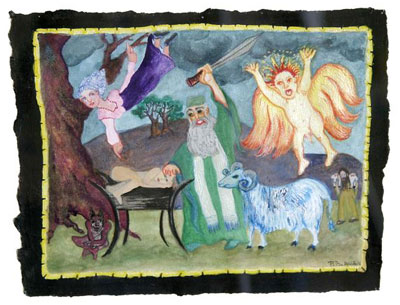
The Akedah by Pat B. Allen


So, even though I really struggle with the story of the binding of Isaac, of this image of a God who would demand the absolute worst of a person, I have come to understand that this is not a story about how we ought to have a blind obedient faith like Abraham, who was willing to sacrifice his only son at God's direction. Rather, it is a story about how Abraham's faith was a struggle as ours continues to be a struggle. Even in the face of miracles, Abraham made mistakes. Even with the words of God ringing in his ears, Abraham forgot God's will for his life. And yet, even when he was not, and even when we are not, faithful to God, God will be faithful to us.

Because, though this story of the binding of Isaac begins with the terrible and confusing words of God demanding an unspeakable evil, it ends with God calling out to Abraham, staying his hand, and providing a sacrificial ram instead. The story ends, as is usual for God and Abraham's relationship, with God speaking words of hope and blessing. “I will indeed bless you,” God says, “and I will make your offspring as numerous as the stars of heaven and as the sand that is on the seashore...and by your offspring shall all of the nations of the earth gain blessing for themselves...” (Genesis 22:17-18 NRSV).

This morning, may you hear hope and blessing in this place, remembering how even when you might mess up, even when you pull away from God, you are in good company. Abraham wasn't perfect either. But God loves him anyway, and God loves us too. God calls us back and offers us opportunities, opportunities as numerous as the stars or the dust on the earth or the sand by the sea, opportunities to reset ourselves so that we can live into that promise of blessing.

1Danna Nolan Fewell and David M. Gunn, “Keeping the Promise,” Gender Power and Promise: The Subject of the Bible's First Story (Nashville, Tennessee: Abingdon Press, 1993), 43.
2See Teri Peterson, “The Word of the Lord??” A Sermon for September 15 (Narrative Lectionary year 4, week 2), Clever Title Here, 14 September 2013, http://clevertitlehere.blogspot.com/2013/09/the-word-of-lord-sermon-for-september.html.

Wednesday, September 11, 2013

Please stop using women and children as excuses to go to war

I wrote this last week in the middle of the night. I updated it after the president's most recent speech. It has been weighing heavily on me, so posting it here today:

Please stop using women and children as excuses to go to war.

In the last few weeks, the leaders of the USA have spoken a lot about our ethical responsibility to save Syria from chemical weapons. As was done by former president George W. Bush in Iraq, rescuing women and children from living under oppressive and violent regimes has emerged as a important motivation for US military action. President Obama opened his remarks on Syria on August 31 by speaking of the fate of women and children. Earlier this week, he again opened by reminding us that “Assad’s government gassed to death over a thousand people, including hundreds of children” (emphasis mine).

On August 23, John Kerry actually spoke of the treatment of women and children as a moral obscenity. He said, “The indiscriminate slaughter of civilians, the killing of women and children and innocent bystanders by chemical weapons is a moral obscenity. By any standard, it is inexcusable.” He is quite right.

Except that it does not make much sense that military action is the proper response, for, as UNICEF has reported, “armed conflict kills and maims more children than soldiers.” Which we have seen in our own military's record on moral obscenities in Iraq, Afghanistan, Yemen, and Pakistan is abysmal. As I listened to John Kerry speak, massacres in Majalah in Yemen where 21 children and 14 women were killed in 2009 US missile strikes echoed in my memory.

So too, our domestic record in which women and children suffer from lack of access to health care, in which women's reproductive health is seen as a political football rather than a human right, in which children's head start programs are the first to be cut in the face of fiscal problems, in which women still in 2013 do not receive equal pay for equal work--- all of this makes plain to me that women and children are not interesting to us as a nation except as excuses to go to war.

And as I write this, I also remember hearing some people in Bosnia and Herzegovina and Kosovo talking in glowing terms about former president Bill Clinton's push of NATO intervention during the genocide in the 1990s. I am not proposing we do nothing as women and children are violently attacked by their own government. Rather, more of us need to echo folks like Rev. Andy Oliver at Reconciling Ministries Network who wrote, “Please stop repeating the story that our wars keep us safe, our killing is justified, our weapons are humane, please stop repeating it because it isn't true.” Or folks like Jim Wallis at Sojourners who wrote, “Old military solutions have clearly failed. It’s time to find a better and more successful way.” There are no easy answers, but there is an imperative to find a new way.

Rather, we need to lead a creative response to moral obscenities in a way that does not do further harm to civilians, particularly women and children. We need actually care for and show compassion for civilians brutalized by any government, rather than ignoring them until we can use them as talking points and rallying cries to justify ramping up the war machine.

Sunday, September 8, 2013

The Process of Revision

This week we had a beautiful outdoor service complete with a baptism to celebration God's work of creation. At Presbury United Methodist Church, we are beginning to use the Narrative Lectionary through Pentecost to better explore the story of our faith. 

Gospel Reading: John 1:1-5
Creation: Genesis 1:1-2:4a (Inclusive Bible translation)
In the beginning,
God created the heavens and the earth.


But the earth became chaos and emptiness, and darkness came over the face of the Deep--- yet the Spirit of God was brooding over the surface of the waters.

Then God said, “Light: Be!” and light was. God saw that light was good, and God separated light from darkness. God called the light “Day” and the darkness “night.” Evening came, and morning followed--- the first day.

Then God said, “Now, make and expanse between the waters! Separate water from water!” So it was: God made the expanse and separated the water above the expanse from the water below it. God called the expanse “Sky.” Evening came, and morning followed--- the second day.

Then Gd said, “Waters under the sky: be gathered into one place! Dry ground: appear!” So it was. God called the dry ground “Earth” and the gathering of the waters “Sea.” And God saw that this was good. Then God said, “Earth: produce vegetation--- plants that scatter their own seeds and every kind of fruit tree that bears fruit with its seed in it!” So it was, the earth brought forth every kind of plant that bears seed, and every kind of fruit tree on earth that bears fruit with its own seed in it. And God saw that this was good. Evening came, and morning followed--- the third day.

Then God said, “Now, let there be lights in the expanse of the sky! Separate day from night! Let them mark the signs and seasons, days and years, and serve as luminaries in the sky, shedding light on the earth.” So it was: God made the two great lights, the greater one to illuminate the day, and a lesser to illuminate the night. Then God made the stars as well, placing them in the expanse of the sky, to shed light on the earth, to govern both day and night, and separate light from darkness. And God saw that this was good. Evening came, and morning followed--- the fourth day.

God then said, “Waters: swarm with an abundance of living beings! Birds: fly above the earth in the open expanse of the sky!” And so it was: God created the sea monsters and all sorts of swimming creatures with which the waters are filled, and all kinds of birds. God saw that this was good, and blessed them, saying, “Bear fruit, increase your numbers, and fill the waters of the seas! Birds, abound on the earth!” Evening came, and morning followed--- the fifth day.

Then God said, “Earth, bring forth all kinds of living soul--- cattle, things that crawl, and wild animals of all kinds!” So it was: God made all kinds of wild animals, and cattle, and everything that crawls on the ground, and God saw that this was good.

Then God said, “Let us make humankind in our image. To be like us. Let them be stewards of the fish in the sea, the birds of the air, and everything that crawls on the ground.”

Humankind was created as God's reflection:
in the divine image God created them;
female and male, God made them.

God blessed them and said, “Bear fruit, increase your numbers, and fill the earth--- and be responsible for it! Watch over the fish of the sea, the birds of the air and all the living things on the earth.” God then told them, “Look, I give you every seed bearing plant on the face of the earth, and every tree whose fruit carries its seed inside itself: they will be your food; and to all the animals of the earth and the birds of the air and things that crawl on the ground--- everything that has a living soul in it--- I give all the green plants for food.” So it was. God looked at all of this creation, and proclaimed it was good--- very good. Evening came, and morning followed--- the sixth day.

Thus the heavens and the earth and all their array were completed. On the seventh day God had finished the work of creation, and so, on that seventh day, God rested. God blessed the seventh day and called it sacred, because on it God rested from all the work of creation.

These are the generations of the heavens and the earth when they were created.

Sermon: The Process of Revision
At the beginning of God's creating God told a story “that became the universe.”1 This beginning was not so much a time so much as a process,2 a process that may be still going on today, as the earth continues to change and adapt, as we change and adapt. This is a story not just about the earth and how it came to be, but it is also a story about us, about how we as people of faith came to be. This is not a literal, civil-engineer certified blueprint for how to create a world. It is a story. But it is a story that shows us the power of Word and Spirit.

When we translate this story from Genesis into English, it seems very straightforward. I had Minister Jackie read from a translation called the Inclusive Bible because it lets some of the confusion of the verses sink in. Where we usually read “formless and void,” in this translation we read something a little bit closer to the Hebrew: “chaos and emptiness.” But these two things together are confusing. My office in my house is chaotic BECAUSE it is not empty but full of stuff I have to organize. And every other time a phrase similar to this occurs in the bible, it signifies ruin and desolation.3 But isn't this the beginning? How could things be ruined already?

The text nurtures our questions but does not give answers to them specifically. Instead, we get another kind of answer. We get the Spirit and the Word. The Spirit of God broods over the surface of the waters, “the way a bird broods over the eggs in her nest...represent[ing] the divine power to recreate and restore that which has been spoiled or destroyed.”4 The story doesn't end with chaos and emptiness. It begins again with Spirit and Word; the power of God is to elicit goodness, to elicit life in the world again. From this brooding, God speaks, and that which God speaks becomes. And God saw that the desolation, the chaos, was transformed into goodness.

In the second chapter and first verse of Genesis, we read, “Thus the heavens and the earth and all their array were completed.” When we read that verse, sometimes we focus too much on the word “completed” and forget the first verses of chapter one that hinted at the processes of revision and restoration that are continually a part of creating.

I, unfortunately, am not a crafty person; when I want to create something, I use words, and used to write a lot more fiction. In an introduction to creative writing class I took in college, I got frustrated with my professor for denying that a story can be “completed,” as we read here in Genesis. He said that we are never wholly finished with a story. We do not attain perfection after receiving feedback from colleagues and writing a certain amount of drafts. We may get to a point where we decide that we cannot work on the story anymore, but we never craft the perfect story.

What made me mad about this point my professor made was that I could theoretically come back to a published story--- not a huge problem for me since I have not published any of my fiction, but it is the principle of the thing--- I could come back to a published story and find a word I wanted to change, or a paragraph I wanted to move around, or even something like a comma that should have been a semi-colon. I found this first hand when I stripped a novella I had written for this class--- at least a hundred pages--- down to a simple, one-page prose poem my senior year of college. All that work, hours of writing, for one single page? But where I was as an eighteen-year-old, fresh from Harford County wondering what the heck she was getting into, was not where I was as a senior who was fluent in another language, had lived in big cities, slept outside of train stations, made new friends, and heard my calling. And so I saw in revising that story how we ourselves are constantly revised.

God is constantly at work among us, revising, restoring, recreating. Always trying to lure us back to that goodness when things seem to get all ruined. Just look at the story of our faith:
  • We're having a good old time with God, but we eat this fruit God told us not to, and so we have to revise our way of living away from the garden;
  • we hurt one another and creation so badly that God sends a flood to kill everything but a small remnant to start over, but such an action makes God so sad that God promises never to do it again;
  • we get caught in the clutches of slavery, and God rescues us and gives us the Law to help us start over;
  • but still we fight and squabble and so God gives us a king to lead us;
  • only the king God gave to lead us becomes inept and corrupt, and we are sent into exile, but God sends prophets to give us words of repentance and of hope until we return home at last.
And those are just some of the moments in our faith story in the Old Testament that demonstrate this process of revision and restoration. We fall away, and God works with us to bring us back to that goodness God proclaimed at the beginning of God's creating. And of course then, in the New Testament, God gives us Jesus to walk among us and teach us and show us a new way to live, helping us revise our lives full of sin and oppression into ones of life and light. These are big moments where God shows us how that creation process really is never complete until the kingdom on earth Jesus preached is fully realized on Earth.

But there are smaller moments where God helps us to revise the story we're writing about ourselves and our community, helps us to revise our own stories from ones about isolation and greed, loneliness and grief, injustice and oppression to ones about goodness, light, and life. Maybe we had a Sunday school teacher like Miss Minnie or Miss Ethel or Baylee who instilled a love of God in us at a young age so deeply that we remembered that love when we were feeling at our worst. Perhaps we heard a song that spoke the gospel to us in such a new way we found renewed energy for life and service. Maybe a stranger offered us kind words in a moment of need that shed light on how we need to shed lives of busy-work for ones of intimacy. Through people and situations, the Spirit of God broods over the chaos and emptiness we may feel in our own lives and helping us create something good out of it all.

Baptism is a type of revision and recreating too. As Methodists, we often baptize children, which can be confusing, for most of us don't view infants as inherently sinful creatures who need to die to the chaos and emptiness within them and be born again in the goodness of Christ. Instead, baptism is a way that we as a community come together to proclaim God's constant recreating and restoring work in our lives. That's part of why we only do it once as Methodists--- if we were baptized every time God was at work in our lives offering goodness and redemption, we'd have to walk around with little baptismal font Supersoakers holstered on our backs or something. And if we chose to be baptized only after experiencing some particularly saving event, we could accidentally forget the power in all the events to follow in which God broods over us. Rather, baptism is a time where we as a community enter into this story of a God who has the power to restore and create us no matter what happens throughout our lives.

Now, we could live our entire lives with God brooding over us but never crack that shell to emerge into a world of goodness. When God creates humans in this story, God gives us co-creating responsibilities, telling us not only to bear fruit, but to watch over the life on the earth. We don't do this well. Sometimes we actively refuse to work for goodness, and use our co-creating powers for destruction and ruin. But God still reaches out to us, still demands a response that will lead to restoration.

The Gospel of John reminds us, that, “What has come into being in the Word,” both the Word God spoke at the beginning and the Word that is Jesus, “was life, and the life was the light of all people. The light shines in the darkness, and the darkness did not overcome it.” Let us live into that light together, my friends, rejoicing in God's power to recreate and restore all to goodness again.

1Michael Williams, editor, “The First Account of Creation: Genesis 1:1-2:4,” The Storyteller's Companion to the Bible, vol.1: Genesis (Nashville, Tennessee: Abingdon Press, 1991), 28.
2Notes to verse 1 of Genesis 1 in The Inclusive Bible: The First Egalitarian Translation.
3Notes to verse 2 of Genesis 1 in The Inclusive Bible: The First Egalitarian Translation.
4Ibid.