Friday, April 29, 2011

Lighting the Cave

This is my adapted final sermon from my introductory preaching course with Dr. Gary Simpson. We had to write an Easter or Resurrection sermon. I still am working out the beginning of the sermon, but here it is as a little resurrection for the week after Easter. And away we go...

Scripture: John 20:1-18 1

Early on the first day of the week, while it was still dark, Mary Magdalene came to the tomb and saw that the stone had been removed from the tomb. So she ran and went to Simon Peter and the other disciple, the one whom Jesus loved, and said to them, "They have taken the Lord out of the tomb, and we do not know where they have laid him."

Then Peter and the other disciple set out and went towards the tomb. The two were running together, but the other disciple outran Peter and reached the tomb first. He bent down to look in and saw the linen wrappings lying there, but he did not go in. Then Simon Peter came, following him, and went into the tomb. He saw the linen wrappings lying there, and the cloth that had been on Jesus' head, not lying with the linen wrappings but rolled up in a place by itself. Then the other disciple, who reached the tomb first, also went in, and he saw and believed; for as yet they did not understand the scripture, that he must rise from the dead. Then the disciples returned to their homes.

But Mary stood weeping outside the tomb. As she wept, she bent over to look into the tomb; and she saw two angels in white, sitting where the body of Jesus had been lying, one at the head and the other at the feet. They said to her, "Woman, why are you weeping?" She said to them, "They have taken away my Lord, and I do not know where they have laid him."

When she had said this, she turned round and saw Jesus standing there, but she did not know that it was Jesus. Jesus said to her, "Woman, why are you weeping? For whom are you looking?"

Supposing him to be the gardener, she said to him, "Sir, if you have carried him away, tell me where you have laid him, and I will take him away." Jesus said to her, "Mary!" She turned and said to him in Hebrew, "Rabbouni!" (which means Teacher).

Jesus said to her, "Do not hold on to me, because I have not yet ascended to the Father. But go to my brothers [and sisters] and say to them, 'I am ascending to my Father and your Father, to my God and your God.'"

Mary Magdalene went and announced to the disciples, "I have seen the Lord"; and she told them that he had said these things to her.


Sermon: Lighting the Cave

This text presents us with the picture of Mary Magdalene, eyesight blurred by tears, stooping down to look into the tomb, bent over to look into that empty place that is supposed to hold Jesus' body. This image of Mary bending over to look into the tomb, which was essentially a cave, was one that spoke to me when I first read this passage. I don't know how many of you have been in caves, but picturing the tomb as this carved out cave really captured my attention.

My family went on vacations across the USA when I was a kid, and we would go to different caves opened as parks to the public--- we weren't like spelunkers or anything--- and without fail in the middle of the tour, the guide would shut off all the lights and tell us that in the world you can only experience absolute darkness in two places, the bottom of the ocean and in a cave. And the guides would then always say that a person cannot survive in absolute darkness very long. They told of cavers whose candles or later flashlights would go out, leaving them stranded underground. They would go blind, eyes constantly searching for some sort of brightness that just did not exist inside the cave, and slowly they would be mentally consumed as well, minds craving sunlight as the body did. This kept running through my head as I bent down with Mary to look in the tomb.

And so, will you pray with me:
God-With-Us, this Holy Week we read of a time of confusion and fear,
culminating in this Easter morning moment. As we explore this text together,
might we remain open to the workings of the Spirit,
actively listening for the ways in which you are leading us.
In the name of the Living One. Amen.


In the Gospel of John, which we read today, Mary Magdalene comes to the tomb alone. She has lived in fear the last few days, wondering as so many of us did at the quick turn around from Palm Sunday to the terror of Maundy Thursday and Good Friday. She has lived through the abandonment of the disciples named the Twelve in the gospels2--- those who are supposed to be Jesus' closest friends and companions. She has stood watching with her own eyes the crucifixion of her teacher. And then there was Saturday. She must not have been able to wait any longer. She slipped out of the house where she must have been staying with other followers of Jesus, making a pilgrimage by herself to see the body. At this point, it was all she had. Jesus' crucifixion was someone blowing out the candle in the cave, and she has been searching for a little light. Finding the lifeless body there would not be that light, but she did not know what else to do.

So when she approaches the tomb in that early morning and she sees the stone had been removed from the tomb, I imagine her heart stopping, sinking into the pit of her stomach, and her lips mouthing no. The way you feel when you feel like the world has done its worst to you but then it throws out one thing more. Mary is robbed of even the shell of a memory. Even that has been taken from her. At this moment, the fear is just too much, and she can't stay in that place. So she runs to Simon Peter and the other disciple, seeking someone to stand with her in her grief and confusion. But she is left alone again weeping at the mouth of the tomb, unwilling to go in, just crouching down, tears filling her eyes. And her tears do not slow even when she sees down into the darkness two figures seated where the body should be.

"Woman, why are you weeping?"

"They have taken away my Lord, and I do not know where they have laid him."


She needs to see the body, to touch the body again, but it is gone and she does not know where it is. She is so preoccupied with finding this body again, preoccupied with finding this object of her grief that she does not respond to the fact that these are angels in the tomb. These angels could be those spots of brightness in the absolute darkness of the cave, but they aren't for Mary. Not even angels can pierce through her grief.

So she turns away from the tomb. Perhaps it is too difficult for her to sob in that crouched position, looking down into the darkness. But in turning away, she faces yet another who asks her, "Woman, why are you weeping? For whom are you looking?" She thinks it is the gardener. Who else would be out here at this time of the day when everyone else had abandoned her. She ignores the gardeners questions, instead, head down, wringing her hands asks slowly so as not to belie the fear and confusion she feels through her voice. "Sir, if you have carried him away, tell me where you have laid him, and I will take him away." She will not ask questions, all she wants, all her bereaved mind can think of now is fulfilling the purpose for which she came here on this morning.

But Jesus reaches through that grief, that confusion, and calls her by name. "Mary!" And it is the sound of his voice, the sound of that familiar voice she has heard day after day teaching her, loving her, this voice she hasn't heard since Friday when it came from him in great gasping breaths as his life left him--- left her, standing there watching. This is the moment where her eyes stop straining for light even when she closes them because it is there in front of her. This is the moment when her eyes begin to drink in the light after her days in the absolute darkness of the cave.

The text, while not describing in detail her response, leads us to believe it was a physical one, her reaching out to hold onto that body she has so longed to see, to touch, to invoke her memories of what these not only past few days but past few years of her life with Jesus, to figure out what that has meant. Because all morning, she was left to think that it meant nothing. Even Peter and the other disciple had left her alone, sobbing outside the empty tomb of her teacher. But then she hears his voice, and she hears his voice saying her name, calling her out of her grief, calling her to discover that he is still with her, though she feels so alone.

Her response is one that I think is so common with those of us who are pulled out of suffering by good test results or speedy recovery--- we want to hold onto that which is calling us out of suffering. We want to stare unblinking into the light after being alone in the darkness of the cave. But Jesus says, "Do not hold on to me..." And I think it would have been so easy for Mary to reach out and attach herself to Jesus and never let him out of her sight, let everything else go just to create this little world of the two of them, a safe world, one in which he will never get taken away from her again. But Jesus says, "I have not yet ascended to the Father." Not yet. See, his time with her now is to break through that fog of grief, to help her to move on with the work he has called her to do, reminding her that his presence will always be with her. He is the light within her that will not go out.

So Mary's joy at feeling Jesus' presence is redirected outward. She cannot sit still in the cave, transfixed by the light her eyes have so longed for. No, she must use that light to find a way out, towards living that kindom vision that Jesus her Rabbouni, her teacher, had taught her. And so, after Jesus urges Mary to go out to her brothers and sisters, to remember that his presence is not for her alone, she becomes the first witness to Easter morning. She is not the only one grieving, though so often in our grief we feel as though we are the only ones. Rather, hearing Jesus call us out of our suffering, feeling Jesus' presence again after this great loss beckons us to continue to work for the living.

Jesus is reaching into our grief and our confusion, calling us by name.
How will we respond?
 

Thursday, April 28, 2011

Can't We Leave Jesus Out?

Crossposted at OnFire for the #Why MFSA campaign April 25-May 4 (the approximate dates for General Conference next year) during which a whole host of different people are blogging about why they are connected to the Methodist Federation for Social Action (MFSA). It's about getting ready to change the Church folks!

When I turned eighteen, I thought it would be a good idea to get a cross and flame tattoo on my back. I had grown up United Methodist and attributed much of my radical politics to my mother, who is a pastor, and because of that, I also attributed those radical politics to The UMC. Both my parents taught me social justice as a Christian value. So I was pretty surprised after I turned eighteen to see that The UMC was not as radical a place as I thought it was. I was appalled to find out that The UMC did not ordain what the Discipline names self-avowed, practicing homosexuals.

Later, after becoming a lay delegate to Annual Conference as a Junior, I was appalled at the opulence of the hotels our conference is held in and the slow-moving bureaucracy that is our church. So I wondered: what were some of the ways I could transform that tattoo into something else, something no longer Methodist-related? But then I went to Student Forum, where I learned about MOSAIC and OnFire, the young adult chapter of MFSA. Here were places where I saw hope for making The UMC into that church I thought it was growing up, that church that practiced the justice that Jesus taught us.

As a seminarian at Drew Theological School, I have had the opportunity to participate in the OnFire Borderlinks immersion trip to the border between the USA and Mexico and later to mobilize with others, including so many United Methodists, on Washington for immigration reform. Those moments were moments where I was proud to be United Methodist, amidst these people working for justice in the world and in our church.

Last semester, I researched Methodist publications for their reactions to the Red Scare, in light of the fearmongering in our time, and was so inspired by what I read about MFSA. In the new history of United Methodism, for instance, the authors write,
"In 1953 [Rev. Jack] McMichael [of the Methodist Federation for Social Action] appeared before the [House Committee on UnAmerican Activities] and challenged its accusations of Communist subversion with such telling references to the ministry of Jesus that an aggravated committee member shouted, 'Can't we leave Jesus out.'" 1
MFSA has shown me that Jesus' ministry is one of subversion, and that The United Methodist Church can live into that same ministry with the help of a few folks committed to justice. Why MFSA? Because they won't leave Jesus out of it; they are working to bring the church into that vision of justice Jesus taught us.

1 Russell E. Richey, Kenneth E. Rowe, and Jean Miller Schmidt, The Methodist History in America: A History, vol. 1, (Nashville: Abingdon Press, 2010) 420.

Sunday, April 17, 2011

Who is this?

The monthly sermon post! This is a sermon for Palm Sunday, that I first used on my preaching class with Dr. Gary Simpson at Drew. Today, I preached it at Bernardsville United Methodist Church in New Jersey, where I have been preaching once a month as part of my supervised ministry. It is a very small congregation, and the people are so wonderful and friendly. I thank them for their support of me as a student pastor and will be sad to go, since this was the last Sunday I will preach there. But that means supervised ministry is almost over and I will have some time to write something for my blog other than a sermon!

Scripture: Matthew 21:1–11 (from the Inclusive Bible translation)1

As they approached Jerusalem, entering Bethphage at the Mount of Olives, Jesus sent off two disciples, with the instructions, "Go into the village straight ahead of you, and immediately you will find a tethered donkey with her colt standing beside her. Untie them and lead them back to me. If anyone questions you, say, 'The Rabbi needs them.' They they will let them go at once."

This came about to fulfill what was said through the prophet:
"Tell the daughter of Zion,
Your sovereign comes to you without display,
riding on a donkey, on a colt---
the foal of a beast of burden."


So the disciples went off and did what Jesus had ordered. They brought the donkey and her colt, and after they laid their cloaks on the animals, Jesus mounted and rode toward the city.

Great crowds of people spread their cloaks on the road, while some began to cut branches from the trees lay them along the path. The crowds--- those who went in front of Jesus and those who followed--- were all shouting,
"Hosanna to the Heir to the House of David!
Blessed is the One who comes in the name of the Most High!
Hosanna in the highest!"


As Jesus entered Jerusalem, the whole city was stirred to its depths, demanding, "Who is this?"

And the crowd kept answering, "This is the prophet Jesus, from Nazareth in Galilee!"


Sermon: “Who is this?”


I saw Godspell at Bernards Township High School a few weeks ago. It is one of my favorite musicals--- I prefer hippie musicals. And, though the song "Prepare Ye the Way of the Lord" is a John the Baptist song, calling people to repent, I always hear this song and think of Palm Sunday. If you have seen the musical live, you may associate the rushing forward in the song--- which at the high school due to that large cast sounded like a herd of elephants--- with the forward motions of the crowd, proclaiming as loudly and joyously as you have to do to sing "Prepare Ye the Way of the Lord."

And so this is the image I have in my mind of Palm Sunday, a rushing forward, a joyous preparation of Jesus coming to Jerusalem to assume his role as King, really. The occasion is one of such brightness and color that we almost skip over that verse, the one that is foreshadowing the events coming later in the week. You see,

As Jesus entered Jerusalem, the whole city was stirred to its depths,
demanding, "Who is this?"

Who is this guy riding a donkey with her colt alongside her into our city? Who is this person that has so invigorated the masses? Who is this and what does he want? What does he want with us?

Will you pray with me?

Gracious God, Patient Teacher, we ask your presence among us as we gather here. May the words of my mouth and the meditations of all our hearts bring us closer to understanding who is this Jesus and how can we become better followers of him. Amen.


Thoughout my study of this passage this week, the question I kept coming back to was that "Who is this?" question. The text, though, makes it pretty clear who this is. In the beginning of the passage, we see Jesus as a great teacher, as one who gives instructions that are followed, as one who says "you will find a tethered donkey" there and it is so. And the author of this gospel tells us that this happened to fulfill what was said through the prophet. So who is this Jesus? The Promised One. The One the people have so longed for. The sign of this king was not a warhorse, not chariots drawn as Caesar would have it, no the sign of this promised one given to the people by God through the prophet was that a simple man would ride in without display on a dinky old donkey, still tied to her young colt. The people are clear that this man on the donkey is prophesying a change, and that is why they shout Hosannas.

I think the scene was one so like what we saw in Egypt. The people so overflowed with joy at the thought of their freedom. They stood in Tahrir--- which means liberation--- Square, together surging forward with a vision of the end of oppression and the beginning of a new way to be Egypt together. The whole city stirred to its depths is the world, people glued to the TV wondering what will happen next, asking who are these people?

But too often the asking of the question who is this? is the signal of fear. It is clear from the passage that Jesus has come to Jerusalem to change some things--- we can say that before he even overturns the tables in the Temple, which in the Gospel of Matthew, he does the same day as his entry into the city. A Palestinian man, who must be obviously poor, obviously dusty from extensive travel, sits on top of a donkey, rides through the streets, and is given the welcome of a great king. This is frightening for those in power; this is the time when their fear translates into a need to quash the uprising. Yet others are out in the streets shouting Hosannas.

The whole city is stirred to its depths as it is presented with a choice, to continue with the old way of living, the way of warhorses, or to try to do something new. To follow this strange man on a donkey.

The Who is this? question is really one about what truths we will admit to ourselves, about whether or not we are willing to let the God who is stirring us to our depths do something new in our lives or whether we are going to quash it within us, close our eyes, turn our backs on the processional.

We all have these who is this? moments in our lives, these moments when we see God and know who God is but we have to ask if we are willing to admit that to ourselves.

One of the most important Who is this? moments for me in my life happened when I went to Bosnia and Herzegovina on a mission trip for the first time. My sister and I were picky eaters, but we certainly were nowhere near starving, but our host, a tiny firey woman named Saja decided we were wasting away and so whisked us away from the rest of the group, bringing with us one of our translators named Ðana since Saja herself knew little English, to the home of her friend for a special dinner. Now, I was sixteen, out of the country for the first time, sitting at a table outside a home still riddled with bullet holes and shrapnel from the war, listening to three strange women chatting in Bosnian. Bosnian is not a language like French or Spanish where a lot of the words are similar to English either. But despite the confusion of the situation, my sister Kate and I just sat quietly, absorbing it all. Ðana became quiet soon too, and then she reached over to Kate and I and told us she loved us. She had known us for two days, and here she was telling us she loved us.

Who is this?It had to be God. I had known the woman for two days. I had lived an extremely sheltered life and spent my childhood planting pumpkins in my backyard that didn't grow until the year we moved, playing with kittens, and writing science fiction. Ðana spent her childhood hiding from the Serb and Croat armies. Her father was killed during the war and every day she leaves her house she passes the marker along the road where he had been murdered. She had never spoken English outside of class before she met us, and the only Bosnian word I knew at that point was the number 8 because it sounds like the word awesome. She was a Muslim whose people were targeted by Christian genocidaires and I was a USAmerican Christian in a post- 9/11 world. And yet the God within her reached out to me beyond all of those barriers and loved me.

And this is one of the moments in my life where I did recognize God, and that I still today rely on as the assurance that God loves me. Me of all people. This is what I imagine those folks along the road that day celebrating. Of course, my who is this? moment is not completely parallel to that of Palm Sunday. There, God had given them this radically different picture of kingship, but in that picture they felt God saying, as I felt in Bosnia, I love you. And I have a better way of living planned for you.

But with this recognition comes a call to a change. Are we going to be those people shouting Hosannas, or are we going to insist that we do not know the answer to the question Who is this?

Of course, even when we are in that crowd, shouting Hosannas on a Sunday,

where do we end up that Friday?


For sometimes we shout Hosannas on Sunday only to go into hiding Friday or even become the bloodthirsty crowd. We must remember that not all revolutions end peacefully. Right now many of us are praying for Libya, mowed down by a dictator. This is not another Egypt revolution, which though it did come under siege briefly by Mubarek's thugs, was overwhelmingly peaceful and joyous. But Libya resembles less this joyous parade to Jerusalem than it does the way Jesus left Jerusalem on Good Friday. We read in Matthew,
On their way out [of Jerusalem], they met a Cyrenian named Simon who they pressed into service to carry the cross. Upon arriving at a site called Golgotha--- which means Skull Place--- they gave Jesus a drink of wine mixed with a narcotic herb, which Jesus tasted but refused to drink.

Once they had nailed Jesus to the cross, they divided his clothes among them by rolling dice; then they sat down and kept watch over him. Above his head, they put the charge against him in writing: "This is Jesus, King of the Jews."2
Jesus' entry into Jerusalem is a scene of rich color and vibrance, not the darkness pressing down on us of the scene of Jesus leaving Jerusalem.

Both scenes are full of topsy-turvery reversals: in the first, a man is given the welcome of a king, though he comes without display, riding a donkey; in the second, a man is named a king mockingly as he is killed as a political criminal. But this Jesus is just as much our king here in this Good Friday scene as he is on Palm Sunday. This Good Friday scene is a fulfillment of that Palm Sunday picture. It shows that the answer to the Who is this? question is the one that got him killed.

We are in our last week of Lent, a time of renewal, a time of bringing life from ashes. We are spending this season of Lent, particularly this Holy Week, preparing ourselves for the Way of the Lord. And when we are preparing ourselves for the Way of the Lord, we have to prepare ourselves for those Fridays too, prepare ourselves to be willing to answer the question Who is this? even when we are stirred to our very depths.

Sunday, March 27, 2011

Inside and Out

Yes, pretty much all I write now are sermons, but do not worry because I have a bunch of story ideas wandering about in my brain. Hopefully after this crazy semester, I will have a chance to write! Ha.

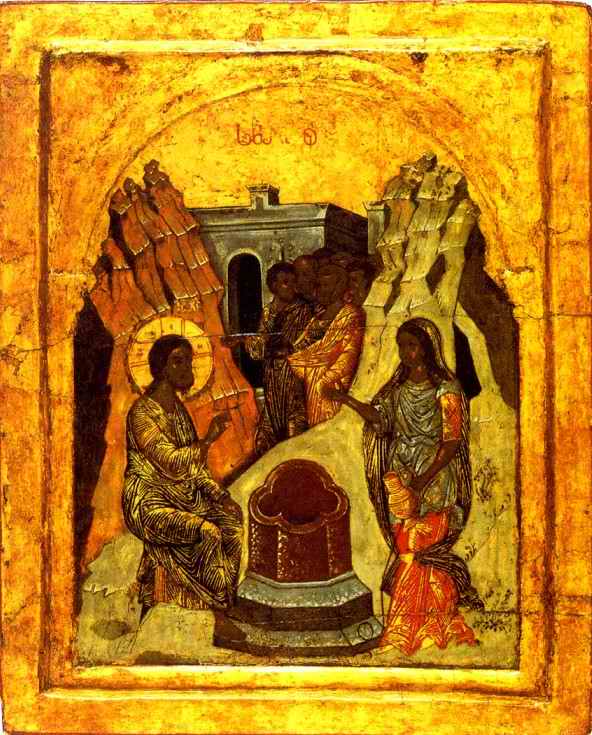
This is a sermon on John 4:5-42. I preached it at Bernardsville United Methodist Church in New Jersey, where I preach once a month as part of my supervised ministry. It is a very small congregation, and the people are so wonderful and friendly. I thank them for their support of me as a student pastor, especially when I change up the service a bit due to the length of the scripture reading and make them learn a bunch of new songs at once!

This sermon was difficult for me to write, as I mention in the sermon itself, because I don't like Jesus in this story. When I first read this passage, I said to myself that there are a few passages from John that I really like--- why couldn't this week's reading be one of those? I thought, give me the Jesus who said about the adulterous woman that you who are without sin throw the first stone.1 That's the kind of Jesus I can get behind. I thought, give me the Jesus who puts mud on people's eyes to make them see.2 A Jesus who heals using dirt, who gets messy--- I like that kind of Jesus. Give me the Jesus who weeps when he gets to Bethany after the death of Lazarus and sees the tear-stained faces of Mary and Martha.3 A compassionate Jesus, one moved by our pain, that's a Jesus I believe in. So this week, I read the text and found at first an evasive Jesus and I kinda wanted to shake him. To tell him that's not how he's supposed to behave. But I was really intrigued by the character of the Samaritan woman, so I couldn't get the passage out of my head this week.

from Hermanoleon clipart http://bit.ly/hwWCDN


Scripture: John 4:5–42 4, from Eugene Peterson's paraphrase The Message

He came into Sychar, a Samaritan village that bordered the field Jacob had given his son Joseph. Jacob's well was still there. Jesus, worn out by the trip, sat down at the well. It was noon.

A woman, a Samaritan, came to draw water. Jesus said, "Would you give me a drink of water?" (His disciples had gone to the village to buy food for lunch.)

The Samaritan woman, taken aback, asked, "How come you, a Jew, are asking me, a Samaritan woman, for a drink?" (Jews in those days wouldn't be caught dead talking to Samaritans.)

Jesus answered, "If you knew the generosity of God and who I am, you would be asking me for a drink, and I would give you fresh, living water."

The woman said, "Sir, you don't even have a bucket to draw with, and this well is deep. So how are you going to get this 'living water'? Are you a better man than our ancestor Jacob, who dug this well and drank from it, he and his sons and livestock, and passed it down to us?"

Jesus said, "Everyone who drinks this water will get thirsty again and again. Anyone who drinks the water I give will never thirst— not ever. The water I give will be an artesian spring within, gushing fountains of endless life."

The woman said, "Sir, give me this water so I won't ever get thirsty, won't ever have to come back to this well again!"

He said, "Go call your husband and then come back."

"I have no husband," she said.

"That's nicely put: 'I have no husband.' You've had five husbands, and the man you're living with now isn't even your husband. You spoke the truth there, sure enough."

"Oh, so you're a prophet! Well, tell me this: Our ancestors worshiped God at this mountain, but you Jews insist that Jerusalem is the only place for worship, right?"

"Believe me, woman, the time is coming when you Samaritans will worship the Father neither here at this mountain nor there in Jerusalem. You worship guessing in the dark; we Jews worship in the clear light of day. God's way of salvation is made available through the Jews. But the time is coming— it has, in fact, come— when what you're called will not matter and where you go to worship will not matter.

"It's who you are and the way you live that count before God. Your worship must engage your spirit in the pursuit of truth. That's the kind of people the Father is out looking for: those who are simply and honestly themselves before him in their worship. God is sheer being itself— Spirit. Those who worship him must do it out of their very being, their spirits, their true selves, in adoration."

The woman said, "I don't know about that. I do know that the Messiah is coming. When he arrives, we'll get the whole story."

"I am he," said Jesus. "You don't have to wait any longer or look any further."

Just then his disciples came back. They were shocked. They couldn't believe he was talking with that kind of a woman. No one said what they were all thinking, but their faces showed it.

The woman took the hint and left. In her confusion she left her water pot. Back in the village she told the people, "Come see a man who knew all about the things I did, who knows me inside and out. Do you think this could be the Messiah?" And they went out to see for themselves.

In the meantime, the disciples pressed him, "Rabbi, eat. Aren't you going to eat?"

He told them, "I have food to eat you know nothing about."

The disciples were puzzled. "Who could have brought him food?"

Jesus said, "The food that keeps me going is that I do the will of the One who sent me, finishing the work he started. As you look around right now, wouldn't you say that in about four months it will be time to harvest? Well, I'm telling you to open your eyes and take a good look at what's right in front of you. These Samaritan fields are ripe. It's harvest time!

"The Harvester isn't waiting. He's taking his pay, gathering in this grain that's ripe for eternal life. Now the Sower is arm in arm with the Harvester, triumphant. That's the truth of the saying, 'This one sows, that one harvests.' I sent you to harvest a field you never worked. Without lifting a finger, you have walked in on a field worked long and hard by others."

Many of the Samaritans from that village committed themselves to him because of the woman's witness: "He knew all about the things I did. He knows me inside and out!" They asked him to stay on, so Jesus stayed two days. A lot more people entrusted their lives to him when they heard what he had to say. They said to the woman, "We're no longer taking this on your say-so. We've heard it for ourselves and know it for sure. He's the Savior of the world!"


Sermon: Inside and Out

I want to confess today to you that I do not like the Gospel of John, and I don't mostly because of stories like this one we read today about Jesus and the Samaritan woman at the well. Jesus in this story rubs me the wrong way--- he won't answer people's questions directly, he is not even a little bit humble, frankly, I think he is kind of a jerk in this story. At least, that's what I thought the first time I read this story.

But then I reread the passage and began to see the story unfold differently. I saw a Jesus who was tired, but who was willing to engage in theological discussion with not only someone he was raised to believe was ethnically inferior but also a woman. And I saw in that woman a firey example of how we are to respond to Jesus. This was a scandalous conversation, one that invites us to enter into scandalous conversations as well.

Will you pray with me?
Holy One-in-Three who enters into the midst of our emptiness and quenches our thirst,
may you enter into these words I speak today and into the reflections of all of us here today, that we might better understand your truth that is living water.
Amen.


Now that I've opened our exploration of this text this morning with rather honest description of my original reaction to the text, I want to return to it, try to get a better picture of this story. Jesus in this story is leaving from Jerusalem for Galilee, journeying through Samaria, which is a big deal that we in our modern times don't often recognize. See Jews and Samaritans both descended from ancient Israel, and even practiced similar religions, worshiping the same God. Yet there was a hostility between them that was so strong Jews would often go out of their way to avoid crossing through Samaria even though that added miles to their route!5

Samaritans are often used as unexpected foils to those we expect to be good religious folk throughout the gospels, as you will remember in the parable of the Good Samaritan. Jesus' and the gospel writer's audiences would just hear the word Samaritan in these story and sneer--- and then be incredulous when they realized the Samaritan was the good guy! A good Jew would avoid Samaria, and if he or she could not, then he or she would have to avoid contact with Samaritans at all cost. Jews couldn't even buy from Samaritans.

Our unnamed Samaritan woman at the well knows this. She can tell that Jesus is a Jew, and so, given her history with Jewish people, she is suspicious. And she calls Jesus out on it. She says, "How come you, a Jew, are asking me, a Samaritan woman, for a drink?" She comes from a group of people marginalized by another ethnic group, the Jews, who are themselves marginalized under the Roman Empire. Because of this doubly outcast status, the Samaritan woman is wary when someone of a group who has oppressed her approaches her. When Jesus answers her, he doesn't respond to her question, instead giving her a cryptic response about living water. If I were her, I would say, "Listen mister, you asked me for water. Now you are the one offering it? Make up your mind." Her response to him, while perhaps is not as uppity as mine would have been, is still guarded. In my imagination, her words are hard. She asks Jesus if he has a bucket hidden somewhere to fetch the water, and then if he presumed himself greater than Jacob. She isn't gullible. And if Jesus is going to play games with his evasive answers, she can play them right back.

But when he speaks again of living water, I believe she drops her hard exterior a bit, just enough to reveal to us and to Jesus that her thirst is real, when she says, "Sir, give me this water so I won't ever get thirsty, won't ever have to come back to this well again!" Let us remember that she is coming to this well at noon, not an ideal time to get water because you wouldn't want to be carrying back the heavy jar of water in the heat. She really could be desperate, a marginalized woman looking for the comfort of a cool drink of water that does not wear off. And Jesus knows this.

Some interpreters see the turning point of the story to be the next exchange in the story, the one where Jesus reveals to her that he know about her husbands. This woman has had five husbands and now lives with a man who she is not married to. But I like Eugene Peterson's interpretation of her response. She seems sarcastic here: "Oh, so you're a prophet!" She says. The turning point for me comes in her next question. Here, she finally engages Jesus' theological conversation, and she does it with what seems to me a little jab at the divergence of their ethnic religious traditions. "Well, tell me this: Our ancestors worshiped God at this mountain, but you Jews insist that Jerusalem is the only place for worship, right?"

This woman is the first character in the Gospel of John to engage Jesus in serious, theological conversation.6 And Jesus takes her seriously! This is a big deal. The first character to challenge Jesus theologically in this Gospel, and I don't mean challenge in a bad way, but challenge in the sense of growth, is a Samaritan! And, not only that, but she's a woman! That is, after all, what scandalizes the disciples when they return to the well to find Jesus having a theological discussion with this unnamed woman. In the New Revised Standard translation of this passage, we read that the disciples were "astonished that he was speaking with a woman."7 And they make the situation so awkward really that the woman leaves them, even neglecting to bring her water jar back to town with her.

And then compare Jesus' conversation with the disciples with that of Jesus' conversation with the woman. We read this morning from The Message that They couldn't believe he was talking with that kind of a woman. No one said what they were all thinking, but their faces showed it. The New Revised Standard version gives us insight to some of the questions running through the disciples minds even though these questions are never voiced: "What do you want?" or "Why are you speaking with her?"8 These disciples we see are not like the woman who told Jesus what she thought.

What would this situation look like today in our world? Though talk of Samaritans and the lack of women's rights seems out of place often today, when broken down we see the same troubles in our world. There are barriers that are physical, like the Wall on the border between the USA and Mexico. Jesus traveling from Jerusalem to Galilee through Samaria is a little like someone from this area going to vacation in Cancun, but to get there rather than taking a plane and bypassing the poverty and the violence on the border, that person decides to walk through the desert, on roads controlled by drug cartels. We avoid those areas, but Jesus seeks them out. And not only does Jesus seek such places out, but he sits himself down by a well to rest there and gets caught up in conversation with someone the disciples would not approve of.

I don't know if any of you have heard of the organization Borderlinks; it is an experiential educational program run out of Tucson, Arizona, and Nogales, Mexico, to teach people about life on the border. I had to opportunity to go in 2009 with a group of other young adults.9 One of the most powerful parts of the experience was when we spent the night in a migrant shelter in the dusty town of Altar, one of the gateways people take into the desert to go North. It is a place where you can find guides to take you across the desert.

In the courtyard of the shelter, there was a huge barrel of water with a flag reaching way up into the sky coming out of it. This shelter is one of those wells for people, a place where people can stop, rest, and get a drink and a meal. Before dinner, we shared songs to welcome tired souls as people came in. We met Pedro, a man in Altar looking for money to buy a prosthetic leg as his old prosthetic was splitting. He said he needed the leg so he could work harder. We met José, an eighteen year old, small, quiet, who sang softly along with us even when he didn't know the words. We met Juan, who came for dinner but did not stay the night as he was going to begin to cross the desert that night. He told us he had been deported fifteen times. What kind of desperation is it that someone who had been deported fifteen times would be getting ready to again cross the desert? It is a physical desperation like the Samaritan woman at the well had.

But as our story tells us that the Samaritan woman was looking for more than fulfillment of their physical thirst. The moment of change for the woman was engaging in theological conversation with Jesus. So the moment of change with her was that moment that Jesus affirmed her self worth, affirmed her by engaging her, and by not judging her. I think we all have a need for that, don't we? We need someone to just be there and affirm our humanness, help us remember that we are made in the image of God. When we were at the migrant shelter, people came into the shelter so exhausted and down, but we were there playing music, asking them about themselves, and just trying to be present with them.

The story of the Samaritan woman at the well becomes more though than just a story of a woman who pushes back against Jesus. It is this very conversation in which she pushes back against him, in which she questions Jesus, that she comes to know him as the Messiah. Samaritans, too, believed in the coming Messiah, and in their conversation, she attested to her own belief and hope that all would be made known when the Messiah comes. When Jesus tells her that indeed he is more than a prophet but the Messiah for whom she waits, she is tongue-tied--- for once! She does not respond to him again, and instead leaves when the disciples arrive. But when she returns to the village, she begins to talk to others saying as much to herself as to them, "Come see a man who knew all about the things I did, who knows me inside and out. Do you think this could be the Messiah?"

The good news, the reason why this woman is spreading the word about this man she met at the well, is that, if he was indeed the Messiah, he knew her inside and out and still loved her, still wanted to share with her the living water, the meaning of abundant life. It wasn't that he could figure out how many husbands she had. In fact, though the Samaritan woman is often referred to as a prostitute by preachers, there is no place in the text where that assumption comes from other than the fact that she is a woman, essentially.10 Her husbands could be the result of a Levirate marriage, a custom in which if one brother died without giving his wife children, his brother would marry her, of which there are several stories in the Old Testament. There are many reasons why she could have had so many husbands in her life, but the numbers remind us that women in her day were dependent on men. And Jesus never once condemns her or even judges her in this story.

Rather, Jesus knowing her inside and out meant that he knew she was a Samaritan, he knew she was a woman, he knew she was a little uppity, he knew what she had lived through. He also knew that the hour is coming and is now here that God will neither be worshiped on a mountain or in Jerusalem, but in spirit and in truth. He knew her inside and out and still saw her as one of those who could leave the mountains and Jerusalem temples behind to instead worship in spirit and in truth. And she does: she invites her own people to enter in on this scandalous conversation with her to come and see what it is like to be known and still offered this living water, this promise of life abundant.

She is inviting us too. Shall we go hear for ourselves?


Sunday, February 20, 2011

“The Most Subversive Protest of All”

This is the sermon on Luke 5:38-48.1 I first preached it in my preaching class with Dr. Gary Simpson at Drew. I preached at Bernardsville United Methodist Church in New Jersey, where I preach once a month as part of my supervised ministry. It is a very small congregation, and the people are so wonderful and friendly. I thank them for their support of me as a student pastor!

Matthew 5:38-48:2


You have heard that it was said, An eye for an eye and a tooth for a tooth. But I say to you, Do not resist an evildoer. But if anyone strikes you on the right cheek, turn the other also; and if anyone wants to sue you and take your coat, give your cloak as well; and if anyone forces you to go one mile, go also the second mile. Give to everyone who begs from you, and do not refuse anyone who wants to borrow from you.
You have heard that it was said, You shall love your neighbor and hate your enemy. But I say to you, Love your enemies and pray for those who persecute you, so that you may be children of your Father in heaven; for he makes his sun rise on the evil and on the good, and sends rain on the righteous and on the unrighteous. For if you love those who love you, what reward do you have? Do not even the tax collectors do the same?And if you greet only your brothers and sisters, what more are you doing than others? Do not even the Gentiles do the same?
Be perfect, therefore, as your heavenly Father is perfect.


I don't know how many of you have been following the revolution in Egypt but one image in particular from this popular uprising really struck me. You may have seen it, but if not, here it is, a woman kissing a police officer during the protests.3


This week as I preparing the sermon, this image was just stuck in my head. Like when you have a song stuck in your head and you can't get it to go away. So I'm asking you today to hold this image in your mind as we explore this passage together.

Will you pray with me?


Patient Teacher, one who calls us to be hearers and doers of your Word, open us up to the movement of your Spirit as we gather here. May we be so bold to find the Word that lives within us today. Amen.


You know those scriptures you hear all the time, but are never explained? This is one of those passages for me. It is from what the Gospel of Matthew calls the Sermon on the Mount, which, if you have been following the lectionary for the past few weeks, you have been reading. This passage in particular includes two of the (what are called) antitheses in the Sermon on the Mount: these are places where Jesus tells us something we have heard said (you have heard it that it was said), and then tells us to do the opposite. And these things we've heard, they make sense. I want to focus on that first part of the scripture this morning, on how we've heard the saying "take and eye for an eye and a tooth for a tooth."

Recently I was reminded that this rule was really used to be merciful rather than vindictive.4 If someone knocks out your tooth, allowing you to knock out their tooth brings a kind of equality and prevents people from killing those who have wronged them just by knocking out a tooth, you know? In principle, international rules of war operate on this same idea, calling it proportionality. For instance, according to the law of proportionality, if some lone person launches a hand grenade into your country, you can't declare nuclear war on their country. It is the same idea in our criminal justice system that the punishment should fit the crime, meaning that if you murder someone you get more time to serve than if you steal something from a store. Makes sense, right? It is about fairness.

Only, and I think this is what Jesus is pointing out, this eye for an eye system of handing out justice to one another doesn't work. You've heard Ghandi's saying, "An eye for an eye makes the whole world blind." More often than not, an eye for an eye means that you have little Palestinian boys throwing stones at an Israeli soldier, and the Israeli soldier retaliating by shooting at them. You have a woman put in jail for a long time after killing an abusive partner, but big bankers swindling millions of USAmericans get bailed out by the government. When we read Jesus' call to turn the other cheek, we think that he is asking us to do something that is too hard--- without looking at our failed attempts to follow that system we see as reasonable, an eye for an eye.

This is not to say that turning the other cheek is easy in comparison. But I think when we read passages like this, we often write Jesus off as some hopeless idealist, asking us always to do the impossible, but Jesus here is not about making us feel inadequate. Eugene Peterson in his contemporary language paraphrase of the bible called The Message presents this scripture as saying:


Here's an old saying that deserves a second look: "Eye for eye, tooth for tooth." Is that going to get us anywhere? Here's what I propose: "Don't hit back at all." If someone strikes you, stand there and take it. If someone drags you into court and sues you for the shirt off your back, giftwrap your best coat and make a present of it. And if someone takes unfair advantage of you, use the occasion to practice the servant life. No more tit-for-tat stuff. Live generously.5

Live generously, that's what Jesus is asking us to do here. It isn't about doing the impossible. It is about living into the abundance that God became incarnate in Jesus to show us how to do.

Living with an eye for an eye mentality ends up being so shallow. It ends up being about payback, a payback that seems no matter how many times you pay it still doesn't bring any sort of healing. We can't keep up with our own misplaced sense of fairness, thinking maybe it will bring us happiness or something. But it turns out that rather than caring for people and relationships, we are keeping a tally, only caring about that tit-for-tat stuff. It is not about living generously. We know from experience if we think about it that this attempt to follow an eye for an eye turns into this vicious cycle.

Now some of you might read this passage and say, well I don't think that being walked all over is living generously either. Because isn't that how we read it sometimes? After all, in The Message, Eugene Peterson paraphrases Do not resist an evildoer, which in and of itself seems to be all wrong as, Don't hit back at all. We can easily read this as meaning that we ought to just smile and take it. This is that notorious passage that has been used time and again to tell people to go back to abusive spouses. They use these verses to say that passivity and nonaction are good things. This reading in effect says then to take yourself out of an abusive situation, to liberate yourself, is against the will of God.

But how is this living generously? Giving in to abuse does not fit with the end vision of the kin-dom, the end vision of how humanity will live together as whole, healed persons, Jesus is painting for us in these verses. Though it is easy to look at these verses and see that a literal understanding of them is calling us all to be pushovers, in fitting these pieces in with our readings of other scripture and our experience of God as a liberating God we know that on a much deeper level, these verses are pointing to something much different.

Clarence Jordan, New Testament scholar, farmer and Habitat for Humanity founder, translates Do not resist an evildoer in the Cotton Patch Gospels, as


But I'm telling you, never respond with evil.6

The living generously comes out of this refusal to respond to evil with evil. By turning the other cheek, we are not passively avoiding conflict, but we are standing up for a vision of living that is much different from the world as we see it today. We are responding, but our responses don't fit into those rules society has come to see as true and sensible.

Here's a big picture example what turning away from tit-for-tat, eye-for-an-eye living looks like. I've spent a lot of time in Bosnia and Herzegovina, starting with mission trips and then continuing to go back because of the relationships I developed there, so I've read a lot about the history and it just so clearly shows that tit-for-tat system at its worst. See, during World War II, Serbs and Muslims were put in concentration camps by Croats. And then during the Bosnian genocide in the early 1990s, in the north of Bosnia, Croats and Muslims were put in concentration camps by Serbs. And in fact, the Serbs used the cultural memory of a battle lost to the Ottoman Empire in 1389 to rally people to commit genocide against Muslims. Today, the country is still economically destitute and every few months I see a report from the BBC asking not if but when the Balkans will erupt again. Or just during the European Cup a couple years ago some young man was killed in the ethnically dividing uproar over the Croatia-Turkey game.

Yet there is hope in the actions of those who move to break this cycle of retaliation. I have worked with a support group for Muslim women survivors of concentration camps. I go and sit with women who lived through the genocide and listen to their stories and the horrors they lived through, yet they don't look at their Croat or Serb neighbors with violence. In fact, they see in the other women the same pain and fatigue that reside in their own eyes. Their response to the wars they have lived through is not to teach their children that they have been wronged and so must wrong those who hurt them. No, they want to educate, to tell their stories, to make that much-talked-about but little-done-about mantra, Never Again true for their community. They are turning the other cheek, not by rolling over and staying silent, but by choosing to use their experiences to educate their community about the horrors of war and encourage them to instead come together to return evil with good.

Turning the other cheek, giving our coat in addition to the shirt off our backs, then are not some passive action, a nonaction that we so often think they are. Rather it is a conscious decision to look in the face of evil and say, I will not. I will not stoop to that level. I will not continue living in this world of cold supposed fairness that doesn't work. Jesus has shown us another way, a way of abundance.

This is the revolutionary kind of living Jesus is calling us to, a generous way of living breaking free of the old way. Let it be so for you and for me. Amen.


Wednesday, January 19, 2011

We, the Living, Uphold This

I went to Ghana January 3-18, 2011, to fulfill the Drew Theological School Cross Cultural requirement. It seems that my trips have led into each other, into this one to Ghana. Venezuela and South Africa--- these pilgrimages began in a small way to force me to recognize my race privilege. This pilgrimage to Ghana is yet another step, a bigger step, for me on the journey to understanding my race privilege and working against racism. This is my reflection from January 6, one of the most powerful days of the trip.

When I walked down into the dungeon for men in Cape Coast "Castle," there was just this horrible weight that pushed me down so much that I thought I would scream under the weight of it. The dungeon was designed to be a place of terror, a place where 1500 men were packed in and abused like livestock on factory farms are today, while so-called Christian missionaries lived in the apartments above them. In reflection later Jessica asked, how can a merciful God love us when this is what we do to one another?

Today began with a lot of apprehension on the part of our group. Most of the other students dressed up, knowing that this place they were visiting is a grave and trying to show respect. Then they sang gospel and praise songs on the bus on the way there, which Garrett broke into to read from Genesis 50:15-20:
Realizing that their father was dead, Joseph’s brothers said, "What if Joseph still bears a grudge against us and pays us back in full for all the wrong that we did to him?" So they approached Joseph, saying, "Your father gave this instruction before he died, 'Say to Joseph: I beg you, forgive the crime of your brothers and the wrong they did in harming you.' Now therefore please forgive the crime of the servants of the God of your father." Joseph wept when they spoke to him. Then his brothers also wept, fell down before him, and said, "We are here as your slaves." But Joseph said to them, "Do not be afraid! Am I in the place of God? Even though you intended to do harm to me, God intended it for good, in order to preserve a numerous people, as he is doing today."

I shivered as he read it. Shivered to realize what it was my African American classmates were facing as we journeyed ever closer to those forts on the coast, looking out over the sea where so many died in the Middle Passage.

As soon as we arrived to the Elmina Dungeon--- castle is not an appropriate term here as it signifies to me Disney princesses, rather we must find a name that better captures the horror of it like dungeons or concentration camps--- one woman began crying, overwhelmed by just standing on these steps, stones soaked in death and brutality.

At Elmina, our guide told us the story of the systematic dehumanization of the slaves, the rape of the women, the slow starvation of resistors, the deprivation of light, air, food. The stench of death and dying still lingers in the poorly ventilated women's quarters, almost two hundred years after its use, while the sea air caressing us in the officer's quarters was a slap in the face. Particularly as we stood in the Dutch church above the women's dungeon, or the Portuguese church in the center of the fort (different churches for different occupiers), feeling sick to our stomachs to think people could worship God on the very spot they committed atrocious crimes against humanity. We walked from the men's dungeon into the transition room, into the Room of No Return, where an opening barely big enough for me was the only way out into, in those days when the water was higher, the sea, into boats that would take them to those ships of death that would take the Middle Passage.

In the face of walking over this space where such atrocities, people, particularly white people I think, link this horror to others we know. The horror of Elmina reminded me of the orderliness of German-run concentration camps during the Holocaust. Systematic, orderly destruction. Here bodies had to be kept weak to avoid revolt, so they practiced a business model that caused the death of countless unknown. A business model. Cape Coast Dungeon, though, that reminded me of the sheer brutality of the Bosnian and Rwandan genocides. Out of control brutality rather than orderly brutality. We walked down this slope into the male dungeon, stones worn by the feet on men, the filth of their humiliation now fossilized on the stone floor so no amount of sandblasting or excavation could remove it. This serious of dungeons for men had tiny oles way at the top of the walls for slivers of light and air. When our guide shut off the already pitiful lightbulb dangling from the ceiling, added for the tours, I couldn't breathe. It was like being in a cave.

Beside this first room was one in which resisters were chained and starved--- crucified--- in sight of the others, a primitive drain for this blood, urine, and shit to run off. Then we continued to descend into a sorting room where men were sorted by the merchants who bought and branded them. The tunnel--- through which the men would be forced down another, agonizingly long, that led to the Door of No Return--- has now been sealed and blocked by an Akan shrine that had been in that spot long before this place of death and returned to educate and I think try to drive the spirits of that place home to rest.

The women's prisons were not like the men's, down a tunnel through which no guard or officer would go even to feel the men--- no, the women's dungeons had to be more accessible to satiate the white monsters'--- for there is no way men working in these places could be anything but monsters--- lust for power, control. And these women's fates, like those of the men, led out of that Door of No Return just the same.

Both our guides in these places ended with hope. At Cape Coast, you leave through the Door of No Return, look out over the sea, but when you turn back around the door has been labeled the Door of Return as the remains of those who had been slaves in Haiti and the USA have been exhumed and returned through that door, symbolizing the right of return for all whose ancestors were victims of that place.

Both ended with a hope that such sites and the education that is their purpose are a call that Never Again will something like this happen. Yet I am always disturbed by this call because too often we think that if slavery has ended in that form the brutality has also ended. Our guide at Cape Coast boasted that the "castle" is more than a site of terror but, because of how it was used afterward, a site that helped bring Ghana into the new international economic order. I agreed: it is a site that is representative of an economic system that still exists today in which people of color are exploited so a small number of whites (and those who share white hegemonic power) can get rich. One of the realizations I had standing there as he spoke was that today I stood in slave dungeons. On January 31 I will stand in a prison to take a course with women on the inside. Just another way that this system in which we live enslaves people of color.

Yet these sites have forced us to ask questions, critical questions about the way the slave narrative has been fed to us (in text books written by white men, as Dr. Naana Opoku Agyemang talked about in a lecture we went to later that night). We saw in the structure of the building that these dungeons were intended as sites of terror from the laying of their foundations NOT as places to trade gold and ivory that evolved into the trade of human beings. We saw the resistance that must have been, despite their absence in the history books, in the very shape of that building, cannons not only facing the sea but the surrounding village. And we heard a few stories of walled communities to protect from kidnapping, people hiding from slavers in the immense hollow center of a baobab tree. We heard of the white merchants creating tribal warfare to benefit their trade as continues to be common economic and political practice in the two-thirds world today.

And I am an inheritor of these white merchants, as I am white, middle class, and a citizen of the U.S.A. I came to Ghana to continue my journey to understand my race privilege and unlearn racism and these slave dungeons now sit on my heart with the weight of the crimes against humanity. Too long have I thought, "My people"--- which as a construction in and of itself is problematic--- "have never been slave owners. We were busy being colonized by the British ourselves.---" as though I have any kind of cultural memory of that event--- "We came over after the Civil War because of the Famine, and we once classified as people of color too." This delusion denies the fact that when the Irish became white, I became an inheritor of a system in which because of the color of my skin I have opportunity, guarantees, safety, education, wealth, and other privileges I take for granted that some of those African American students with me in Ghana have not had. And this means it is my responsibility to acknowledge my inheritance of this racist system and work against it.

So when I, like Joseph's brothers, say,


"I beg you, forgive the crime of your brothers and sisters and the wrong they did in harming you...please forgive the crime of the servants of the God of your parents."

I have felt the weight of those crimes, breathing in the putrid air in the women's dungeons in Elmina. And I know it is not enough to ask forgiveness, so I must seek ways to act to erode racism, to atone.